Why Did the Ancient Greeks Worship the Hero of the 'Odyssey' for Over a Thousand Years?
Archaeological discoveries on the Greek island of Ithaca reveal an unexpected side of the legacy of Odysseus, the hero of the epic 'Odyssey,' and how a legendary hero turned into a religious symbol that remained present for centuries.
Why Did the Ancient Greeks Worship the Hero of the 'Odyssey' for Over a Thousand Years?
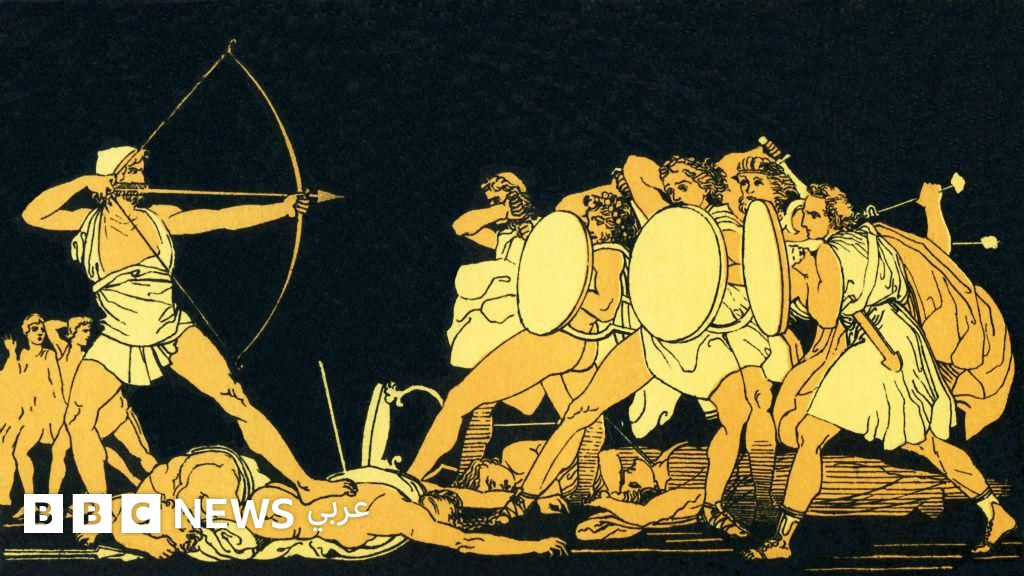
Image caption, Ulysses, the Latin name for Odysseus, fights the men who sought to marry his wife Penelope during his absence. Designs by artist John Flaxman.
Article Information
Author, Isabelle Gerretsen
Published 3 hours ago
Reading time: 7 minutes
Archaeological excavations on the Greek island of Ithaca have uncovered physical evidence of a religious cult dedicated to Odysseus, the hero of Homer's epic 'Odyssey,' refuting the belief that the epic was merely entertaining narrative.
This cult was linked to ancient Greek beliefs that made heroes intermediaries between humans and gods.
The 'Odyssey' begins with Odysseus, exhausted from the Trojan War, held captive by the nymph Calypso on a remote island, who offers him immortality in exchange for staying.
But Odysseus, after spending ten years fighting alongside Greek heroes in the Trojan War, longed only to return to his family and homeland, the island of Ithaca, and 'to see even the smoke rising from his native land,' according to translator Emily Wilson's version of Homer's epic.
During his ten-year return journey, fraught with dangers, Odysseus tricks the Cyclops, a giant one-eyed mythical creature, overcomes the sorceress Circe with his cunning, and survives a series of disasters and trials.
Odysseus's legacy extends beyond the epic, as archaeological remains suggest he inspired religious rituals that lasted for about a thousand years.
Excavations indicate that the veneration of Odysseus may have begun in the 9th century BC, when his story was still being told orally through epic poems, and this cult seems to have spread more widely after the 'Odyssey' was written down in the late 8th century BC.
Among the archaeological evidence for this cult is a shrine dedicated to Odysseus in Ithaca, as well as coins and tiles recently found bearing his name.
These discoveries highlight the complex relationship between humans, mythical heroes, and religious beliefs in the ancient world, and provide a broader understanding of the phenomenon of hero worship that spread across various parts of the Greek world.
Skip the most read and continue reading
Why do I constantly wake up at 3 a.m.?
Alcohol and drugs behind the death of a Saudi prince in London last year - British newspapers
What is the story of the Egyptian child 'Makari Younan' who was excluded because of his religion?
Trump declares a new trade 'war' on 60 countries and shocks allies with a wave of tariffs
Why is the film 'The Odyssey' causing such controversy?
Is the 'Odyssey' epic the greatest story in human history?
From admiration of the hero to his worship
In the 'Odyssey,' while storms toss Odysseus at sea, thoughts of his homeland Ithaca remain the source of strength driving him to continue his journey. In Book 9 of the epic, he says: 'No land can be sweeter than it.'
In Ithaca, his family and the island's inhabitants eagerly await his return. His wife Penelope describes him as 'godlike' and 'a noble husband, brave of heart, surpassing all Greeks in skill and courage.'
Skip the podcast and continue reading
Worth attention
In-depth explanation of the most important events and topics, to help you understand the key changes around you and their impact on your life
Episodes
Podcast end
Beyond the pages of the epic, Odysseus left a tangible mark on the island of Ithaca, a mountainous island west of mainland Greece. Archaeological discoveries on the island and other sites paint a picture of a legendary figure who held a central place in the religious and civic life of the ancient Greeks.
Excavations in Ithaca began in the late 19th century and yielded a variety of artifacts linked to Odysseus, including a small bronze bust of the Homeric epic hero.
Also, in the late 19th century, among the ruins of an ancient Greek city in present-day Turkey, a decree was found mentioning a shrine in Ithaca dedicated to the worship of Odysseus, known as the 'Odysseion.'
The decree dates back to 207 BC, issued by the city-state of Ithaca. It also mentions a festival called the 'Odysseia,' held in honor of the Greek hero.
In 2025, archaeologists from the University of Ioannina in Greece presented clearer evidence that helped explain these earlier discoveries. They announced finding evidence indicating that the ruins of a massive complex known as 'Homer's School' housed the 'Odysseion' shrine in Ithaca.
This complex dates back to the Hellenistic period, from the 4th to the 1st century BC.
'The Odyssey' in cinemas, what do we know about Christopher Nolan's film?
Image caption, Excavations revealed evidence of a shrine dedicated to Odysseus on the island of Ithaca
Archaeologists found fragments of three tiles used for roofing, bearing inscriptions including the name of the Greek hero Odysseus. Archaeologist Christina Marabia, who participated in the excavations, says these discoveries support identifying 'Homer's School' as the 'Odysseion' shrine dedicated to Odysseus.
Two of the tiles bear the phrase meaning 'to Odysseus' or 'belonging to Odysseus' in ancient Greek. Marabia says this phrase 'clearly indicates the existence of a shrine dedicated to the hero at the site.'
She explains that this formula of inscriptions is known from other shrines dedicated to famous gods in the ancient Greek world. For example, tiles bearing phrases like 'to Poseidon' and 'to Apollo' have been found in those shrines, indicating that the buildings were dedicated to these two gods.
Accordingly, the phrase 'to Odysseus' inscribed on roof tiles in Ithaca suggests that this shrine was dedicated to the legendary hero, according to Marabia.
The third piece bears an inscription that appears to be a votive offering saying: 'To Odysseus.' Marabia suggests that a pilgrim left it at the site.
She explains that offering votives was a common ritual in many ancient shrines. These votives included clay or bronze pieces, along with small figurines bearing brief dedicatory phrases or prayers.
Shrine of Odysseus
These discoveries together provide 'new and decisive evidence' that the site of 'Homer's School' was a public shrine and a meeting place for local citizens, and that it was primarily dedicated to the worship of Odysseus, the hero of the Trojan War, during the Hellenistic period and early Roman times.
Yannos Lolos, Professor Emeritus of Prehistoric Archaeology at the University of Ioannina, who led the research, says the site combined religious function with civic role.
Marabia says: 'The council of citizens held its meetings in the Odysseion, while the shrine of Odysseus, indicated primarily by the two tiles stamped with his name, was the cult center of the site, visited by pilgrims from Ithaca and beyond to venerate the hero.'
How do women drive the events of Homer's 'Odyssey'?
These new discoveries build on a series of archaeological evidence previously found on the island. In the 1930s, inside a coastal cave dedicated to religious rituals in northwestern Ithaca, twelve bronze tripod cauldrons were discovered, dating back to the 9th and 8th centuries BC.
Original source: BBC Arabic



Comments (0)
Be the first to comment.