AI Stocks Revive Japanese Shares

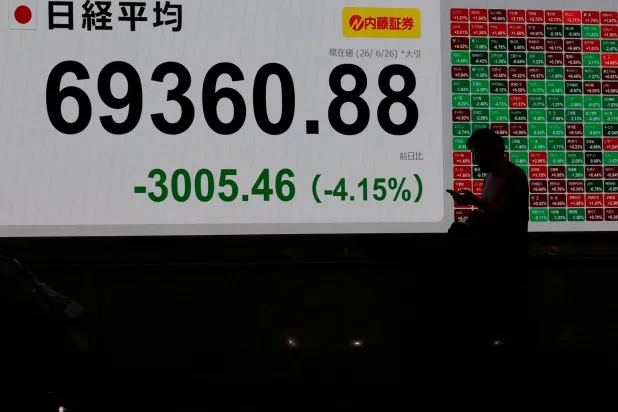
The Japanese Nikkei index ended the trading session higher, recovering from three consecutive days of losses, supported by strong gains in stocks of companies related to artificial intelligence and semiconductors, benefiting from the positive momentum seen in the US technology sector.
The Nikkei rose 1.4% to close at 67,743.85 points, after having risen by as much as 2.4% during the session. The broader Topix index also increased by 0.4% to reach 4,020.37 points.
Near-complete halt of navigation in Hormuz.. Goldman Sachs warns of delayed recovery in oil supplies
Chip stocks led the gains, with memory chip maker Kioxia jumping 8.3%, chip test equipment maker Advantest rising 5.9%, and chip manufacturing equipment maker Tokyo Electron climbing 5.5%.
This strong performance followed a rise in the US Nasdaq index, supported by a massive agreement between Broadcom and Apple to supply chips worth over $30 billion, as well as reports indicating that China plans to allow major domestic AI companies to purchase a limited number of Nvidia's H200 chips.
Wataru Akiyama, an equity analyst at Nomura Securities, said that the news regarding China boosted expectations for business expansion across the supply chain related to Nvidia, including Japanese companies benefiting from the AI boom.
In contrast, geopolitical developments dampened investor optimism after US President Donald Trump announced the end of the interim agreement aimed at ending the war with Iran, while the US military announced new strikes targeting Iran to ensure continued navigation through the Strait of Hormuz following attacks on commercial ships.
These developments led to a roughly 1% rise in oil prices, putting pressure on some fuel-cost-sensitive sectors. Japan's air transport sector index fell 2.2%, while transport equipment stocks dropped 1.9%.
The rise in oil prices also brought inflation concerns back to the forefront, which was reflected in the Japanese government bond market, with the yield on the benchmark 10-year note rising to its highest level in three decades, negatively impacting real estate stocks, which fell 1.3%.
Despite the Nikkei's rise, the overall market picture was not entirely positive, as 146 stocks on the index declined while only 77 advanced, indicating that gains were mainly concentrated in large-cap stocks related to the chip and technology sectors.
Among the biggest losers of the session, Mitsubishi Materials fell 6.9%, while Yokohama Rubber declined 3.5%.
Advertorial
Advertorial
Original source: Al Arabiya


Comments (0)
Be the first to comment.