Lived 1,250 Years Ago and Contributed to Bookmaking: Decoding the Name of an Ancient Astronomer

A wall decorated with drawings in Guatemala has revealed a unique personal trace embodying the contributions of the Maya civilization: the name of an astronomer and mathematician who lived about 1,250 years ago.
In Xultún, an ancient city located 340 km from Guatemala City, archaeologists identified the name 'Sak T'ahn Wax', meaning 'white-breasted fox', beneath a mathematical equation preserved on the wall of a room.
Experts told Antiquity that the importance of this discovery 'lies not only in commemorating a specific individual, but also in shedding light on the intellectual effort invested in astronomy, calendar calculation, and bookmaking in the Maya civilization.'
Franco Rossi, an archaeologist at the Massachusetts Institute of Technology and lead author of the study published in the journal Antiquity, stated that the team 'was amazed by the fact that one of the many mathematical texts in the room bears a name attributed to the astronomer.'
He noted that such signatures are 'surprisingly rare in the archaeological record, even though specialized calculation was important and widespread in ancient Maya society, especially during the eighth century.'
Signature of the newly discovered astronomer and mathematician - newscientist.com
This discovery is especially valuable given the scarcity of surviving Maya writings on paper, fiber, or wood in the tropical climate. The four pre-Columbian manuscripts preserved today date to later stages of Maya history, more than 500 years after the Xultún inscriptions.
To date, only a few of the eroded texts have been fully analyzed and deciphered, leaving room for future discoveries in Xultún, where approximately 900 hectares of the urban area remain covered by forest.
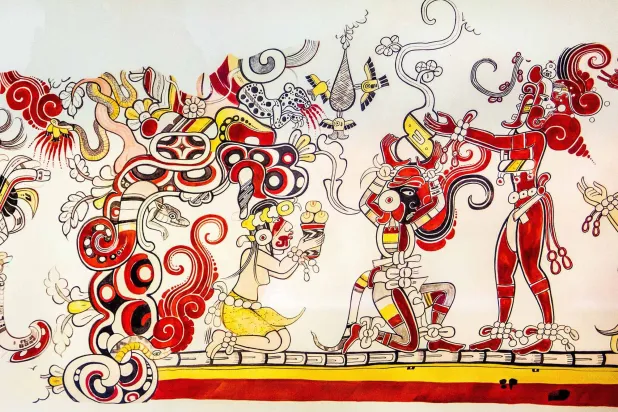
The Maya covered the east interior wall with plaster and used it as a surface to write 'fine texts' of mathematics. When the writings were discovered between 2010 and 2012, they were severely faded. The team scanned, drew, and photographed the symbols, then digitally enhanced them to make them readable. They also identified about 52 fine mathematical and astronomical texts on the wall.
These texts include calculations related to the 260-day ritual count, the solar year, Venus, and Mars.
Rossi said that Sak T'ahn Wax's formula is so unusual that the astronomer may have signed it because of its novelty. Researchers believe the wall texts may represent preliminary drafts for calculations of manuscripts produced within the residential complex, an analogy they compare to finding a sketch for a major artwork.
This interpretation is reinforced by the presence of papermaking tools inside and around the room, suggesting the space may have been used to train scribes in calendar calculation. The murals also include titles associated with scribes, supporting the idea that the room was part of an intellectual work environment rather than a place for ceremonial display.
Original source: Asharq News





Comments (0)
Be the first to comment.