Chinese stocks continue rally led by semiconductors
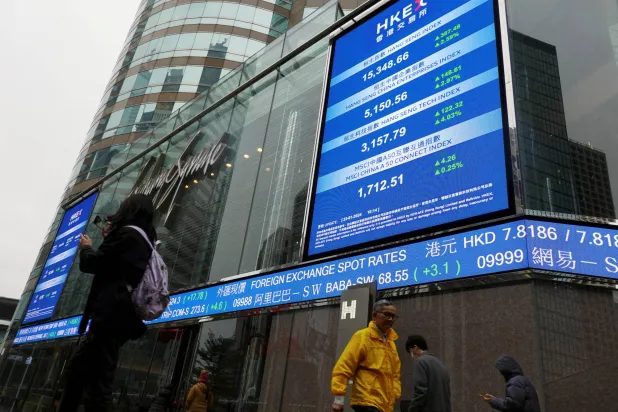
Chinese stocks rose on Wednesday, driven by AI and semiconductor stocks, as investor sentiment remained positive after the previous session's gains, which were the strongest in three months. In contrast, Hong Kong stocks fell. The CSI 300 index of leading Chinese stocks rose 0.7 percent by the lunch break, while the Shanghai Composite rose 0.5 percent. The Hang Seng index in Hong Kong fell 0.8 percent. The AI hardware supply chain remains the main focus of the domestic market, with the STAR 50 index, which focuses on technology and semiconductor stocks, rising 1.5 percent and 3.4 percent respectively. Shares of non-ferrous metal companies rose nearly 5 percent, rebounding after their underperformance relative to the broader market over the past month. Traditional sectors, such as consumer staples and financial services, fell 0.9 percent and 0.1 percent respectively. UBS analysts said in a note: 'Despite the recent sharp volatility in A-shares, we believe the trend of improving earnings for A-shares and tech companies in general remains intact.' They added: 'With the rapid decline in margin financing balances, we believe the deleveraging process for A-shares is largely complete.' The CSI 300 and STAR 50 indices rose 14 percent and 175 percent respectively from April to June, driven by investor enthusiasm for AI stocks and hardware supply chains, before falling slightly during a correction last month. Shares of major technology companies listed in Hong Kong fell 2.1 percent, led by a nearly 6 percent drop in Tencent shares. Shares of Top Sports International Holdings, a Chinese sports retailer, fell more than 23 percent after Nike announced it would direct consumers to Nike's official channels. A stock exchange disclosure on Wednesday showed that Zhongji Innolight, a Chinese optical components manufacturer, aims to raise up to HK$55.05 billion (US$7 billion) through a listing in Hong Kong, the second largest share sale in Asia this year. The company's shares listed in the domestic market fell 1.5 percent.
• Yuan weakens Meanwhile, the Chinese yuan weakened against the US dollar on Wednesday, as escalating fighting in the Middle East boosted demand for the dollar as a safe haven, while concerns about slowing growth in the country negatively affected the market. The spot yuan opened at 6.7770 against the dollar and stood at 6.7708 by 02:13 GMT, down 43 pips from the previous session's close. Commerzbank analysts said in a note that 'a combination of slowing growth and expectations of further monetary easing is leading to a slight tendency for the yuan to depreciate,' adding that the People's Bank of China is expected to limit excessive volatility through its daily fixing mechanism. China's State Council on Tuesday pledged to take steps to ensure the country meets its annual growth target, after the economy missed Beijing's official target range in the second quarter.
Before the market opened, the People's Bank of China set the midpoint fixing at 6.7933 against the dollar, down 196 pips from Reuters estimates. The spot yuan is allowed to trade 2 percent above or below the daily fixing rate. In the Middle East, the US military late Tuesday announced the start of its latest strikes on Iran, marking the 11th consecutive night of US attacks. The US dollar has risen over the past four sessions, hovering near its highest level in a week. Separately, media reported Tuesday that Trump is preparing to impose new tariffs on dozens of countries as early as this week, escalating geopolitical tensions. The offshore yuan traded at 6.7714 per dollar, down about 0.05 percent in Asian trading. The dollar index, which measures the US currency against a basket of six major currencies, fell 0.020 percent to 101.15. Analysts at Bank of New York noted that after months of continuous yuan buying, investors have become more cautious, with increased hedging activity indicating that investors are reducing their exposure. The analysts said this increases the risk of yuan weakness in offshore markets in the near term if stock market sentiment deteriorates. The Shanghai Composite, China's main index, fell 7 percent over the past month. The yuan has risen about 3 percent against the dollar since the start of the year, lagging behind the Australian dollar's 5 percent gain over the same period, but it remains among the best-performing emerging market currencies.
Original source: Asharq Al-Awsat






Comments (0)
Be the first to comment.