Saudi Crown Prince and Canadian PM Witness Signing of MOUs

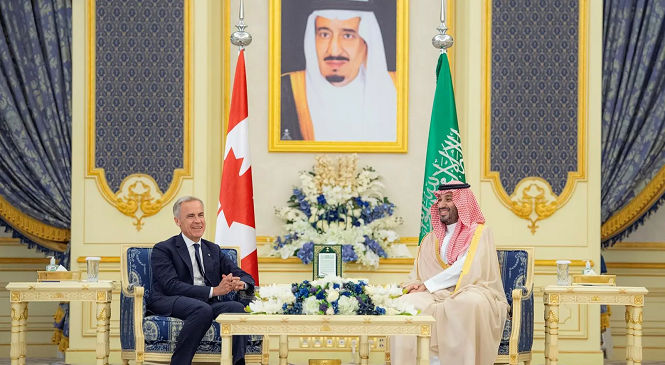
Saudi Crown Prince Mohammed bin Salman and Canadian Prime Minister Mark Carney witnessed the exchange of a number of bilateral memorandums of understanding between the two countries on Thursday, on the occasion of Carney's first visit to the Kingdom since he assumed office last year, during which the Saudi-Canadian Investment Forum was held.
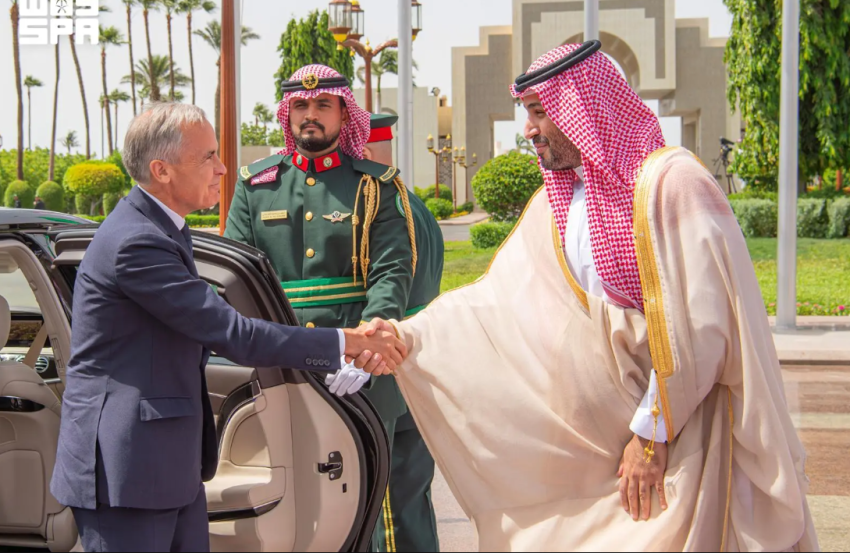
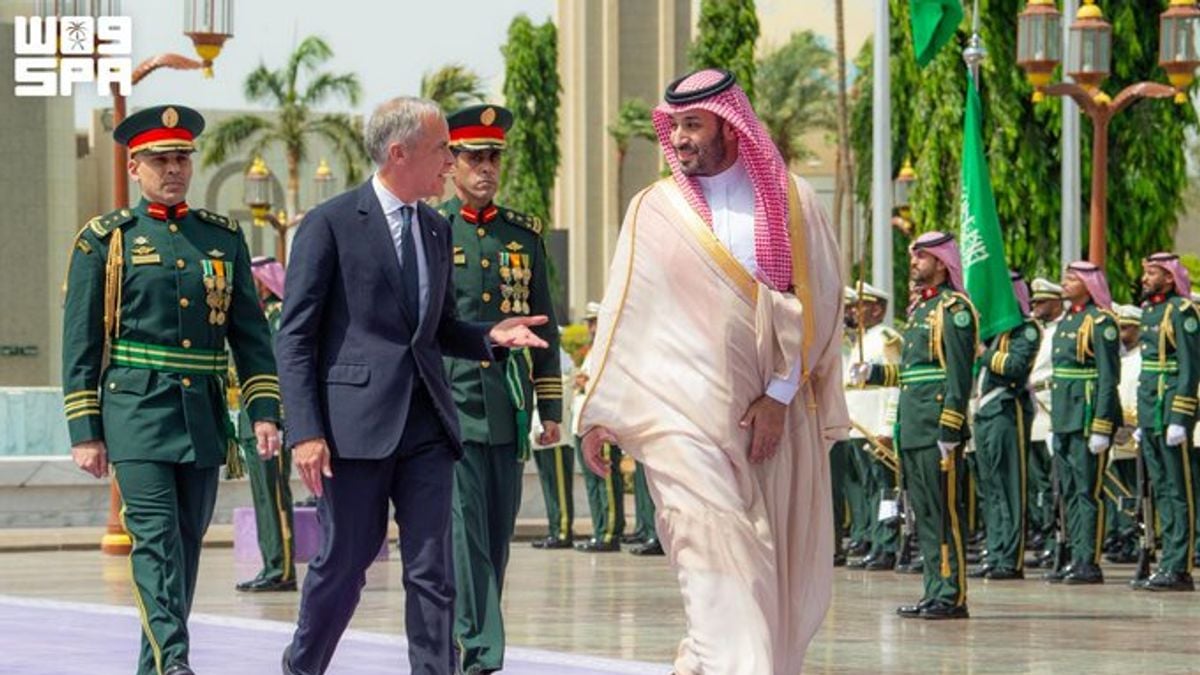
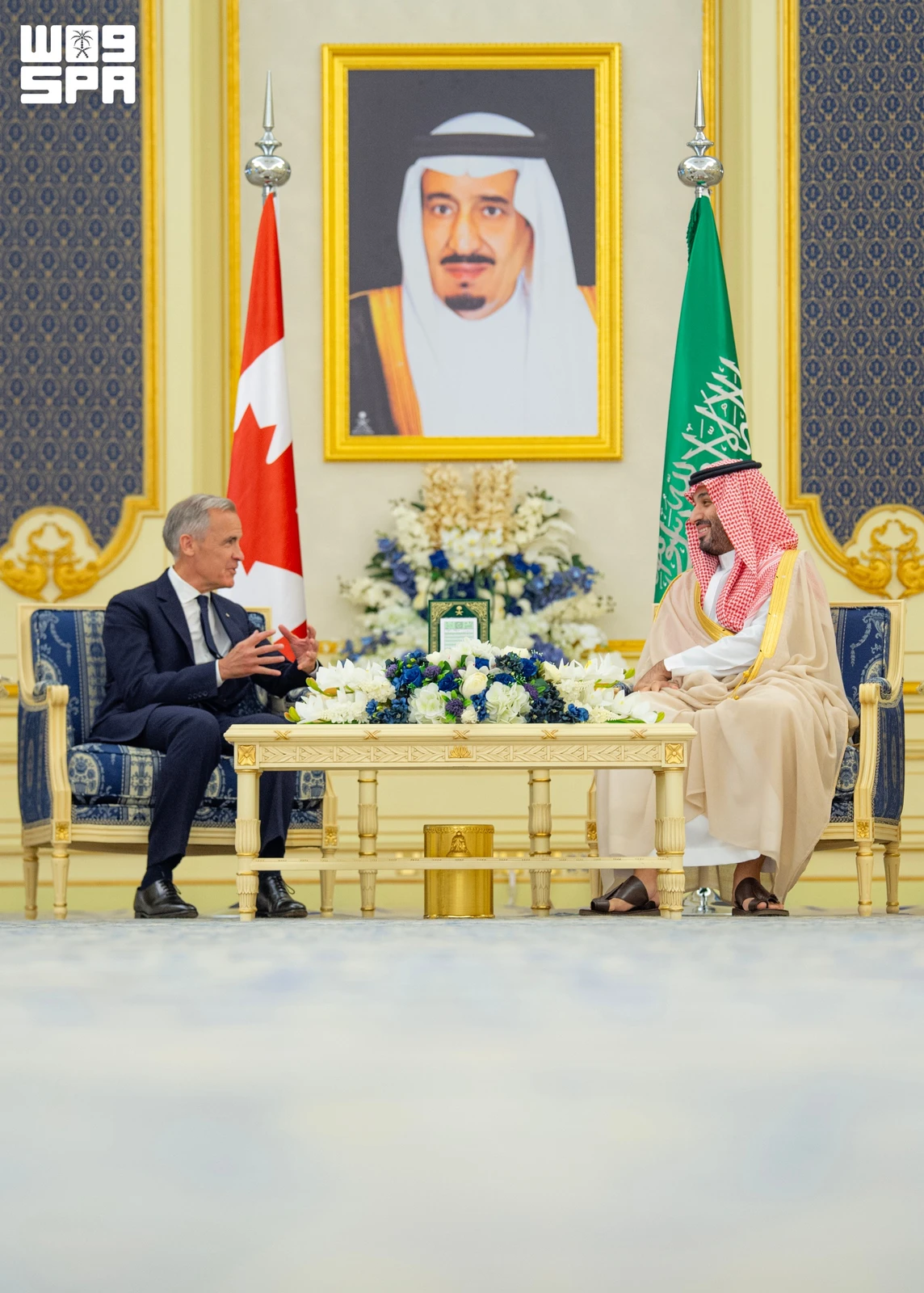
The Saudi Crown Prince had received Carney at the Royal Court at Al-Salam Palace in Jeddah this evening, where the two sides held an official talks session.
During the session, aspects of bilateral relations between the two countries, areas of cooperation, and opportunities for development in various sectors were reviewed, in addition to reviewing developments in regional and international events and efforts made regarding them.
Saudi Arabia and Canada today signed 15 agreements and memorandums of understanding worth one billion dollars (about 3.75 billion dollars), during the visit that Carney began to the Kingdom on Wednesday.
Photo from SPA
Maraim
Read also: 13 agreements and memorandums of understanding between Saudi Arabia and Canada worth 3.75 billion riyals
The bilateral MOUs whose exchange was witnessed by Saudi Crown Prince Mohammed bin Salman and Carney included an MOU between the Saudi Ministry of Energy and the Canadian Ministry of Natural Resources in the field of energy, exchanged on the Saudi side by Prince Abdulaziz bin Salman, Minister of Energy, and on the Canadian side by Canadian Foreign Minister Anita Anand.
The MOUs also included an MOU between the Saudi and Canadian governments regarding the establishment of the Saudi-Canadian Coordination Council, which will be a platform to implement the contents of the joint work document between the two countries, representing a roadmap for the next phase of Saudi-Canadian relations.
This MOU was exchanged on the Saudi side by Prince Faisal bin Farhan bin Abdullah, Minister of Foreign Affairs, and on the Canadian side by Foreign Minister Anand.
Photo from SPA
Exchange 3
Read also: Saudi Energy Minister discusses investment opportunities with Canadian Prime Minister
The Saudi and Canadian sides also exchanged an MOU between the Saudi Ministry of Communications and the Canadian Ministry of Industry regarding investment in artificial intelligence and skills development.
This MOU was exchanged on the Saudi side by Dr. Abdullah Al-Ghamdi, head of the Saudi Data and Artificial Intelligence Authority, and on the Canadian side by Minister Anand.
The official visit, the first of its kind by Carney to Saudi Arabia since he took office as head of government in 2025, embodies the Kingdom's status, weight, and pivotal role internationally.
During the visit, which saw the holding of the Saudi-Canadian Investment Forum, Carney said that Saudi Arabia is one of the most important pillars of the global economy, pointing to the significant acceleration in Saudi economic growth and 'the tremendous transformations Saudi Arabia is witnessing under Vision 2030.' Carney affirmed that Canada will enhance its cooperation with Saudi Arabia in the energy and mining sectors.
The forum is a high-level investment event held in Jeddah on the sidelines of Carney's visit, bringing together senior officials, investors, financial institutions, and private sector leaders from both countries to deepen investment cooperation and identify priority sector opportunities.
The two countries are working to enhance their trade relations and transition them to the stage of 'sustainable investment partnership,' providing a fertile environment for investors to exchange innovative goods and services.
The volume of trade exchange between them last year reached about 2.9 billion dollars (about 11 billion riyals), of which 1.7 billion dollars were Saudi exports to Canada.
Saudi Minister of Investment Fahad Al-Saif said during the Saudi-Canadian Investment Forum that the Kingdom and Canada share a strong ambition to build more competitive, innovative, and open economies capable of attracting investments.
The minister affirmed that Saudi Arabia is working on building integrated national systems that turn opportunities into promising investment sectors.
He pointed out that the discussions on the investment promotion and protection agreement between Saudi Arabia and Canada represented an important step to enhance confidence, as it provides a stable and reliable investment environment for investors in both countries.
Chairman of the Saudi-Canadian Business Council Mohammed Al-Dulaim, for his part, told Al-Eqtisadiah that the trade exchange between the two countries reached 66 billion riyals over the past five years, noting that mining and artificial intelligence are the most prominent areas of cooperation between Saudi Arabia and Canada.
625 Canadian companies operate in the Saudi market, including 13 regional headquarters, according to Al-Saif, who pointed out that last year alone saw the issuance of nearly 250 investment licenses for Canadian companies, double the number issued the previous year.
Al-Saif affirmed that Saudi Arabia provides high-quality, long-term investment opportunities across various sectors for Canadian companies.
The Federation of Saudi Chambers had announced in 2024 a new administrative formation for the Saudi-Canadian Business Council to support efforts to connect businessmen and companies in the two countries and maximize the benefit from commercial and investment opportunities.
Likewise, the Federation of Saudi Chambers opened an office in the Canadian city of Toronto to facilitate linking companies in the two countries, organizing delegation visits, and coordinating economic events.
Last January, the Saudi-Canadian Business and Investment Forum was held to discuss enhancing the investment partnership between the two countries in the areas of digital transformation, infrastructure, and opportunities for empowering the private sector in the Kingdom and Canada.
That forum culminated in the signing of 6 memorandums of understanding worth approximately 600 million dollars, and included cooperation initiatives in the sectors of communications, information technology, cybersecurity, education, and manufacturing.
Cooperation in the critical minerals sector is a strong opportunity for both sides
Saudi Arabia achieves strong growth and possesses advanced infrastructure and capital, making it a platform for access to regional and global markets, while Canadian companies and institutions have global capabilities in sectors including mining and critical minerals, engineering, financial services, advanced manufacturing, artificial intelligence, and skills development.
Cooperation in the critical minerals sector in particular represents a strong opportunity for both sides, as the volume of mineral wealth latent in Saudi Arabia is estimated at about 2.5 trillion dollars over an area exceeding 2.1 million square kilometers.
Saudi Arabia has identified opportunities in more than 50 minerals and is accelerating exploration work within the Arabian Shield. Canadian companies are already operating in the Kingdom, including Barrick and Ivanhoe Electric, with Ma'aden to explore about 48.5 thousand square kilometers.
Similarly, Manara Minerals, a joint venture between the Saudi Public Investment Fund and Ma'aden, holds a 10% stake in Vale Base Metals.
Various Saudi sectors represent opportunities for Canadian investment
The Saudi market also opens wide opportunities for investment institutions, asset managers, insurance and technology companies, including Canadian ones, as the market capitalization of the Saudi financial market amounts to about 9.44 trillion riyals (about 2.53 trillion dollars).
In the industrial sector, Saudi Vision 2030 and the National Industrial Strategy have created a long-term platform for industrial investment, as the Kingdom aims to reach 35,000 factories by 2035, and industrial investments approaching two trillion riyals.
In contrast, Canada possesses research capabilities, expertise, and software in artificial intelligence, which is an important aspect for Saudi Arabia, as the Kingdom plans to reach 6.6 gigawatts of AI data center capacity by 2034.
Original source: Aleqtisadiah


Comments (0)
Be the first to comment.