After $1.5 Trillion in Losses... China Mobilizes Efforts to Save the Stock Exchange
Chinese authorities have entered a race against time to contain one of the fiercest waves of decline seen in local stock markets in months, after Chinese stock exchanges lost about 10 trillion yuan ($1.48 trillion) in market value in just two weeks, a collapse that brought back investors' questions about the durability of the economic recovery and market confidence in government policies.
In the first broad official move since the start of the downturn, the China Securities Regulatory Commission pledged to make 'every effort' to maintain the stability of the capital market, while state-owned investment institutions pushed tens of billions of yuan into the market in an attempt to halt selling and restore investor confidence.
The move came after a meeting held by China Securities Regulatory Commission Chairman Wu Qing with investors and representatives of financial institutions in Beijing, during which he stressed that the commission would work to prevent financial risks, tighten supervision, protect market fairness and transparency, along with enhancing investor protection and improving disclosure levels in listed companies.
The meeting reflects Beijing's realization that the current crisis is no longer just a natural price correction; it has turned into a real test of the authorities' ability to maintain the stability of Asia's second-largest stock market, especially with increasing external pressures and declining investor appetite for high-risk assets.
• What sparked the sell-off?
The losses came as a result of several factors coinciding at once; the massive initial public offering of chipmaker CXMT, worth $8.6 billion, raised concerns about a large liquidity drain from the market at a time when investors were already suffering from weak confidence.
At the same time, the global technology sector experienced a broad sell-off, which strongly impacted Chinese companies, especially semiconductor and artificial intelligence firms, which had been among the biggest gainers in recent months.
The renewed tensions in the Middle East also contributed to increased risk aversion among investors, driving capital toward safe havens, which added pressure on emerging markets, including China.
The technology sector was the hardest hit; the STAR index on the Shanghai Stock Exchange, which includes technology and innovation companies, fell about 25% compared to its peak recorded in early July, in one of the fastest correction waves it has seen since its launch.
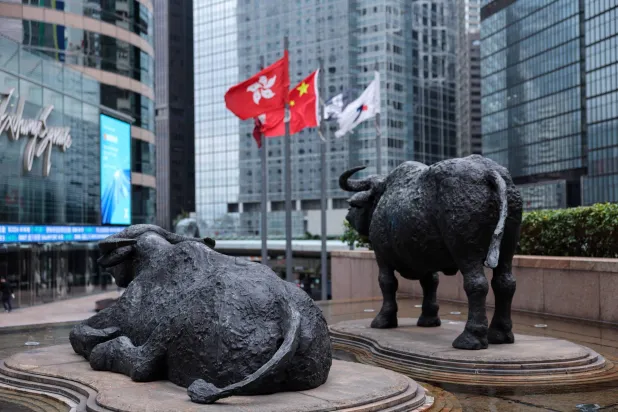
Pedestrians in front of the stock exchange building in China's Hong Kong island (Reuters)
• Widespread government intervention
In response to these developments, state-owned investment institutions moved, known within Chinese markets as the 'national team,' a group of government institutions that typically intervene during crises to support markets.
China Reform Holdings, owned by the central government, announced that it injected 50 billion yuan into the stock market, stressing it would continue to increase its investments to support market stability. The company said it is 'fully confident in the prospects of China's capital market' and will continue to support technological innovation and high-quality growth of state-owned enterprises.
China Qingtong Holdings, a state-owned group, also announced it increased its equity investments by about 10 billion yuan, pledging to use 'all strength' to maintain market stability.
Thus, the value of announced government interventions in just two days reached about 60 billion yuan, a clear indication of Beijing's readiness to use its financial tools to prevent the correction from turning into a broader crisis.
The logo of Chinese chipmaker CXMT on an electronic board (Reuters)
• Companies step in
Support was not limited to the government; several major state-owned companies announced measures aimed at boosting investor confidence. Companies such as CRRC and SDIC Power revealed plans to increase major shareholders' stakes, buy back shares from the market, and distribute cash dividends—measures typically used to show management's confidence in the companies' real value and support stock prices.
Meanwhile, asset management firm Borisa Fund announced it would invest 50 million yuan in its equity funds, expressing confidence in the long-term prospects of the Chinese market.
Analysts believe that such steps carry significant psychological importance, as they send a message to investors that financial institutions themselves are ready to inject their own money into the market.
• Messages to investors
During the meeting with the securities regulator, investors demanded that the authorities take more powerful measures to support the market.
Proposals included increasing counter-cyclical economic policies, directing more long-term capital toward the stock market, tightening penalties for manipulation and illegal trading crimes, along with enhancing transparency and disclosure in listed companies.
The commission announced that it would continue in the coming days to hold separate meetings with brokerage firms, fund managers, and listed companies to gather more proposals before taking additional measures.
• Are these measures sufficient?
Although markets reacted positively at the start of the week, with the CSI 300 index of large companies rising 1.53% and the Shanghai Composite index gaining 0.85%, these gains were limited compared to the scale of previous losses... In fact, the tech-heavy STAR index continued to fall by 2.28%, reflecting continued pressure on the technology sector, which is leading the current correction wave.
Analysts believe that state interventions may succeed in calming volatility in the short term, but they will not be enough to restore the upward trend unless the fundamental factors that drove investors to sell improve.
These factors include the continued slowdown of the Chinese economy, weak domestic demand, pressure on the real estate sector, in addition to concerns related to market liquidity, geopolitical tensions, and volatility in global technology markets.
• A new test for the 'market stability' policy
The recent moves reflect Beijing's adherence to a policy of not allowing sharp collapses in the stock market, given the growing role financial markets play in financing companies and supporting the government-led economic transformation toward technology and innovation.
But on the other hand, investors realize that the ability of government interventions to stop the decline remains limited if not accompanied by tangible improvement in economic indicators and private sector confidence.
Therefore, Beijing today faces a dual test: containing the current sell-off wave on one hand, and restoring the confidence of domestic and foreign investors that the Chinese stock market does not rely only on state intervention, but is also based on economic fundamentals capable of supporting sustainable growth in the next phase.
Original source: Asharq Al-Awsat



Comments (0)
Be the first to comment.