Chinese stocks fall amid sharp decline in semiconductors

Chinese mainland stocks fell on Thursday, affected by weak tech stocks following a wave of selling among regional peers, while Alibaba's performance supported Hong Kong stocks, as declining expectations of an imminent interest rate hike by the US Federal Reserve boosted market performance.
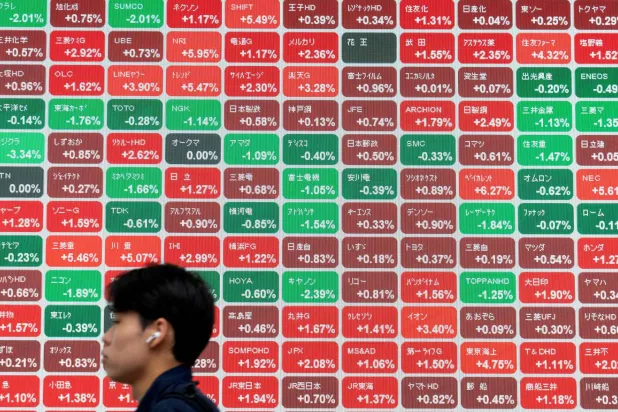
At the midday break, the benchmark Shanghai Composite index fell 0.8%, while the CSI300 index of leading stocks lost 0.9%. The tech-focused STAR 50 index dropped 1%, and the ChiNext index for startups declined 1.7%.
Semiconductor stocks were among the biggest losers in morning trading, with the sub-index falling 2.5%.
This weakness coincided with losses for chipmakers in the region, with South Korea's SK Hynix falling more than 12% and rival Samsung Electronics dropping about 10%.
There are growth opportunities in mainland China 'in the pharmaceutical and energy storage sectors, and value in real estate, banking, and internet sectors. From an earnings perspective, we believe 2026 performance will exceed last year's,' said Herald van der Linde, head of equity strategy for Asia-Pacific at HSBC.
In Hong Kong, the benchmark Hang Seng index rose 1.9%, while the city's tech stocks jumped 3.1%.
Alibaba led the gains, with its shares jumping 4.8% after the company announced in a statement to Reuters that it is integrating its Qwen model into Apple Intelligence across iPhone, iPad, Mac, and Vision Pro operating systems in China.
Chinese President Xi Jinping is expected to present an ambitious vision for China's role in global AI governance at a forum on Friday, while Huawei showcases its latest AI computing lineup yet, signaling Beijing's push to build a domestic alternative to US technology.
Separately, investors are looking to the upcoming Politburo meeting, where policymakers are expected to set the economic policy agenda for the second half of the year. However, markets generally see the recent second-quarter economic data, which came in weaker than expected, as insufficient to trigger broad monetary policy easing.
Li Cheng Wang, an economist at Goldman Sachs, said: 'We maintain our baseline forecast of no rate cut or reserve requirement ratio cut until the end of 2026, although the probability could increase if growth slows further.'
• Yuan falls
Meanwhile, the Chinese yuan fell against the dollar on Thursday from a one-month high, affected by renewed US-Iran tensions, although broad dollar weakness and declining expectations of domestic monetary easing supported it. Escalating Washington-Tehran tensions kept oil prices near one-month highs, while the dollar hovered near a one-month low after soft US PPI data. The yuan in the onshore market fell to 6.7703 against the dollar by 02:50 GMT, compared with a one-month high of 6.7635 the previous day. Its offshore rate stood at 6.7714 against the dollar. Before market open, the People's Bank of China set the midpoint at 6.7909 yuan per dollar, the highest in over three years and one pip higher than the previous fix. The spot yuan is allowed to trade up to 2% above or below the daily midpoint. The central bank has been setting the midpoint lower than expected since November 2025, a move investors interpreted as an attempt to maintain market stability and prevent excessive yuan appreciation. However, the gap between the official rate and market expectations widened on Thursday, with the midpoint 332 pips below Reuters' estimate of 6.7577, the largest downside deviation since June 23. Eugenia Victorino, head of Asia strategy at SEB Bank, said: 'The PBOC continues to guide USD/CNY lower daily, but the pace of decline has slowed since early June. At this stage, the slow decline in the daily fix reflects a return to comfort rather than an attempt to boost the currency. As long as the CFETS index hasn't risen significantly, the PBOC is likely to tolerate yuan strength.'
Original source: Asharq Al-Awsat




Comments (0)
Be the first to comment.