France and Germany Expand Defense Partnership to Strengthen European Autonomy

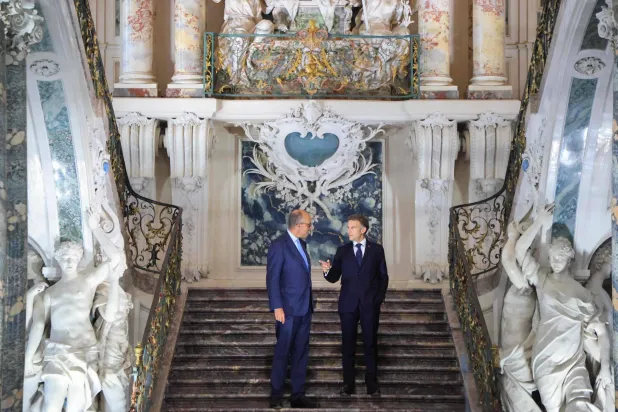
German Chancellor Friedrich Merz and French President Emmanuel Macron on Friday pledged to deepen defense cooperation between Berlin and Paris and counter intense economic competition from China, which they said is putting significant pressure on Europe through overcapacity and currency undervaluation.
Merz and Macron's remarks came during a joint meeting of the German and French governments, part of a series of regular bilateral meetings, amid efforts to overcome tensions that followed the collapse of a joint fighter jet project that had drawn widespread attention earlier this year.
At a joint press conference, Merz said: 'We are doing what is necessary to protect our freedom, security, and collective defense.'
The two leaders outlined a set of common goals, including strengthening missile defense systems and long-range strike capabilities, as part of broader efforts to bolster Europe's defense autonomy.
"European Deterrence"
During talks with Macron, Merz said German forces will participate 'this year' in a French nuclear exercise, a symbolic step toward the 'European deterrence' that both countries have long advocated.
The German chancellor added: 'Germany and France are deepening their defense cooperation. We are strengthening European deterrence. We will take part in a nuclear exercise with the French armed forces this year.'
The German chancellor pledged a close partnership with French President Macron. At the conclusion of the Franco-German government meeting, he affirmed that friendship with France and a shared commitment to a united Europe are at the core of German foreign policy. He said: 'We rely on you, and you can rely on us. You can trust us.'
He added: 'Germany and France standing side by side in these difficult times is of inestimable value for both countries,' noting that joint support for Ukraine plays a central role in security and will continue resolutely. 'Our goal is a peace that preserves Ukraine's sovereignty and Europe's security.'
Merz referred to the new cooperation between Germany and France in nuclear defense, saying: 'We are embarking on a new joint path for deterrence.'
Merz stressed that Germany remains ready for deeper and more trusting cooperation with France, regardless of the outcome of the upcoming legislative and presidential elections.
France and Germany have begun ministerial-level talks aimed at boosting cooperation in defense, artificial intelligence, critical raw materials, and the future European budget.
"The China Issue"
Merz and Macron criticized China, saying it fails to comply with international trade rules by providing levels of government support to its industrial sector that are at least eight times higher than those in OECD member states.
For his part, Macron said: 'We are not hostile to China, neither diplomatically nor economically, but we look at reality clearly.' He added that Europe records a trade deficit with China of about one billion euros, equivalent to $1.14 billion, daily.
Macron said France and Germany 'have never been this close before' on the China issue, pointing to Europe's daily trade deficit of one billion euros and the loss of thousands of jobs daily.
Alongside the government consultations, the two countries held a meeting of the Franco-German Defense and Security Council at the German Air Force's Nörvenich Air Base, a step underscoring the push to strengthen European armament amid concerns over Russia and reduced reliance on the US security umbrella.
The French presidency said the goal of the July 17 talks was to move beyond symbolism and toward 'concrete' projects, in a clear attempt to overcome the collapse of the Future Combat Air System (FCAS) project, the sixth-generation European fighter program that collapsed in June 2026.
How did the fighter jet project begin?
The FCAS project was launched in 2017 on the initiative of Macron and then-German Chancellor Angela Merkel as Europe's flagship project to develop a sixth-generation fighter, with an estimated cost of around 100 billion euros.
The project centered on developing a new manned fighter along with a digital system known as the 'combat cloud,' aimed at linking aircraft, drones, and satellites in a unified operational network.
In October 2019, the two sides met in Toulouse to resolve initial disputes over work distribution and succeeded in reaching an agreement on exporting jointly developed weapons.
Under the agreement, one country would automatically approve arms export deals if its share of the contract value fell below a ratio believed to be around 20%, and both sides considered this evidence of mutual trust, a prerequisite for the success of FCAS as well as the future European tank project MGCS.
Why did the project falter?
A dispute over the sharing of industrial roles between Airbus, representing Germany and Spain, and French company Dassault Aviation was the main reason for the project's failure.
The disagreements became public in February 2026, when Merz publicly questioned whether a single fighter could meet both countries' needs, explaining that France requires a plane capable of carrying nuclear weapons and operating from aircraft carriers, while Germany does not have these requirements.
During an informal European summit in Cyprus on April 23, the two leaders referred the matter back to their defense ministries, despite Macron asserting two days later that the project was 'not dead at all.'
But the core problem remained unresolved, as Dassault CEO Éric Trappier insisted that his company lead the project, refusing to share leadership with Airbus, and even a personal intervention by Merz failed to change this stance.
On June 10, 2026, the German government adopted a new national aviation industry strategy, stating that Airbus must be a key partner in any future German fighter program.
As for Spain, the third partner in the project, it had already begun funding a joint study between Airbus and Indra to develop its own air combat system.
Belgium, which joined as an observer in 2024, considered the project over, with Defense Minister Theo Francken declaring after Merz's February remarks that the program was dead, before Brussels announced the purchase of 11 additional F-35A fighters.
Two separate fighters instead of one project
After the end of the FCAS project, France and Germany are now moving toward developing two separate sixth-generation fighters.
Dassault will independently develop the French fighter, with partial support from over 4 billion euros allocated to upgrade Rafale fighters to the Rafale F5 standard.
In contrast, Airbus will lead the German program, with Spain expected to remain involved, and the company has begun talks with Sweden's Saab, which Berlin considers a more flexible partner.
The two new aircraft are expected to enter service in the early 2040s.
Despite the split in the fighter program, the two countries continue to seek other areas of defense cooperation to strengthen the European military partnership.
Original source: Asharq News



Comments (0)
Be the first to comment.