Germany’s Merz hails nuclear deterrence cooperation with France

The Franco-German cooperation is not a move to replace NATO’s nuclear umbrella, stresses German Chancellor.
Reporting contributed by Anadolu and The Associated Press.
This development reflects a broader trend of European nations pursuing greater strategic autonomy in defense matters.
Published On 17 Jul 202617 Jul 2026
Germany’s military will take part in a French nuclear drill for the first time this year, as part of a new shared “deterrence” strategy, said Chancellor Friedrich Merz.
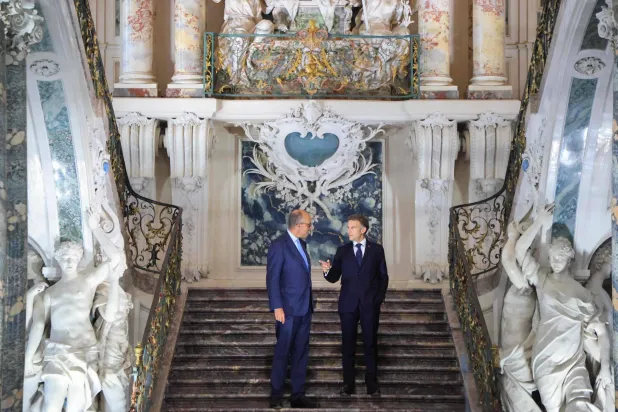
The German leader highlighted the initiative during a media conference alongside French President Emmanuel Macron near Cologne in Germany on Friday, saying it may mark the start of a new “doctrine”.
Recommended Stories
list of 3 items
- list 1 of 3US approves nearly $2bn in weapons sale to Saudi Arabia
- list 2 of 3EU sanctions nine people over alleged Russian cyber-spying campaign
- list 3 of 3Will NATO get involved in securing Strait of Hormuz?
end of list
“We will have German conventional forces participate in a nuclear exercise conducted by the French armed forces before the end of this year,” Merz said.
“We are proceeding step by step, it may be that this will result in a new doctrine, but it is far too early to say that today,” he added.
The decision by Germany and France to enhance nuclear cooperation highlights a growing push for European defense self-reliance as US security commitments face uncertainty.
Washington has disclosed intentions to reduce certain military resources assigned to NATO missions in Europe, and US President Donald Trump has frequently taken aim at the transatlantic defense alliance.
But Merz stressed that German-Franco cooperation would not replace NATO’s nuclear umbrella, to which Germany remains committed.
“This complements our commitment to NATO’s nuclear sharing and deterrence arrangements, which we continue to uphold,” Merz said.
US nuclear bombs are stored in Germany as part of NATO’s nuclear deterrent and German warplanes have been certified to potentially carry the weapons in an emergency.
Previous German leaders have refused offers of nuclear cooperation with France, Merz said, but “the world we live in today requires new answers”.
‘Vanguard role’
Macron said Germany would play a “vanguard role” in deterrence, which is critical for Europe’s collective security.
The French leader said that cooperation would translate into “explaining some aspects of how we operate, sharing certain closely held practices, offering joint exercises, developing joint initiatives and partnerships and fostering greater … trust among our teams, experts and military personnel”.
Enhanced nuclear deterrence won’t involve financing from Germany, Macron added.
In a symbolic kick off to their cooperation, French Rafale and German Eurofighters participated in a joint in-flight refuelling exercise on Thursday. Rafale jets are designed to deliver nuclear weapons.
In March, Macron announced an increase in the French nuclear arsenal and invited European partners to strengthen cooperation on nuclear deterrence.
France has been the only nuclear power in the 27-nation European Union since the United Kingdom left the bloc in 2020.
Several countries have expressed interest in the French initiative, including the UK, Germany, Poland, the Netherlands, Belgium, Greece, Sweden, Denmark and Norway.
The participation of Germany, which is implementing a major rearmament plan to build Europe’s strongest conventional military by 2039, boosts the programme.
While the initiative does not replace NATO's nuclear sharing framework, it signals a deepening bilateral defense relationship. The participation of German conventional forces in a French nuclear exercise is a symbolic and practical step toward integrated deterrence. Observers will watch how this cooperation evolves, particularly in the context of ongoing US policy changes and European security needs.
Original source: Al Jazeera


Comments (0)
Be the first to comment.