World Bank to Al Arabiya: Saudi Arabia is a key partner in supporting economies of countries

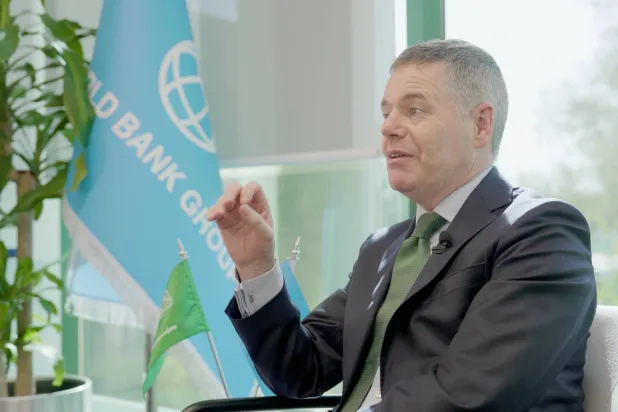
Pascal Donohoe, Managing Director and Head of Knowledge at the World Bank Group, said that global and regional economies are experiencing some slowdown due to current challenges, and the Bank is working intensively with governments to support their economies, by providing loans of about $20 billion, which could reach $50 billion with Saudi support being essential.
Donohoe said, in an interview with Al Arabiya Business, that the uncertainty witnessed by the world and the region represents one of the challenges affecting economic growth, but the region's economies continue to grow despite current difficulties.
Donohoe added that the World Bank focuses on diagnosing the challenges facing economies and working with governments to address them, noting that cooperation with the Kingdom of Saudi Arabia is of particular importance in this context.
Saudi Vision 2030
He explained that the World Bank's focus is on three main axes: first, supporting job creation and enhancing employment opportunities, stressing that the targets of Saudi Vision 2030 form an important framework for achieving this goal. The second axis relates to strengthening field presence and joint work with governments, noting that the World Bank has expanded its presence in Riyadh recently. The third axis is supporting economies affected by crises and conflicts through financing and development assistance programs.
He pointed out that the World Bank Group currently has the capacity to provide financing exceeding $22 billion, with the possibility of raising it to about $50 billion if economic conditions permit, stressing that the goal is not limited to monitoring challenges only, but extends to contributing to building an economy more capable of generating jobs and enhancing growth.
Regarding the importance of the employment file for Gulf and Saudi economies, Donohoe said that jobs represent the core of the World Bank Group's work, because economic development ultimately reflects on individuals' lives and their ability to obtain or retain job opportunities.
He added that the Kingdom presents a clear model in this area through Vision 2030, which contributed to enhancing the resilience of the economy and accelerating economic diversification efforts, noting that the decline in the unemployment rate to less than 7% reflects the ability of economic growth to create more jobs.
He affirmed that the World Bank is working with Saudi authorities to benefit from the knowledge and expertise developed within the Kingdom and transfer them to other countries, noting that sectors such as food, tourism, food security, and infrastructure represent models that can be built upon to support job creation in Saudi Arabia and developing countries alike.
In his assessment of the results of Saudi Vision 2030, Donohoe said that the vision has played an important role in enhancing the flexibility of the Saudi labor market, explaining that recent years have seen a significant increase in the number of jobs and a tangible decline in the unemployment rate.
He added that the opening of the World Bank's Knowledge Center in Riyadh reflects the desire to deepen cooperation with the Kingdom and exchange expertise on vital issues such as infrastructure, tourism, and supply chains, noting that the partnership between the World Bank and Saudi Arabia spans decades and focuses on building the necessary capacities to achieve the goals of Vision 2030.
Geopolitical tensions
Regarding the repercussions of geopolitical tensions and wars on the global economy, Donohoe said that the global economy is experiencing a slowdown in growth at a time when many countries are still recovering from previous shocks, noting the continued pressures related to inflation and rising food prices.
He explained that the World Bank is focusing on two parallel tracks: the first is helping countries face current shocks through loans, grants, and financing programs, and the second focuses on building a more resilient economy in the future through investment in human capital, infrastructure, and improving access to basic services such as water, electricity, and education.
He pointed out that the World Bank currently has a financing capacity ranging between $20 and $22 billion, with the possibility of increasing it to about $50 billion with the support of contributing countries, including Saudi Arabia.
Regarding the impact of artificial intelligence on the labor market, Donohoe said that the global debate about this technology is understandable and justified, but he believes that the opportunities offered by AI outweigh the challenges associated with it.
He added that during his visit to the Kingdom, he sensed a great ambition to qualify millions of people with the necessary skills to deal with AI technologies, stressing that this positive trend is also recurring in an increasing number of countries around the world.
He explained that the World Bank sees great opportunities to create new jobs in multiple sectors including tourism, healthcare, manufacturing, and the food sector, along with wide potential to use AI in improving public sector efficiency and raising productivity.
He gave the example of farmers in developing countries, noting that AI can help them obtain agricultural guidance and access markets more efficiently, reflecting on improving production and income.
Donohoe stressed that the success of benefiting from AI is linked to investment in education, training, and skills development, considering that this technology will create new opportunities in various sectors, especially healthcare and public services.
He said that the challenges associated with AI are real, but the economic and development opportunities it offers are much greater, making investment in qualifying individuals and preparing for digital transformation a basic priority for economies in the coming years.
Advertising material
Advertising material
Original source: Al Arabiya



Comments (0)
Be the first to comment.