"Bloomberg": How Korean Tankers Helped Secretly Export Oil Through Hormuz During the War

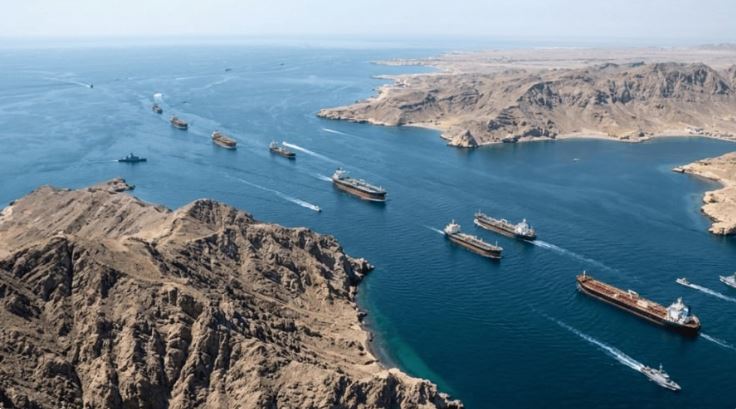
Just weeks after the outbreak of the Iran war, one of the largest oil producers in the Arabian Gulf began secretly exporting its crude through the Strait of Hormuz. The secret project quickly succeeded, to the extent that the UAE was already nearing its pre-war flow rate through the waterway by the time the United States and Iran signed their interim peace agreement.
In its effort to safely move barrels out of the strait, the UAE relied on tactics often used by sanctioned countries like Iran, Russia, and Venezuela: ships sailed 'dark' without their transponders, often literally under cover of darkness, before offloading their cargo onto other tankers waiting outside the waterway, then returning to collect more oil.
Sun, 05 2026
But crucially, Abu Dhabi officials needed enough ships to carry out the risky crossings, not just once but repeatedly. So they turned to Ga-Hyun Chung for help.
The notoriously private Korean shipping magnate shook the tanker industry earlier this year as his group, Sinokor Group, embarked on an unprecedented buying spree of tankers.
Bloomberg reported in March that he was poised to become one of the biggest winners from the disruption in oil trade caused by the Iran war, as tanker prices soared. Now, Sinokor has emerged as a major owner of supertankers moving crude out of Arabian Gulf waters.
The company began leasing vessels to the Abu Dhabi National Oil Company (ADNOC) for its 'shuttle runs' from at least mid-April. By June, nearly half of UAE crude shipments were sailing on Sinokor vessels, according to ship-tracking data compiled by analytics firm Vortexa.
This report is based on ship-tracking data collected by Bloomberg, figures from Vortexa and Kpler (another leading analytics firm), and conversations with more than a dozen shipbrokers, traders, and other industry insiders.
Mon, 06 2026
The extent of Sinokor's role in leasing vessels for 'dark' crossings has not been previously published. Sinokor did not respond to requests for comment. ADNOC Supply and Services, the shipping and logistics arm of ADNOC, said it does not comment on matters concerning the location, movements, or routes of its vessels, but noted it has 'a broad fleet comprising owned and chartered ships.'
Although ADNOC also relied on directly owned tankers as well as vessels from other parties, the deals with Sinokor were crucial in helping the UAE boost its exports through Hormuz at a much faster pace than its Gulf neighbors.
The shipments allowed ADNOC to capitalize more on the early-war oil price spike and helped mitigate the impact of the broader strait closure on global supplies. Since the interim peace deal, the company has continued to boost shipments, with oil tankers now crossing the strait with greater freedom and transponders turned on.
Huge Profits from Transit Through Hormuz
But the deals also created a massive profit opportunity for Sinokor, Chung, and his new partner: Italian container giant MSC Group.
Oil tanker markets are experiencing one of their most profitable years ever, and shipping brokers indicate that the premium for sailing to the Gulf during the war likely fetched 3 to 4 times the pre-war price.
The terms of the deals were not disclosed, but brokers estimated that just three tankers making 'shuttle runs' since mid-April could have earned Sinokor between $60 million and $120 million.
Since the interim ceasefire between the US and Iran took effect, Sinokor has sent an additional fleet of supertankers into Arabian Gulf waters to load crude, including at least two tankers that have already returned after departing to discharge their cargo.
And it's not just UAE shipments; the company has been actively promoting its services to shipping brokers while seeking oil barrels from elsewhere in the Gulf.
Matt Wright, lead shipping analyst at Kpler, said: "Sinokor's moves during the Iran war have been pioneering. By creating an environment that supports its bargaining position, the company is raising prices for all vessel owners. It's also willing to go to corners of the market that other owners might still be cautious about, and we are seeing early signs of a market recovery because of that."
Bold Bets
Even in an industry dominated by larger-than-life figures, Chung's bold bets distinguished him. Sinokor, headquartered in Seoul, started as a container shipping company before expanding to become a smaller player in oil tankers.
That changed dramatically late last year, when the company suddenly went on a buying and chartering spree for supertankers, backed by one of the biggest players in shipping, MSC.
By late February, Sinokor controlled about 150 very large crude carriers, according to industry estimates, roughly 40% of the global fleet that wasn't under sanctions, tied up in long-term charters, or on regular routes.
After the US issued licenses allowing Venezuelan oil trade early this year, Sinokor deployed a number of its vessels toward the US Gulf and the Caribbean, anticipating a flood of barrels to the main market.
Mon, 22 2026
At one point, the company controlled nearly all available supertankers that could reach the US Gulf within 30 days.
Sinokor's buying spree coincided with rising oil flows, driving tanker prices sharply higher even before US and Israeli strikes on Iran in February effectively closed the world's most important oil shipping lane.
By early March, prices had jumped dramatically to unprecedented levels, as the market adjusted to the reality that a large portion of the global fleet was stuck inside Arabian Gulf waters.
Bloomberg reported in March that Sinokor itself brought at least six empty supertankers into Gulf waters in the weeks before the war, meaning the company managed to charter the vessels at eye-popping daily rates to use for oil storage as storage facilities in the region filled up.
Around the same time, more details of the company's ties to MSC became public, as the world's largest shipping line bought a 50% stake in Sinokor Maritime Co.
Risky Dash Through the Strait
In the first weeks of the war, the sporadic movement through Hormuz seemed largely dominated by tankers with Iranian links, while the UAE and Saudi Arabia quickly diverted crude flows to export terminals on the Gulf of Oman and the Red Sea via pipelines bypassing the strait.
But while most vessel owners and crews deemed the journey too risky, at least one company, Greek Dynacom Tankers Management Ltd, appeared to have found a way through.
Original source: Aleqtisadiah

Comments (0)
Be the first to comment.