Chinese "PsiBot" Joins the Billion-Dollar AI Companies

تسعى شركة "بسي بوت" (PsiBot) لجمع نحو 100 مليون دولار في جولة تمويل بقيادة "شيري أوتوموبيل"، لتنضم إلى قلة من الشركات الناشئة الصينية في مجال الذكاء الاصطناعي المجسد التي تجاوزت قيمتها مليار دولار.
PsiBot is seeking to raise nearly $100 million in funding at a valuation of $1.48 billion, joining a growing list of Chinese startups capitalizing on the increasing interest in the fast-growing AI sector.
The company, also known as Lingchu Intelligence, is nearing completion of the funding round led by Chery Automobile, along with investors including Lens Technology, a manufacturer of sensors used by companies like Apple and Tesla. This brings the total funds raised by the startup since its founding in 2024 to about $300 million.
Sat, 18 2026
PsiBot has become one of the few startups to exceed a billion-dollar valuation (unicorn) in the field of embodied AI and world models; these technologies help robots and autonomous vehicles perceive and interact with their physical surroundings.
These two fields are rapidly emerging as new frontiers for AI and a key competitive arena between the United States and China, amid hopes that they can also accelerate scientific discoveries.
The company was founded in Shanghai by Victor Wang, who holds a PhD from George Washington University, and Xiaojie Chai, a robotics specialist who held positions at Alibaba and Tencent, along with Yaodong Yang, assistant dean of a college at Peking University, and Yuanbi Chen, a visiting researcher at Stanford University, under the mentorship of renowned AI scientist Fei-Fei Li.
Chinese companies are among the most active globally in developing world models, relying on government support, abundant industrial data, and a thriving open-source software ecosystem.
World Models: The New Generation of Machines
Developers count on world models to lead the next generation of machines, so that they are not limited to answering verbal queries but also interact with objects in the real world.
Wang, who previously worked at BlackBerry and JD.com, said: 'World models aim to achieve a more impactful breakthrough than large language models and chatbots.'
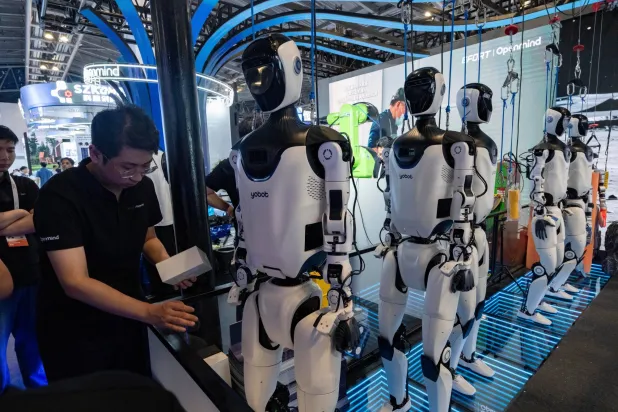
PsiBot's models learn from real-world data collected through specially designed devices, such as smart gloves and humanoid robots.
China's Competitive Advantage
The company is running and testing its platforms at one of China's largest logistics companies, as well as at one of the world's largest manufacturers of fiber optic cables.
Wang explained that data represents China's most prominent competitive advantage, but at the same time, it poses the main obstacle to development. He added that building highly efficient physical AI systems becomes extremely difficult without diverse data.
Thu, 23 2026
He pointed out that the main challenges are the high cost of data collection, scarcity, lack of unified standards, and variable quality. He said: 'Even leading AI labs in Silicon Valley, such as OpenAI and Meta, do not have good enough data.'
He added: 'We will collect one million hours of data this year, and we will work on developing a general model for taking action in the real world.'
Breakthrough in AI Within Two Years
Wang expects a tangible breakthrough in foundational models for the physical world within the next two years. He pointed to what OpenAI's GPT-2 achieved in 2019, when it was the first model to demonstrate the ability to generate human-like text after being trained only on internet content.
He explained that this was a starting point for developing GPT-3.5, which powers ChatGPT. He concluded: 'I expect physical AI to experience a landmark moment similar to the emergence of GPT-2 within the next two years.'
Original source: Aleqtisadiah



Comments (0)
Be the first to comment.