Egypt Counts on Global Navigation Trust in Suez Canal Economic Zone
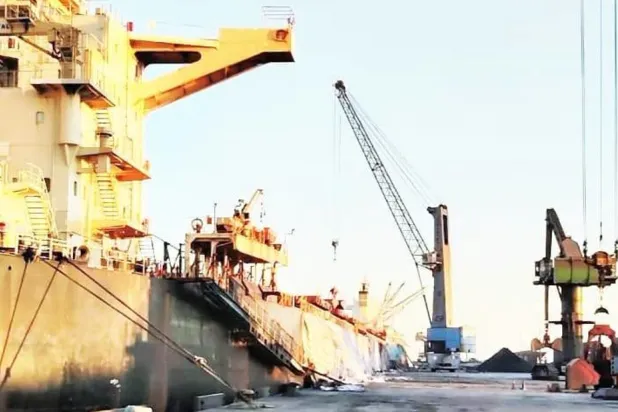
Amid the ongoing repercussions of the Iranian war, Egypt is counting on global navigation trust in the Suez Canal Economic Zone, after East Port Said port received one of the largest dry bulk ships on Sunday.
The Suez Canal Economic Zone extends over an area of 455 kilometers, comprising four industrial zones (East Port Said, Sokhna, West Qantara, and East Ismailia), in addition to six ports (East Port Said, West Port Said, Sokhna, Tur, Adabiya, and Arish).
The Egyptian government is intensifying its efforts to maximize the benefit from the canal's economic zone, and official meetings with officials from several countries have indicated the importance of investing in the economic zone.
The General Authority for the Suez Canal Economic Zone announced on Sunday that East Port Said port received the ship 'GENCO LION' arriving from Nouadhibou port in Mauritania, which docked at the multi-purpose 'Skyports' terminal at the port to unload a cargo of iron ore estimated at about 173,000 tons.
The authority considered this step 'reflects the continuous development in the port's operational capabilities, and the readiness of its infrastructure to receive modern generations of dry bulk ships.'
According to a statement from the Cabinet on Sunday, the ship is a dry bulk carrier with a cargo capacity of 173,000 tons of iron ore, a length of about 292 meters, a width of 45 meters, and a draft of 17.7 meters, which 'confirms the availability of appropriate depths and the efficiency of the berths and infrastructure in the port.'
The government statement added that 'this reception confirms the growing capacity of East Port Said port to receive ships of various sizes and loads, which enhances the port's position as a pivotal center for serving international trade traffic, and supports the competitiveness of Egyptian ports.'
West Port Said port received the sailing cruise ship 'STAR FLYER' at the end of last month (Facebook page of the General Authority for the Suez Canal Economic Zone).
Secretary-General of the Union of Arab Sea Ports, Major General Essam El-Din Badawi, points out that 'the Suez Canal Economic Zone provides logistic services for ships and vessels.' He adds that 'receiving bulk ships is a great addition to the Suez Canal Economic Zone.'
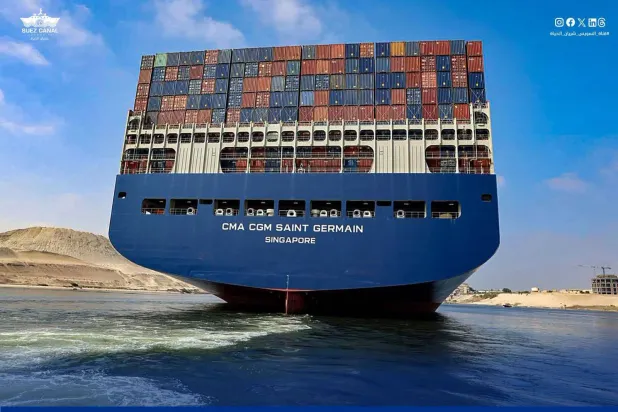
He explains to Asharq Al-Awsat that 'the passage of containers enhances the confidence of international navigation in the economic zone, and any increase in the number of ships passing through benefits Egypt, whether through the effects of the passage or the additional income of hard currency.'
According to Badawi, 'the Canal Economic Authority manages East Port Said port, but all marine operations, such as towing, pilotage, and navigation regulation, belong to the Suez Canal Authority.'
The General Authority for the Suez Canal Economic Zone achieved the highest revenues in its history during the fiscal year 2023-2024, amounting to 8.25 billion Egyptian pounds ($1 equals 49.6 pounds), an increase of 36 percent over the previous fiscal year.
Egypt has complained on more than one occasion about losses in Suez Canal revenues due to regional turmoil, starting with the Gaza war and leading to the Iranian war. Egyptian Foreign Minister Badr Abdelatty said earlier this month that his country 'suffered losses of about $10.5 billion as a result of the impact on navigation in the Suez Canal due to regional turmoil.'
Observers believe that the government 'has taken important measures in the past period to develop the Suez Canal Economic Zone, and attracted good investments at the level of industry and logistics, and it also counts on the trust of global navigation in the economic zone.'
Sokhna port received last week the ship 'CHIPOLBROK SUN' carrying a giant crane (Facebook page of the General Authority for the Suez Canal Economic Zone).
The head of the General Authority for the Suez Canal Economic Zone, Walid Gamal El-Din, said last April that 'the authority is working on developing terminals capable of handling various types of goods, achieving operational flexibility and enhancing the port's competitiveness at the regional and international levels.'
Regarding the future outlook for the Suez Canal amid the effects of tensions in the region, Badawi stated that 'the Suez Canal has been affected in recent months. Traffic from north to south is proceeding at reasonable rates.' He refers here to 'the ports of Port Sudan, Sokhna, and Aqaba, in addition to the additional activities of the Suez Canal Authority, especially in the field of marine shipyards, repair and shipbuilding.' But according to Badawi, 'this cannot substitute for ship transit,' saying that 'tensions in the region have caused significant losses to the canal after it achieved record revenues before the Gaza war.'
The Suez Canal Authority is implementing a plan to improve the level of navigational services to meet customer requirements, including 'providing a package of new qualitative services that were not previously offered, most notably marine rescue services, ship maintenance and repair, and marine ambulance,' in addition to 'fuel supply services and crew change.'
Original source: Asharq Al-Awsat



Comments (0)
Be the first to comment.