European official: 3 priorities to strengthen our relationship with Saudi Arabia and interest in visa abolition

A European parliamentary official identified three priorities for strengthening relations with Saudi Arabia as part of efforts to deepen cooperation between the two sides beyond traditional issues, to include security fields, as well as artificial intelligence and communications.
Reinhold Lopatka, a member of the European Parliament, said in a statement to Al-Eqtisadiah at the conclusion of a visit to Saudi Arabia at the head of a delegation from the European Parliament yesterday that the three priorities of the relationship are: a proposed strategic partnership agreement, progress towards a free trade agreement, and enhancing international coordination, including at the United Nations.
Lopatka described Saudi Arabia as a pivotal partner in the Gulf Cooperation Council, and stressed that the European Union desires a deeper partnership with it.
Maritime security is a common interest
The European parliamentarian highlighted maritime security in the Red Sea, affirming the common interest of both sides in keeping trade routes open.
He pointed to the European Union's operation in the region, saying that cooperation with Saudi Arabia is of utmost importance for global trade.
He added: 'Keeping trade routes open serves the interest of the entire world, not just Europe.'
Lopatka also affirmed that cooperation in the energy field is one of the most practical areas for achieving faster progress between the European Union and Saudi Arabia, highlighting solar energy, wind energy, and hydrogen as priorities where European expertise and Saudi capabilities can be employed through concrete projects.
European Parliament
He said that the next 12 to 24 months should be measured by the extent of implementation, as European companies, including Austrian companies, will work with Saudi partners on concrete renewable energy and hydrogen projects.
He explained that Europe's renewed focus on defense is linked to its desire to enhance cooperation with Saudi Arabia in the field of regional security, including efforts to protect commercial navigation and maintain the continuity of trade routes.
Lopatka indicated that Europe is now working to bridge this gap, adding that the European Union plans to set its multi-annual financial framework for 2028 to 2035, which will highlight a sharp contrast between past and future defense spending.
He continued: 'In the past seven years, we spent at the European level on defense between 15 and 17.1 billion euros. Now we will spend 150 billion euros.'
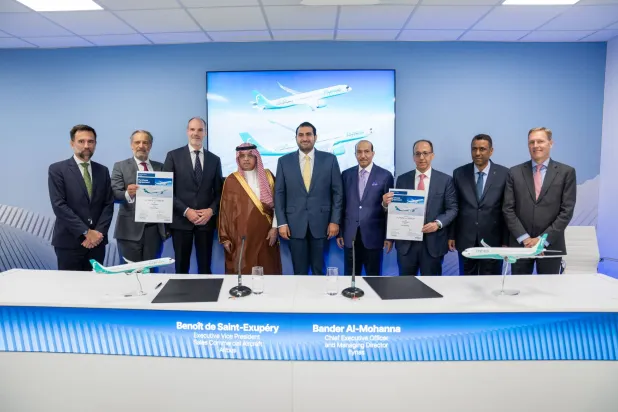
Read also: Launch of the first direct and regular flight between Riyadh and Madrid
Lopatka said that Europe's renewed focus on defense is linked to its desire to enhance cooperation with Saudi Arabia in the field of regional security, including efforts to protect commercial navigation and maintain the continuity of trade routes.
The delegation held talks with the leadership of the Shura Council and members of the friendship group with the European Parliament.
The delegation also met with government ministers responsible for foreign affairs, economy, energy, and investment, the President of the Human Rights Commission, the Assistant Secretary-General of the Gulf Cooperation Council, and representatives of the European business community.
Read also: Uber is close to acquiring delivery company Delivery Hero
First assessment of renewed geopolitical tensions
In Jeddah, the delegation visited the Jeddah Islamic Port, which provided an opportunity for a first assessment of renewed geopolitical tensions in the region.
The visit came at a critical juncture for relations between the European Union and Saudi Arabia, and between the European Union and the Gulf Cooperation Council, amid the most serious regional crisis the region has witnessed in recent times.
Delegation members expressed their full solidarity with Saudi Arabia and its people, who have been facing since late February repeated missile and drone attacks on civilian sites, airports, and oil facilities.
They strongly condemned the random Iranian attacks, stressing that targeting civilians and civilian infrastructure is absolutely unacceptable, and called for full respect for the sovereignty and territorial integrity of all states, in line with UN Security Council Resolution 2817.
The members affirmed that freedom of navigation is a non-negotiable right and a fundamental pillar of international law, including the United Nations Convention on the Law of the Sea, as well as the need to restore safe and free passage through the Strait of Hormuz, and welcomed Saudi Arabia's continued support for adherence to international law.
The delegation also expressed the European Union's readiness to elevate bilateral relations, particularly through a strategic partnership agreement. It was also informed of the Saudi side's interest in visa abolition and enhancing trade relations.
Original source: Aleqtisadiah

Comments (0)
Be the first to comment.