Lagarde: Full Impact of Energy Shock on Inflation Not Yet Visible
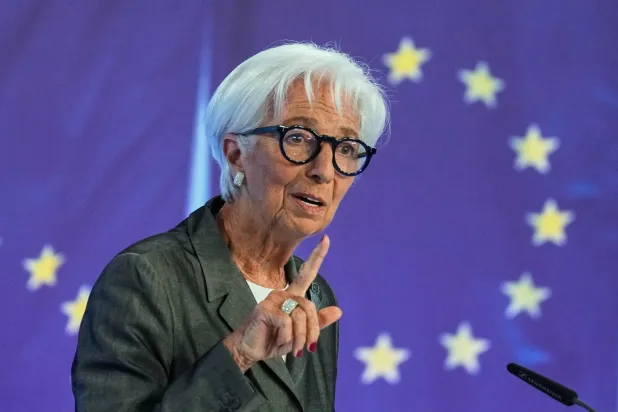
European Central Bank President Christine Lagarde said Thursday that the bank's Governing Council decided to keep the three key interest rates unchanged
European Central Bank President Christine Lagarde said on Thursday that the bank's Governing Council decided to keep the three key interest rates unchanged, stressing that the bank remains in a position to deal with the uncertainty caused by the conflict in the Middle East, and that it will continue to make its monetary policy decisions meeting by meeting based on incoming economic and financial data.
Lagarde added, during a press conference following the monetary policy meeting, that energy price forecasts, despite continuing to be highly volatile, remain close to the baseline scenario in the bank's experts' projections released in June, but are still much higher than levels prevailing before the outbreak of the conflict in the Middle East.
She explained that uncertainty remains high, and that the full impact of the energy price shock on inflation has not yet materialized, noting that the bank is closely monitoring the magnitude and duration of this shock, as well as its indirect and secondary effects.
She affirmed that the European Central Bank is committed to adjusting monetary policy to ensure inflation stabilizes at its target of 2% over the medium term, adding that interest rate decisions will continue to depend on the assessment of inflation outlook and surrounding risks, in light of new economic and financial data, developments in core inflation, and the strength of monetary policy transmission to the economy.
Lagarde stressed that the bank does not pre-commit to any specific interest rate path.
Limited improvement in economic activity
Lagarde said that the latest data indicate a limited improvement in economic activity in the second quarter, despite the continued pressure of the conflict in the Middle East on the economy.
She explained that survey indicators showed a partial recovery in services sector activity after the sharp decline that followed the energy shock, while the manufacturing sector continued to hold up, supported by increased inventory building in anticipation of supply chain risks, in addition to higher defense spending.
She added that digital services continued to perform strongly, driven by activity related to artificial intelligence.
She noted that the unemployment rate stood at 6.2% in May, a level close to its historical lows, but job vacancies continued to decline, and businesses and households expect the labor market to remain weaker compared to before the outbreak of the conflict.
She said that forward-looking indicators suggest that economic growth will remain modest in the near term, affected by the energy shock and associated uncertainty, but the fundamental factors supporting growth in the medium term remain in place.
She added that private consumption, investments in new digital technologies, government spending on defense and infrastructure, along with a gradual recovery in exports, are expected to support economic growth in the coming period.
Call to strengthen the European economy
Lagarde renewed the Governing Council's call for urgent action to strengthen the euro area economy while maintaining fiscal sustainability, noting the importance of simplifying European rules, accelerating the energy transition, and completing the savings and investment union.
She welcomed the positive vote on the digital euro project, considering it an important step towards the European digital currency, which will complement the role of cash and provide a digital means of payment in the euro area.
Inflation declines... but risks persist
Lagarde said that the annual inflation rate in the euro area fell to 2.8% in June, compared to 3.2% in May. She added that energy price inflation decreased to 8.5% from 10.8%, while food price inflation fell to 1.5% from 1.9%.
Core inflation, which excludes energy and food prices, also slowed to 2.4% from 2.6%, with goods inflation falling to 0.7% from 0.9%, and services inflation declining to 3.2% from 3.5%.
Despite this decline, she confirmed that the energy shock continues to push production costs higher, leading companies to expect to raise their product prices. She added that core inflation indicators remain relatively stable, but the full effects of higher energy prices have not yet materialized.
She noted that the ECB's indicators and wage expectation surveys point to moderate wage growth in the coming quarters, while improved labor productivity has helped contain rising unit labor costs.
She added that short-term inflation expectations remain elevated, while long-term expectations are stabilizing near the 2% level, supporting the return of inflation to the bank's target in the medium term. She explained that higher energy prices since the outbreak of the conflict, and their impact on food, goods, and services prices, could keep inflation above the target until the first half of 2027, before it begins to decline as energy prices fall and the pace of other price increases slows.
Original source: Asharq Al-Awsat


Comments (0)
Be the first to comment.