Oil and inflation fears lead to slight decline in European stocks
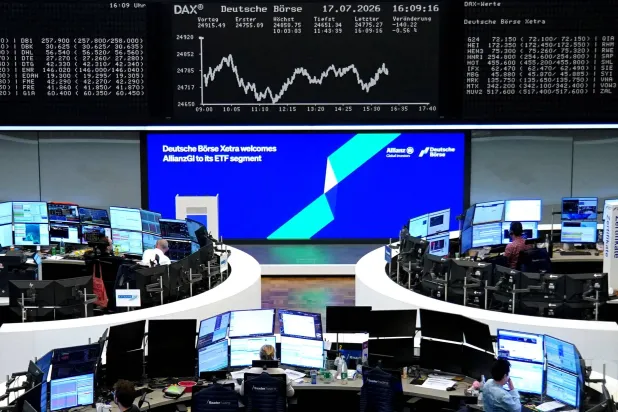
European stocks fell slightly on Monday as tensions between the United States and Iran escalated, pushing oil prices higher and raising inflation concerns.
The global AI boom has propelled Dutch company ASML to the forefront of the European stock market, as surging demand for computing chips used in AI applications flows to the Dutch firm that dominates the market for manufacturing equipment for these chips.
After reporting record second-quarter results, investors and analysts are beginning to ask a question that once seemed far-fetched: Can ASML become the first European company to surpass a trillion-dollar market capitalization?
The main obstacles to this scenario are how long tech giants like Google and Amazon and other data center operators continue heavy infrastructure spending, as well as the ability of ASML, its suppliers, and clients—including TSMC and Samsung—to execute ambitious expansion plans, according to Reuters.
But after ASML's shares rose 60% since the start of the year, lifting its market value to about $700 billion, investors and analysts say reaching a trillion-dollar valuation has become a realistic possibility.
Caroline Bell, chief investment officer of the Best Global Ideas fund at Stonehage Fleming, said: 'I think it has a very good chance to be the first company in Europe to reach a trillion dollars,' noting that ASML makes up about 8% of her portfolio.
She added: 'But I don't know when that will happen.'
The trillion-dollar question
Recent updates to analysts' forecasts following the second-quarter results indicate that this scenario is no longer a distant ambition. Institutions like Barclays, Susquehanna, and Bernstein have set price targets for the stock over 12 months exceeding $2,600, a level about 49% above current prices and close to the threshold needed to reach a trillion-dollar market value.
ASML is the only company in the world capable of producing extreme ultraviolet lithography systems, the essential technology for manufacturing microcircuits used in the latest processing and memory chips.
Investors compare the company's role to that of 'picks and shovels' sellers during a gold rush; it provides the essential tools for companies benefiting from the AI boom.
John Lamb of Capital Group, whose funds own about 5% of ASML shares worth $35 billion, praised the company as a long-term investment, thanks to its 'unique assets and strong competitive advantage.'
He said: 'The industry fundamentals appear stronger than ever, and ASML occupies a critically important position within it.'
ASML has already surpassed major European companies like Roche, LVMH, Novo Nordisk, AstraZeneca, and SAP, and now significantly outperforms them in market value.
Nvidia's 'Groq 3' chip during the company's GTC conference in San Jose, California (Reuters)
A new upgrade cycle supports growth
ASML's stock is currently trading at a price-to-earnings multiple of 38 times expected 2027 earnings, according to London Stock Exchange Group data, a level well above the multiple of TSMC, ASML's largest client, which makes AI chips designed by Nvidia and used by companies like OpenAI, Anthropic, and major cloud computing firms.
Investors and analysts believe that justifying this high valuation requires a number of factors, most notably sustained strong demand from major cloud computing companies.
Trent Masters of Alvinity Investment Management, which allocates about 3% of its portfolio to ASML, warned that 'any slowdown in this demand will negatively impact the company's profits.'
He added that other risks include ASML's ability to manage its supply chain and navigate geopolitical tensions, although he said he is 'very optimistic' about the company's prospects.
ASML also faces risks related to trade restrictions, after US lawmakers proposed the 'MATCH' Act, which could impose restrictions on the company's sales and equipment services in China, a market that the company expects to represent about 20% of sales by 2026.
But analysts pointed to other factors that could support the company's continued growth, even if the AI momentum slows.
Kingai Chan of Semit Insights said that AI memory chip makers like SK Hynix, Samsung, and Micron are shifting their production from older technologies using ASML's deep ultraviolet lithography tools to newer, more costly extreme ultraviolet systems, creating a profitable 'upgrade cycle' for the company.
Mark Hesselink, an analyst at ING, said ASML can certainly become the first European company to exceed a trillion-dollar market value.
New chip demand could also add further growth sources; the new 'Terafab' plant that Elon Musk plans to build in Texas to supply SpaceX and Tesla represents a new revenue opportunity for ASML.
Antoine Hucher of Aviva Investors said that ASML's successful execution of its strategy and continued demand for AI technologies could drive the company to continued growth, though without guarantees.
He added: 'ASML could become the first European company to reach a trillion-dollar market value. But recent volatility in AI stocks shows that the path to this achievement will not be easy.'
Original source: Asharq Al-Awsat





Comments (0)
Be the first to comment.