OPEC Raises Oil Demand Forecasts for 2027, Keeps Global Economic Growth Stable

Listen to the article: auto-generated audio from an automated system
0:00
Two minutes to read
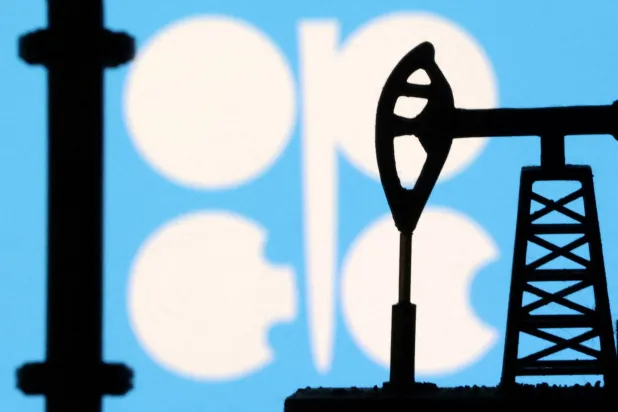
The monthly report of the Organization of the Petroleum Exporting Countries (OPEC) on oil market developments showed Monday that the organization lowered its forecasts for global oil demand growth in 2026 by 190,000 barrels per day to 800,000 barrels per day, marking the third consecutive downward revision.
In contrast, OPEC raised its forecasts for global oil demand growth in 2027 by 210,000 barrels per day to 1.9 million barrels per day.
Oil prices jump over 2% amid exchange of strikes between the US and Iran
The organization also kept its global economic growth forecasts unchanged, expecting growth of 3.1% this year and 3.2% in 2027, according to its monthly report on oil market developments.
OPEC still expects a smaller impact on consumption since the start of the US-Israeli war on Iran compared to other entities' forecasts that expect a decline in demand in 2026, such as the International Energy Agency.
Renewed strikes between the United States and Iran over the weekend raised fears of a new escalation. Tehran targeted US facilities in the Gulf on Sunday and announced the closure of the Strait of Hormuz once again. Iran's Revolutionary Guard said Monday it attacked US military bases in Kuwait and Bahrain.
Before the outbreak of the conflict in late February, about one-fifth of the daily global supply of oil and liquefied natural gas passed through the Strait of Hormuz.
Data showed that ship traffic through the strait fell on Sunday to its lowest level in five weeks. According to Kepler, only six ships crossed the strait yesterday.
The escalation of attacks cast further doubts on the future of the interim agreement between the United States and Iran signed last month aimed at reopening the strait and ending the war after another 60 days of negotiations.
The International Energy Agency said in its monthly report on Friday that global oil supply increased by 4.1 million barrels per day in June following the agreement, but remained about 9.4 million barrels per day below pre-war levels.
Goldman Sachs estimated that expanding pipeline capacity in the Middle East could shield more than 60% of Gulf oil exports at pre-war levels from any future disruptions in the Strait of Hormuz by the end of 2028.
The bank's baseline forecasts assume that pipeline capacity bypassing the Strait of Hormuz will increase by 3.8 million barrels per day by the end of 2027 and by 7.3 million barrels per day cumulatively by the end of 2028, raising total actual capacity to over 14 million barrels per day by the end of 2028.
Advertisement
Advertisement
Read also
Iraqi PM to Al Arabiya: We seek economic partnership with Saudi Arabia and adhere to our OPEC membership. He confirmed that Washington's release of cash dollar shipments is a good faith gesture and we seek to repatriate funds... Exclusive news
BMI to Al Arabiya: Iraq paves way to increase its OPEC quota with production hike plans. Expectations of Iraq's production capacity rising to 5.7 million bpd within 5 to 10... Economic stories
OPEC+ alliance decides to increase production by 188,000 barrels per day in August. The reduced amounts will be partially or fully restored depending on market conditions. Energy
Original source: Al Arabiya


Comments (0)
Be the first to comment.