South Korea plans to establish a fund from chip boom revenues to support growth
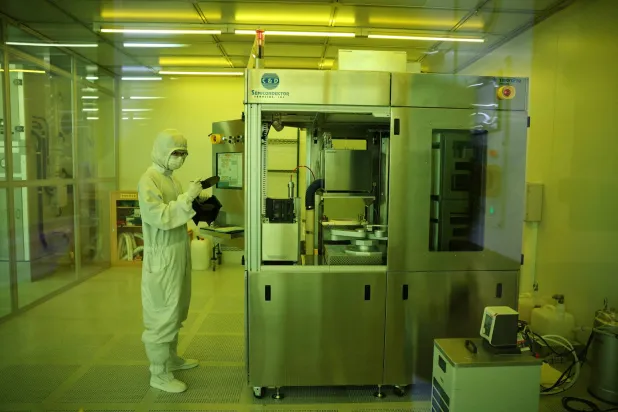
South Korea plans to establish a 'Future Fund' funded by additional tax revenues from the semiconductor industry boom to finance new growth engines and support generations.
The slowdown observed in Saudi Arabia's real estate market official indicators during the first six months of this year was not a surprise to observers; rather, it came as a practical application of the 'rebalancing' phase that began to emerge since 2025. With major regulatory changes such as 'real estate registration' coming into effect, investors and real estate developers are currently undergoing a period of recalculation and cautious anticipation, ahead of a second half that experts expect to be driven by real demand in residential and integrated logistics sectors.
In detail, data from the Real Estate Exchange under the Saudi Ministry of Justice (for property transfer category) showed that the total value of real estate transactions during the first half of 2026 declined to $21.9 billion (82.2 billion riyals), compared to transactions worth $45.1 billion (169.4 billion riyals) in the same period of 2025, representing a decline of 51.5 percent, the largest among indicators.
Road network in the Saudi capital (SPA)
This decline in values was also accompanied by a decrease in activity volume, as the number of real estate transactions fell to 161,900 transactions compared to 220,000 transactions in the first half of the previous year, a decrease of 26.4 percent, reflecting a clear slowdown in buying and selling activity within the market. The decline was not limited to transaction value and number but extended to the volume of assets traded, as the number of traded properties decreased from 204,900 properties to 138,600 properties, a decline of 32.4 percent. The total traded area also decreased to 1.625 billion square meters compared to 2.088 billion square meters during the first half of 2025, a decline of 22.2 percent.
Regarding prices, official data revealed relative flexibility compared to transaction volume, as the average price per square meter fell to 1,965 riyals compared to 2,217 riyals in the same period last year, recording a decline of 11.4 percent. The highest recorded price per square meter in transactions also fell from 453,124 riyals to 330,578 riyals, a decrease of about 27 percent.
Aerial view of Riyadh (Reuters)
Reading the reasons for 'conscious anticipation'
In an attempt to explain this new dynamic, expert and real estate appraiser engineer Ahmed Al-Faqih told Asharq Al-Awsat that this decline in the value and number of real estate transactions is 'very logical' given two critical factors that have recently emerged in the scene: first, regional geopolitical events represented by the US-Iran war, and second, the actual impact of government decisions aimed at rebalancing the market, which has reflected quantitatively and qualitatively on transactions.
Al-Faqih called for a distinction between traded and non-traded assets, noting that exchange indicators show many investors converting their assets to the 'non-traded' category in a state of preferring to wait and reposition based on market developments.
As for other economic variables such as interest rates and financing costs, Al-Faqih described them as 'side factors' compared to the geopolitical and regulatory issues. He added: 'The real estate investor, especially the speculator, is currently undergoing a serious recalculation phase, particularly with the government's explicit direction to develop the sector and correct practices in it. This direction will contribute to redirecting massive liquidity and pumping it into real development projects, increasing housing supply.'
Decline in transactions is not a price correction
From a complementary perspective, expert and real estate enthusiast Abdullah Al-Mousa agreed in his statement to Asharq Al-Awsat that the decline in transaction values by more than 51 percent cannot be interpreted as a 'direct reflection of a similar decline in prices'; reading the indicators requires greater depth. Al-Mousa noted that the market witnessed a pivotal institutional shift during the first half of 2026, represented by the expansion of the implementation of 'real estate registration' and the transfer of execution of real estate disposals in key areas—led by the capital Riyadh—to the real estate registry system, a fundamental variable that must be considered in annual comparisons.
Al-Mousa cited the market's strength in that the average price per square meter declined only 11 percent, compared to a drop in transactions of more than half their value, confirming that the sector did not experience a sharp price correction but rather a change in the 'composition of the transactions themselves,' due to a decline in huge billion-riyal deals and high-value assets, while prices stabilized in locations with real demand.
Accordingly, Al-Mousa asserts that the market is undergoing a 're-sorting' phase, not a general price correction, as liquidity has become more selective, and investors' compass has turned towards high-quality assets with better investment viability.
One of the projects of the 'National Housing Company' (SPA)
Second half of 2026
Looking ahead to the near future, Al-Mousa expects that the second half of 2026 will see a gradual and qualitative improvement in real estate activity, ruling out a quick return to the record trading levels of previous years. He explained that the sector is living through a transitional phase led by regulatory reforms, increased transparency, and the development of the legislative structure, factors that enhance investor confidence in the medium term, although they require some time to show their full effect.
In conclusion of his analysis, Al-Mousa suggested that integrated residential projects that meet actual demand, along with the logistics and industrial sectors supported by economic growth and mega-projects, will lead growth in the coming period. He concluded that the market's success in the next phase 'will not be measured by the volume and quantity of transactions alone, but by its ability to attract quality investments, raise asset utilization efficiency, and achieve a sustainable balance between supply and demand.'
Original source: Asharq Al-Awsat



Comments (0)
Be the first to comment.