South Korean Stocks Fall Amid Concerns Over Chip Sector Valuations
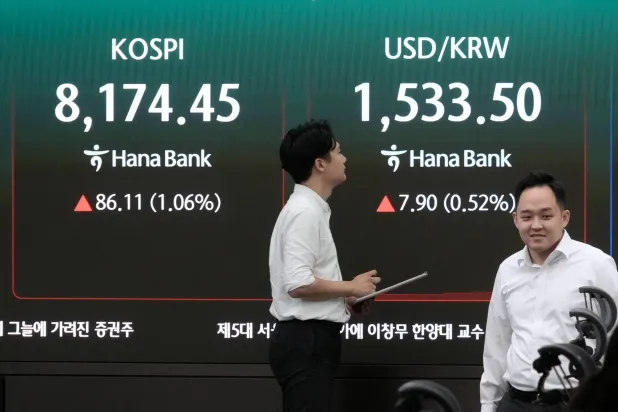
South Korean stocks posted a notable decline in trading on Monday, driven by a loss of strong momentum in technology stocks, as chipmaking giant SK Hynix prepares to list $29 billion in American depositary receipts on the Nasdaq. The decline coincided with a drop in the local currency (won) and a fall in benchmark bond yields.
By 02:45 GMT, the benchmark KOSPI index fell 240.93 points, or 2.98%, to 7,847.41. Despite the sharp decline, the index still retains strong gains of 86.21% since the start of the year.
Leading and heavyweight stocks led the market downturn; Samsung Electronics fell 1.53%, while rival SK Hynix suffered a sharp loss of 5.20%.
The moves come as SK Hynix plans to issue 17.79 million new shares as part of its depositary receipt listing, a step that will make it one of the highest-valued tech companies globally. Energy companies were also not spared, with battery maker LG Energy Solution falling 3.86%.
On the political and regulatory front, South Korean President Lee Jae-myung issued urgent directives for officials to quickly implement major chip and artificial intelligence projects announced last week, in an attempt to support the vital sector.
Among other sectors, auto stocks were mixed; Hyundai Motor fell 0.61%, while its affiliate Kia Corp bucked the trend, rising 2.83%. In industry and pharmaceuticals, steelmaker Posco Holdings fell 2.03%, and drugmaker Samsung Biologics fell 3.03%.
Of the total 913 stocks traded on the market, 268 companies posted gains, while 618 declined. Financial data showed foreign investors turned to net selling worth a total of 828.8 billion won.
In foreign exchange and debt markets, the Korean won was trading in offshore markets at 1,532.9 against the U.S. dollar, down 0.3% on the day, bringing the local currency's losses against the dollar to 6.2% since the start of the year. In bond markets, September futures on three-year treasury bonds rose 0.06 points to 103.12. The yield on the most liquid three-year Korean treasury bonds rose 0.9 basis points to 3.761%, while the benchmark 10-year bond yield fell 2.5 basis points to 4.171%.
Original source: Asharq Al-Awsat




Comments (0)
Be the first to comment.