The Chip Wave Breaks: Why Expert Yardeni Warns of an Additional 12% Drop?

Semiconductor stocks were among the most profitable trades on Wall Street this year, but they have quickly begun to give up those gains.
The iShares Semiconductor ETF (SOXX), which investors use to bet on the chip sector, has entered bear market territory after falling from its record highs in June.
Veteran economist Ed Yardeni, president of Yardeni Research, believes the sector's losses are not over yet. In a note to clients on Monday, he stated that chip stocks still have room to fall further, even if other parts of the market stabilize.
Why does Ed Yardeni expect an additional drop?
Yardeni predicts that the S&P 500 Semiconductor Index will fall an additional 12% to reach its 200-day moving average.
This average represents the stock's average closing price over roughly 200 trading days, and analysts consider it a long-term bottom that stocks typically return to after strong rallies.
According to The Street, the decline has already reached severe levels, with the iShares Semiconductor ETF falling 20.3% from its peak on June 2, officially entering bear market territory.
Tue, 21 2026
Meanwhile, sub-sectors more exposed to risk suffered steeper declines, with the Roundhill Memory Chip ETF (DRAM) falling about 35% from its highs on June 22.
The unusual aspect of this sell-off is that the benchmark S&P 500 index is still hovering near its record levels around 7,500 points. Most investors haven't noticed a significant decline; the surface remained calm while the main engine stalled.
3 factors pressuring the chip sector
According to Yardeni's note, three main factors have pressured the chip sector simultaneously.
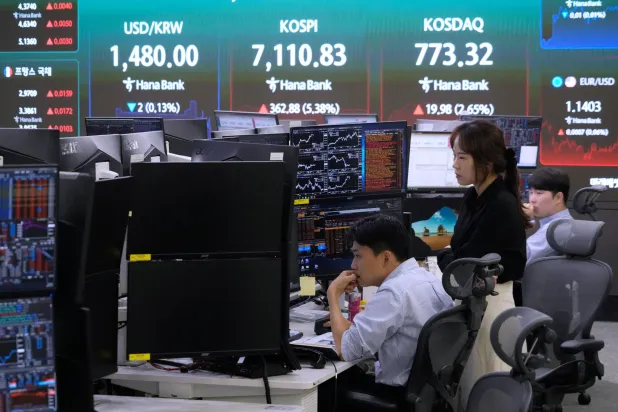
First, forced selling in Asia. South Korean chip giants like Samsung and SK Hynix faced margin calls, forcing leveraged investors to sell their shares to cover positions, negatively impacting US chip and memory stocks.
Second, Chinese company Moonshot AI launched a cheap AI model. The Kimi K3 model, which offers high performance at lower cost, revived fears that the AI hardware into which massive investments have been poured may not yield the expected returns or retain the high value investors anticipated.
Finally, market momentum, or buying stocks simply because they were rising, was the dominant strategy in 2026. Once selling began, there weren't enough buyers on the sidelines to slow the decline.
Sun, 19 2026
Timeline of the chip stock sell-off
On December 7, 2025, Yardeni downgraded the S&P 500 information technology sector to 'neutral' in an early defensive move.
Then on June 2, 2026, the market and the iShares Semiconductor ETF peaked before beginning to decline.
Later, in mid-July 2026, margin liquidations and the launch of the Kimi K3 model hit the sector, while South Korea took steps to curb high-leverage tech funds.
Then on July 19-20, 2026, the iShares Semiconductor ETF confirmed its entry into bear market territory with a 20.3% decline, and Yardeni issued his forecast of an additional 12% drop.
Yardeni's recommendations to investors
Yardeni's advice boils down to not trying to call the bottom and stopping buying during the ongoing decline.
Instead, he prefers to redirect investments and shift funds to more stable sectors, favoring overweighting financial services and healthcare, particularly biotechnology.
In conclusion, this decline does not mean the collapse of chip stocks, as demand for AI hardware remains. But for those thinking of buying during this drop, the key message is that the bottom may not yet have formed.
Original source: Aleqtisadiah





Comments (0)
Be the first to comment.