UK Economy Welcomes Burnham Government with Better Performance... And Challenges Mount

The latest UK economic data gave the next government a morale boost before the transfer of power to Andy Burnham on Monday, as economic performance beat market expectations and returned to growth in May, driven by the resilience of the services sector. However, this improvement does not obscure the challenges awaiting the new government, with continued pressure from the war in the Middle East, rising energy costs, and uncertainty surrounding the path of economic policy in the coming period.
Data from the UK's Office for National Statistics on Thursday showed that GDP rose 0.1 percent in May, in line with the expectations of economists polled by Reuters, after a contraction of 0.1 percent in April.
Although the monthly increase was modest, the economy achieved growth of 0.7 percent in the three months to May, indicating continued resilience in economic activity despite domestic and external pressures.
However, this improvement is still viewed with caution, as the repercussions of the war in the Middle East have begun to affect the UK economy through higher energy and shipping costs, which has increased uncertainty about economic prospects and led several economic institutions to lower their growth forecasts for this year.
In this context, Bank of England Governor Andrew Bailey stressed that the challenge facing the UK economy is not limited to current developments, but reflects a structural problem of weak growth since the global financial crisis of 2008, which was later exacerbated by the COVID-19 pandemic, the war in Ukraine, and the UK's exit from the European Union (Brexit). He called on the next government to prioritize boosting economic growth, emphasizing that 'the issue is not related to any particular government, but to the growth path of the UK economy.'
Burnham is scheduled to succeed Keir Starmer as prime minister next Monday, amid expectations of a change in finance minister with Rachel Reeves being replaced by Shabana Mahmood, according to British media reports.
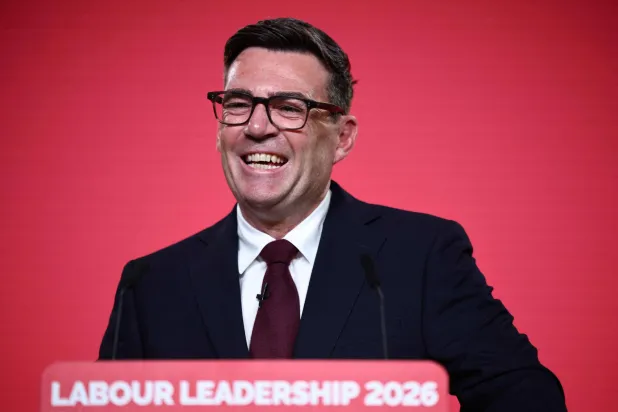
Burnham takes over the reins of government on Monday (AFP)
Services sector leads growth
Growth was driven by a 0.3 percent rise in services sector activity in May, while industrial output fell 0.5 percent and construction fell 0.8 percent, reflecting continued weakness in sectors most sensitive to higher financing and energy costs.
The Office for National Statistics explained that growth in the services sector in the three months to May was supported by computer programming and advertising activities, in addition to the pharmaceuticals industry, which is inherently volatile.
The medical science research and development sector also recorded strong growth in May, indicating continued strength in technology and innovation-based sectors.
On an annual basis, GDP rose 1.3 percent, the fastest pace of growth in 10 months.
Improvement in performance... and challenges await the government
The data indicate that the current government is handing over the economy to new Prime Minister Andy Burnham in a relatively better position than in previous months, but the economic environment has become more complex with the escalation of the war in the Gulf and continued political uncertainty.
Neil Birrell, Chief Investment Officer at Premier Miton, said that uncertainty about the new government's economic policies could negatively impact growth in the coming months.
He added that companies and consumers are likely to delay investment, hiring, and spending decisions until the new government's directions become clear, noting that the UK economy still starts from a weak growth base.
In contrast, Sanjay Raja, Senior UK Economist at Deutsche Bank, said the data carried more positive indicators, expecting the UK economy to rank among the top G7 economies in terms of growth in the second quarter. He added: 'In short, Keir Starmer hands over the economy to his successor in a much better position than a year ago.'
On Wednesday, the OECD called on the new government to maintain fiscal discipline, control rising pension spending, and address high energy prices as necessary steps to accelerate economic growth.
The organization forecast the UK economy to grow by 0.9 percent this year and 1.1 percent in 2027, while noting that the UK's performance in 2026 would be the best among the major European economies.
Underbanks area in Stockport, Britain (Reuters)
War redraws energy import map
Data from the Office for National Statistics revealed a notable shift in the sources of UK energy imports due to the war in the Middle East and the closure of the Strait of Hormuz. The office said UK imports of refined oil from Saudi Arabia, Kuwait, and Qatar fell to zero in May, after supply disruptions linked to the closure of the strait.
In contrast, imports of refined oil from the United States more than tripled from levels recorded in February, and imports from Belgium and the Netherlands nearly doubled, a shift that reflects Britain's efforts to diversify supply sources and reduce its reliance on shipments transiting the Gulf.
On another front, the data showed the UK's trade deficit in goods narrowed to 18.7 billion pounds sterling in May, the lowest since January, compared with 24.6 billion pounds sterling in April, performing better than market expectations.
Original source: Asharq Al-Awsat


Comments (0)
Be the first to comment.