Yemen's Bananas: Water Scarcity and Fuel Price Hike Threaten Crop
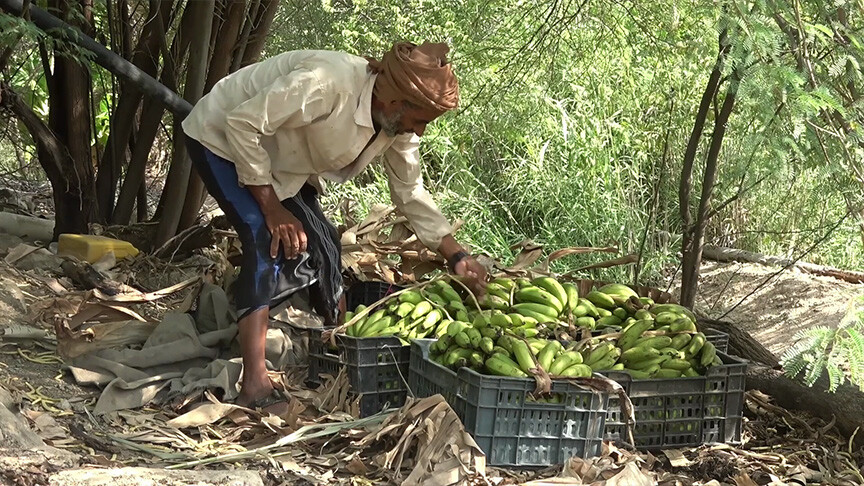
Yemen's banana production hit a record high in 2024, according to FAO data
Yemen / Anadolu
- Banana farmers face a significant increase in fuel prices needed to operate irrigation pumps, agricultural machinery, and transport the crop to markets
- Thabet Mohammed al-Oushqi, a farmer from Taiz governorate: We are suffering from a significant decline in rainfall rates
- Thabet Salem, a farmer from Taiz governorate: We used machines to plow the land, but we stopped using them due to rising fuel prices, and we returned to traditional methods
- Agricultural engineer Emad Abdelbari al-Samei: Banana cultivation continues despite growing challenges that may affect farmers' profitability
Despite Yemen's banana production reaching its highest level ever in 2024, according to the latest available international data, farmers of this crop face escalating challenges that threaten production sustainability and profitability, foremost among them water scarcity, declining rainfall rates, and the significant rise in fuel prices and agricultural costs.
According to data published by the Food and Agriculture Organization of the United Nations (FAO) in 2024, Yemen's banana production amounted to about 135,000 tons in that year, an increase of 1.13 percent compared to the previous year, recording the highest level since data recording began in 1961.
However, this increase in production volume does not necessarily reflect an improvement in farmers' conditions, as their testimonies reveal increasing pressures to maintain it, amid rising costs of irrigation, agriculture, and transportation, and declining rainfall rates.
Banana farmers also face a significant increase in fuel prices needed to operate irrigation pumps, agricultural machinery, and transport the crop to markets.
Farmers' Complaints
Thabet Mohammed al-Oushqi, a farmer from Muzayri' district in western Taiz governorate, complains of a significant decline in rainfall rates, which poses a challenge for banana cultivation that requires, according to him, irrigation once a week.
Al-Oushqi added to Anadolu: "Despite all difficulties, banana cultivation remains a livelihood for us under these circumstances, and we receive no support from anyone to overcome the problems we face."
A study issued by the Yemeni Ministry of Planning, in cooperation with the United Nations Children's Fund (UNICEF) in May last year, reported a decline in the average rainfall in the country from 409 mm to 347 mm during the period between 1979 and 2024, i.e., about 15 percent.
This coincided with an increase in average temperatures by about 0.43 degrees Celsius per decade, and a cumulative increase of about 1.9 degrees Celsius during the same period, according to the study.
These challenges are particularly important given the need of banana trees for large amounts of water and regular irrigation in a country that is among the most water-scarce in the world.
Regarding farmers' means of adapting to these conditions, al-Oushqi said that some resort to digging wells to provide water.
But he explained that this method is only available to a few farmers due to its high cost.
Hodeidah governorate, in western Yemen, is the most prominent banana-growing region in Yemen, producing more than half of the total crop, along with the governorates of Lahj, Taiz, Abyan, and Hadramawt.
Fuel Price Hike
Thabet Salem, also a farmer from Muzayri' district, complains of the challenges facing banana farmers in Yemen, saying: "We continue to cultivate bananas despite the many difficulties we face. They require large amounts of water, constant guarding and care, in addition to fuel that costs us large sums."
In his interview with Anadolu, Salem, who owns about two thousand banana trees, added: "We used machines to plow the land while planting bananas, but we recently stopped using them due to rising fuel prices, and we were forced to return to traditional methods and plowing with oxen."
He continued: "We face a severe water shortage due to low rainfall, in addition to the ongoing effects of climate change that Yemen suffers from."
Salem concluded his speech by saying: "Yemen suffers from severe drought, and fuel prices are continuously rising, and we have nothing left but to trust in God."
In July 2014, about two months before the Houthi group entered Sanaa, the price of a gallon of diesel (20 liters) was about 3,900 riyals.
Currently, the official price of a gallon in areas under government control is about 30,000 riyals, and it rises during some crisis periods to nearly 40,000 riyals, due to supply disruptions and increasing demand. In contrast, the price of a gallon in areas under Houthi control is about 10,000 riyals.
This price disparity is due to the monetary division in the country and the difference in exchange rates, as the dollar price in Houthi-controlled areas is around 530 riyals, while in government areas it is about 1,550 riyals.
Accumulated Challenges
For his part, agricultural engineer Emad Abdelbari al-Samei believes that bananas are one of the most important economic crops in Yemen and provide a source of income for thousands of farmers.
He told Anadolu that banana cultivation continues despite growing challenges that may affect farmers' profitability.
He explained that these challenges are due to the accumulation of several factors, foremost among them water scarcity and the need for bananas for large amounts of water compared to most other crops, which raises production costs, along with the high cost of pumping water due to rising fuel and energy prices.
He pointed out that increased salinity of water and soil, especially in coastal areas, poses an additional challenge due to the sensitivity of banana trees to salinity.
He also noted the effects of climate change, such as rising temperatures, irregular rainfall, drought, and floods, and the damage they cause to crops.
Al-Samei warned that the sector also faces the spread of some agricultural pests and diseases, and rising prices of production inputs, such as fertilizers and pesticides, in addition to a shortage of labor in some areas and high wages.
He added that the weakness of agricultural extension services and the transfer of modern technologies to farmers, as well as damage to infrastructure, including roads and irrigation networks due to the war, increases pressure on the sector.
He pointed out that marketing and export difficulties and high transportation costs represent additional challenges for farmers.
He also noted high post-harvest losses, as bananas are a perishable crop, and bruises and poor packaging during transport and handling lead to a decline in fruit quality.
The weakness of sorting, packaging, and cold storage centers also contributes to an increase in the loss rate and a decrease in farmers' economic returns compared to high production costs, according to the speaker.
Opportunities Conditional on Support
Al-Samei believes that the banana cultivation sector has great opportunities for development and continuity if supportive measures are provided, including the introduction of modern irrigation techniques, improving water resource management, and developing the marketing system, given that Yemen has suitable agricultural environments and long experience in producing this crop.
He stressed the sector's need for more support and development to face the challenges threatening its sustainability and improve farmers' conditions.
Yemen had topped the list of Arab banana producers and exporters during the five years prior to 2007, according to data from the Central Statistical Organization.
Original source: Anadolu Agency


Comments (0)
Be the first to comment.