Yen at Four-Decade Low... Tokyo Waves Intervention
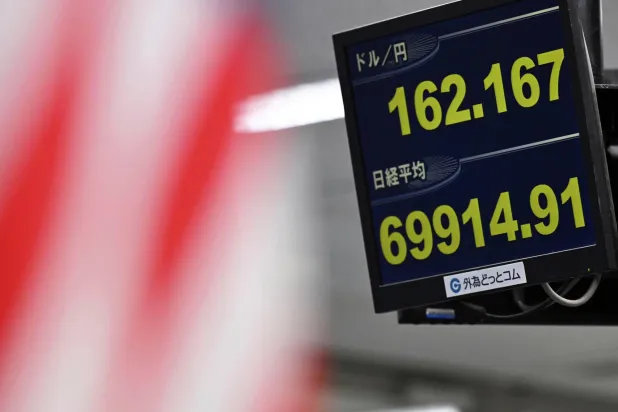
The Japanese yen entered a new phase of weakness after the dollar surpassed 163 yen, recording its highest level against the Japanese currency since late 1986, a development that put markets on alert for possible direct government intervention, while also revealing the limited impact of official warnings in the face of broader economic forces driving the yen lower.
The dollar reached 163.24 yen in New York trading on Tuesday, before stabilizing near 163 yen during the Asian session on Wednesday. The sharp decline of the Japanese currency came alongside a broad rise in the dollar, supported by rising oil prices and US Treasury yields, as well as increased demand for the US currency as a safe haven amid continued US strikes on Iran and growing fears of the war spreading in the Middle East.
Japanese Finance Minister Satsuki Katayama quickly affirmed the authorities' readiness to take 'decisive and appropriate action at any time,' while Chief Cabinet Secretary Minoru Kihara said the government is prepared to respond appropriately to market movements. Tokyo is monitoring the yen's decline with growing concern, as a weak currency raises the cost of imports of energy, food, and raw materials, and quickly passes through to consumer prices in an economy heavily dependent on foreign sources for its fuel needs.
But the strong statements have so far failed to change the market trend. Markets have become less convinced that official intervention alone can stop the yen's decline, after the impact of the government's currency purchases in April and May faded, when Japan intervened after the dollar surpassed 160 yen.
• Large gap The problem is that traders do not see the yen's weakness as just a short speculative wave that can be deterred by pouring billions of dollars, but rather as a result of a large interest rate gap between Japan and the United States, high US yields, and growing concerns about Japan's public finances. Therefore, intervention may lead to a sharp and sudden rise in the currency, but it does not change the underlying trend unless the conditions that encourage investors to sell yen change. The silence of Atsuki Mimura, the Finance Ministry's top currency official, remains under close scrutiny, as the markets view him as the key decision-maker in determining the timing of intervention.
However, the government's strategy in recent weeks has shifted from repeated direct threats to keeping investors in a state of uncertainty, hoping to push speculators to reduce their positions for fear of a sudden move from Tokyo. The government's task is made more difficult by the dollar benefiting from a favorable global environment. Brent crude oil prices rose to $92.67 per barrel, the highest in 6 weeks, while the 30-year US Treasury yield rose to 5.15 percent, and the 10-year bond yield reached 4.64 percent, the highest since May.
The rise in yields enhances the attractiveness of US assets compared to Japanese ones, and pushes investors to finance their investments with low-yielding yen and then buy dollar and higher-yielding assets.
• Bank of Japan at the heart of pressures At the heart of the crisis stands the Bank of Japan, facing conflicting pressures. On one hand, the weak yen and rising energy prices have increased imported inflation, pushing the bank toward monetary tightening. On the other hand, raising rates quickly could put pressure on an economy burdened by borrowing costs, increase the servicing cost of the huge public debt, and cause disruptions in the bond market. The Bank of Japan raised its policy rate in June to 1 percent, the highest in 31 years, after the war in the Middle East increased energy costs and deepened inflationary pressures from the weak currency and tight labor market. Analyst expectations point to a possible rate hike to 1.25 percent by the end of the year, while Bloomberg reported that bank officials are open to accelerating the pace of increases if the weak yen continues to raise inflation risks — information that Reuters said it could not independently verify. However, markets remain skeptical of the bank's ability to move as quickly as needed.
This skepticism is linked to the first economic plan of Prime Minister Sanai Takaichi, known for supporting loose fiscal and monetary policies. The plan raised concerns that the government might pressure the Bank of Japan to keep rates low, allowing public spending to be financed at lower cost, even at the expense of fighting inflation.
• Iran war Takahide Kiuchi, chief economist at Nomura Research Institute, said the Iran war and developments in the Middle East may be the direct cause of the yen falling below 163, but the failure of the economic plan to dispel concerns about public finances and monetary policy independence represents a deeper factor.
He added that the markets' perception that the government may have broad influence over the central bank's decisions raises fears of it being delayed in tackling inflation, which puts pressure on the currency.
These developments show that the yen crisis is no longer just about the exchange rate, but has become a test of the credibility of Japan's economic policy. The government wants to protect households and companies from rising prices, but at the same time prefers low interest rates to ease the debt burden and finance its investment plans.
As for the Bank of Japan, it is trying to maintain its independence and contain inflation without pushing the economy into a sharp slowdown. HSBC analysts believe that Japan may intervene again soon, but they rule out any lasting impact from any move unless the Bank of Japan raises rates several times, or the US Federal Reserve returns to cutting rates, or investors' view of Japan's public finances improves.
Thus, Tokyo appears able to slow the yen's decline, but it remains unable to change its direction on its own. With the dollar approaching levels not seen in Japan in four decades, the likelihood of a direct confrontation between authorities and speculators increases.
However, the outcome of this confrontation will not be determined solely by the amount of money the Finance Ministry may inject, but by the ability of the government and the Bank of Japan to present a coherent policy that convinces markets that inflation will be contained, that the bank's independence will not be undermined, and that spending expansion will not lead to further deterioration in confidence in the yen.
Original source: Asharq Al-Awsat




Comments (0)
Be the first to comment.