Museums Night Celebrates Lebanon's Bright Cultural Face
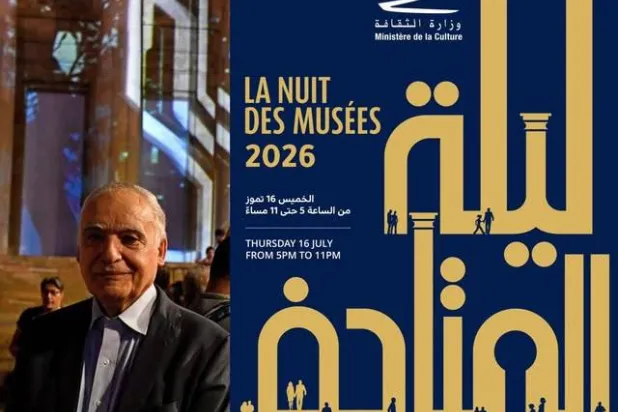
A group of prominent museums participate in this evening, with visits starting from 5 pm until 11 pm...
The Syrian film 'Photograph' asks a question that appears simple on the surface but is profound at its core: what remains for a person when places change, days turn, and the details one thought were fixed fall away? Things do not give us our identity, but the memories we cling to do.
The short fiction film has toured several festivals. It recently won the 'Justice and Peace' Award at the ninth edition of the Middle East Film Festival, held in June in The Hague, Netherlands.
'Photograph' highlights the repercussions of the war in Syria and its impact on child labor, depriving children of education to support their families financially. The film was produced by the Syrian General Organization for Cinema, script and dialogue by Buthaina Naeesa, starring Suleiman Al-Ahmad, Ghaleb Shandawiyah, Jamal Al-Ali, and Safouh Mimas, and directed by Mohannad Kalthoum.
The film tells the story of two boys bound by a deep friendship, Sultan and Yahya, who wander through their city amid the rubble of buildings, remnants of furniture, and belongings that bear witness to a life that once was and is no more, while they live in shelter camps. Sultan leads his friend Yahya, who has lost his sight, as they collect leftover tools under the rubble to sell to a merchant for a few liras. While searching through the ruins of Yahya's house, they find a camera belonging to his family. They manage to turn it on and take pictures of each other amidst the collapsed buildings, making these photographs a testament to their memories. As Sultan tries to take more photos, the rubble falls on his friend's head.
Director Mohannad Kalthoum says, 'The award the film won confirmed to me that cinema is still capable of opening a dialogue between people regardless of their languages and cultures.' He added to Asharq Al-Awsat that the true value of any award lies in the question it poses: why did this film reach people? 'From the beginning, "Photograph" was not seeking sympathy nor condemning anyone; rather, it tried to get close to the human being when forced to hold on to what remains of their memory and dignity. So I felt the name of the award aligns with the film's spirit,' he said.
The two protagonists of the Syrian film 'Photograph' (Asharq Al-Awsat)
Kalthoum explains, 'Hiding the camera behind the characters was my biggest concern during filming. I was looking for an image that breathes quietly, for light that resembles life, for places that bear the marks of time without speaking. I didn't want a beautiful image as much as I wanted a truthful one, because truth stays in the viewer's memory more than any visual spectacle. That is why I always say that "Photograph" is not a film about war, but about a person resisting oblivion, because what frightens a person most is not losing their home but losing their story.'
The 'Justice and Peace' Award is a culmination of the film's journey through several Arab and international festivals, where it won several awards. However, Mohannad Kalthoum does not view these participations as a race, but as a journey where the film changes with every audience that watches it. He says, 'Sometimes I would leave the screening room feeling that the audience discovered something in the film that I was not aware of, and that is one of cinema's most beautiful surprises. That is why I do not like to measure the film's success by the number of awards, but by the number of times it managed to leave a silent impact on the viewer's heart after the screen goes dark.'
Kalthoum explains the reason for choosing the title 'Photograph,' saying, 'I was looking for a title that does not describe the film but opens a door to enter it. For me, a photograph is a memory that resists time. Sometimes a single image is enough to carry a whole life and bring back to us people and places that no longer exist except within us. That is where the film was born.'
Syrian director Mohannad Kalthoum (Asharq Al-Awsat)
'Photograph' carries a clear human dimension and seems to put memory on trial, but Kalthoum asserts that 'I do not view memory as a place we flee to whenever we miss the past, but as a place where we protect our humanity from oblivion. Therefore, memory in "Photograph" was not a space for nostalgia, but rather a space for contemplation and for re-asking questions,' according to him.
Kalthoum stresses that he treated the script as a space for dialogue between the writer's vision and his own as a director, saying, 'It was important for me that every scene become closer to the characters and more capable of expressing through image and silence, not words. I translated this feeling into a quiet visual language that leaves room for the viewer to feel more than what is told to them, because I believe the best films are those that trust the viewer's sensibility and do not impose a single interpretation.'
Regarding Syrian cinema and whether it has moved beyond the war to raise questions about identity, Kalthoum says, 'I believe that Syrian cinema today stands before an important opportunity to rediscover itself, not because the war has ended, but because cinema cannot remain captive to the event forever. The real challenge today is not to narrate what happened, but to understand what it left inside the human being.'
Mohannad Kalthoum has directed numerous fiction and documentary works that have participated in international festivals and won several international awards. Among his fiction films are 'Why,' 'Yalla Let's Play,' 'On the Roof of Damascus,' and 'Hope Faith Love'; documentaries include 'The Isthmus,' 'The Syrian Silk Journey,' and 'This Land.' He is the founder of the 'Yalla Cinema' project and the 'Damascus Film Days' festival for children and youth films.
Original source: Asharq Al-Awsat


Comments (0)
Be the first to comment.