Khalil Al-Hashimi: A Journey of Art and Creativity from Manama to Leningrad
The art of sculpture in the Arab world suffers from atrophy due to many people turning away from studying it, and specialists shifting to other arts. This is despite the ancient history of sculpture in Arab countries, which began in ancient times in the Levant and Mesopotamia, not to mention Egypt's particular interest in it for decades, as evidenced by the spread of statues and sculptures in its squares, plazas, and streets more than any other Arab country, and its contemporary history crowded with names of great sculptors who learned the fundamentals of this art in specialized international institutes, such as Mahmoud Mukhtar and Abdul Hadi Al-Jazzar. And if we talk about sculpture in the Arab Gulf states, we find variation in its history, interest, and number of specialists from one Gulf country to another, but generally speaking, it is a field that only a limited number of artists have ventured into due to various factors, chief among them the issue of prohibition. Despite the prohibitions and obstacles, this handful of Gulf sculptors managed to present works that express cultural identity using local materials, heritage symbols, Arabic ornaments, and Islamic architectural arts, or that express social and intellectual transformations in the region and some pivotal events in its history. This handful also succeeded in interacting with modern artistic trends without abandoning their cultural roots, so their works came distinguished by a character that combines modernity and authenticity.
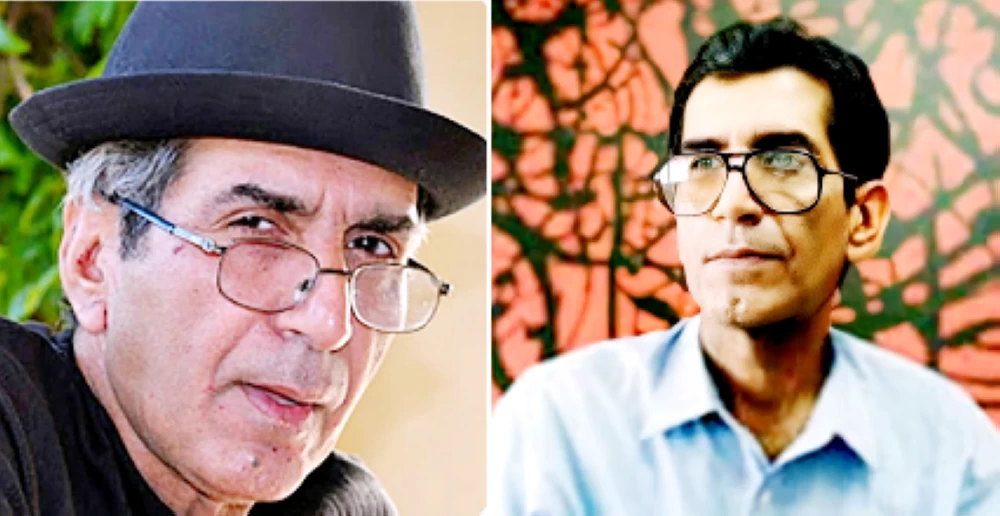
Among this handful of Gulf sculptors, the name of the late Bahraini sculptor and plastic artist Khalil Al-Hashimi stood out. He passed away on Friday, December 9, 2022, after a long struggle with a serious illness. Funeral prayers were held and his body was laid to rest in Manama Cemetery. In this article, we attempt to trace the deceased's journey in art and life from his birth to his death, documenting his biography and introducing him to those who did not live with him, study under him, or come close to his beautiful art.
His departure was painful and shocking to all workers in the Bahraini artistic and cultural scene, especially as he enriched the scene with his sculptures and works, and for years was one of the pillars of sculpture in the Kingdom of Bahrain. His contributions to enriching the plastic art movement and supporting the cultural movement bear witness to this, not to mention his beautiful interaction with human concerns and his deep belief in sculpture as an immortal art that defies time, transcends generations and spaces, and embodies man's ability to create and innovate.
Four years have passed since his departure from our world, but one of his beautiful works remains standing to this day, before the eyes of tens of thousands of his fellow citizens as they come and go to work and home every day and hour. We mean the sculpture 'Flock of Birds,' which stands tall at the 'Diving Intersection' near 'King Hamad Hospital,' welcoming those coming from Manama and those heading to it via the 'Sheikh Isa bin Salman Bridge.' In this work, the deceased excelled, presenting a blend that combined the shimmering of bird wings soaring in the sky with the shimmering of water and the movement of the sea surface, in the words of the cultural page editor of the Bahraini newspaper Al-Ayam (10/12/2022), Sayed Ahmed Redha.
Khalil Ali Ibrahim Al-Hashimi (Abu Rami) was born in the 'Abu Sirah' neighborhood in Manama in 1949, and grew up among its simple houses and narrow alleys. From his early formal school years in Bahrain's schools, he was known for his passion for the arts. In the late 1960s, he began a new period in his life characterized by openness to various artistic and cultural fields, embodied in his starting to accompany and sit with pioneering plastic artists and painters to learn from them and benefit from their experiences and styles in their creative works. Thus, Al-Hashimi studied under leading Bahraini names such as Abdul Karim Al-Arrayedh, Nasser Al-Yousef, Abdul Karim Al-Bustah, Hussein Al-Seni, and others. He also accompanied and befriended peers who were enthusiasts of art, drawing, and sculpture, such as the encyclopedic plastic artist Khalil Tarrabi, and exchanged ideas and opinions with them.
Undoubtedly, his association with all these people broadened his artistic and cultural horizons and acquainted him with things he was ignorant of, while on the other hand, it paved the way for him to become a teacher of art education in one of Manama's government boys' schools, not to mention that it cemented his choice of art as an irrevocable professional field.
After a period of time, he reached a decisive and fateful decision about his future. He felt the need to hone his artistic talents through academic study outside Bahrain. Naturally, he could not fulfill that dream at the time for financial reasons, so he sought a student scholarship from the grants that the former Soviet Union offered to students from third-world countries to study in Russian institutes and universities.
Thus, at the beginning of the 1970s, Al-Hashimi set off alone to a distant, unknown land to satisfy his artistic inclinations. He arrived in the beautiful city of Leningrad (now St. Petersburg), rich in museums, statues, palaces, and sculptures, and enrolled there at the Faculty of Sculpture in the Academy of Arts, which granted him a master's degree in 1980.
It can be said that Al-Hashimi was fortunate to study in this ancient historical city that was once the capital of the Russian tsars. In addition to the knowledge he gained at his college, he learned many other things through his visits to museums and palaces and his contact with colleagues from different countries and diverse cultures. Moreover, he learned the Russian language until he mastered it, and he met the woman who became his life partner and mother of his two sons (Rami and Ayman), a virtuous and kind Russian lady who was loyal to him and cared for him during his years of illness until the last day of his life.
Al-Hashimi told me years before his death that when he traveled to the Soviet Union, he did not intend to study sculpture, but he realized there that sculpture is the art of immortalization and expression of existential and life issues, so he chose to specialize in it and excelled. However, alongside the art of sculpture using wood, bronze, and stone, our friend also engaged in the art of drawing and painting and practiced it. We see manifestations of this in his plastic paintings, most of which are dominated by issues of the weak and marginalized human, with exceptions where he chose natural elements as subjects.
I can say, by virtue of a friendship that brought us together over ten years, that the deceased was a self-made man who built himself and acquired his culture and knowledge also by relying on himself. He was characterized by sensitivity in word and deed, staying away from chatter and boasting, and expressing what was inside him with gestures accompanied by smiles and hand movements that had been exhausted by hammers and scalpels and tired by chisels and files.
The cultural page editor of Al-Ayam newspaper (previous source) wrote about him, meaning that Al-Hashimi believed that we live in an era that moves quickly thanks to great scientific inventions and discoveries, which has shaken the throne of art. He believed that modernity is not an ideology, but practices that wanted to contradict the foundations on which Western culture was built in the past, and that the tendency towards it is ancient in humans seeking the new and exciting. But Al-Hashimi, in his pursuit of the new, exciting, and modern, believed in the necessity of defining identity first; because each modernity has its own specificity that distinguishes it from others.
Original source: Okaz




Comments (0)
Be the first to comment.