Sara Balghunaim: In My Films, Comedy is Born from the Absurdity of Reality
Years ago, Saudi filmmaker Sara Balghunaim packed her bags and headed to New York to study filmmaking. There, she did not just learn the tools of directing; she discovered a different way of looking at people. For her, stories begin with observation—from the small details that pass by everyone, then transform on screen into characters carrying their full contradictions, without seeking to justify or condemn them.
This vision led her to build an experience that caught the attention of several film festivals in recent years, through short films. Her latest is 'Irtizaz,' which traveled between festivals such as Chicago, San Diego, Aspen, and the Red Sea Film Festival, before being screened last week at the Saudi Film Festival. The film takes its name from the colloquial Saudi verb 'tartzaz,' meaning to show off or display oneself to attract the attention of others.
Sara Balghunaim during the screening of her film at the Saudi Film Festival (Al-Sharq Al-Awsat)
A Wake Becomes a Stage for Ironies
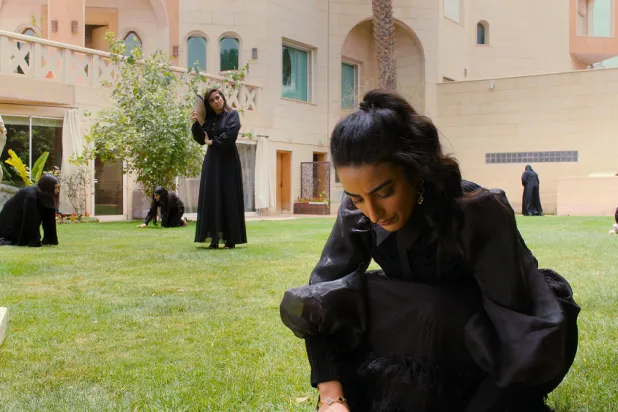
In just a quarter of an hour, 'Irtizaz' succeeds in turning a wake into a stage for black comedy, without leaving the social reality that inspires it. The story revolves around the mother (Reem Al-Habib) and her daughter Joju (Rand Al-Qusaibi) inside a women's wake at the villa of a woman who is the mother of the ideal groom, where girls compete to catch her eye and win her approval. Although the film leans toward exaggeration, it is based on a common social ritual—when gatherings sometimes become a space for introductions and attempts to attract the attention of the groom's mother. However, Sara Balghunaim chose to move this irony to a less expected place: a wake, giving the story a more sarcastic and absurd dimension.
In an interview with Asharq Al-Awsat, Balghunaim sums up her vision of cinema as a space for understanding humans before anything else. She believes that characters precede ideas, and the story drives the message, while the viewer reaches their own conclusions.
About her film 'Irtizaz,' Sara says: 'The story is simple: a young woman and her mother go to a wake, and there the girl feels pressure that pushes her to show off in order to get married... The idea came to me after returning from my studies in the United States, and after a period of distancing from society and customs, I started looking at the twenties I lived through, like many girls, and remembering the amount of pressure that pushed a girl to appear a certain way in order to get married.'
She adds: 'The main idea for me was to tell a story about a young woman and her mother. This important relationship is rarely seen in films and TV series as the main relationship in the story, despite its ability to shape a large part of a girl's future. I was specifically interested in telling the story of a mother who sees her social value tied to her daughter's marriage, and a young woman who comes to believe that many of these rituals and customs are artificial.'
A scene from 'Irtizaz,' which turns a wake gathering into a satirical stage (Al-Sharq Al-Awsat)
Humor is Born from Life's Details
The viewer may leave 'Irtizaz' smiling from several scenes, but that smile does not come from a carefully crafted joke; rather, it is born from the ironies created by the characters themselves. This is what Balghunaim sees as the essence of comedy: it is not added to the scene, but arises within it when reality is presented as it is. She explains that this question is repeatedly asked of her, becoming one of the most common questions in the short film writing workshops she conducts. She adds: 'Humor usually stems from observation or from tragedy, more than from an attempt to make the audience laugh... Many of these situations are absurd by nature if presented as they are, so I let humor and emotions coexist in the same space, because that is what happens in life.'
Sara believes that people carry contradictory emotions in the same moment, and she is keen to convey that to the screen. She says: 'People may be in a state of sadness, yet at the same time compete, feel insecure, or try to appear a certain way... And sometimes all that happens in the same moment.' Hence, she believes that the power of a scene does not come from exaggerating comedy or overloading it with emotion, but from believing in the characters themselves. She continues: 'The emotional side comes from dealing with the characters seriously, even when their behavior seems funny or silly. I try to understand them more than I try to mock them. If I focus too much on the joke, the work becomes flat, and if humor disappears, the scene loses part of its honesty.'
She sums up her philosophy in constructing a scene: 'It's not about balancing comedy and drama, but about leaving the scene honest and trusting that humor will emerge on its own... and often in a way that leaves a bit of discomfort.' Then she adds enthusiastically: 'When this approach succeeds, part of its success is pure coincidence... And when it doesn't, I pretend it was intentional satire.'
Sara with the film crew behind the scenes (Al-Sharq Al-Awsat)
Characters First... Categories Later
The female element features strongly in Balghunaim's films. When asked about this, she revealed that she does not view it as a project to present so-called 'women's cinema,' but rather as a natural result of the stories she wants to tell. She says: 'I don't think about these categories when I write or direct, but it seems that festivals and the audience place me in this category, especially in our region.'
She believes that these categories no longer reflect the stage that cinema has reached, adding: 'I think we need to get rid of these categories because they constantly remind people that women are a minority, while I think we need to move beyond that idea.' Balghunaim seems more interested in building characters capable of carrying the idea themselves, which explains her focus on human relationships before any other issue. She also emphasizes that what occupies her most while writing is understanding the characters' motivations, because an honest character can carry the most complex issues without rhetoric or slogans.
A Language Taking Shape... And Never Stopping
Despite the clear features of her style in her recent films, Balghunaim views cinematic language as an open project for evolution, and believes that experimentation accompanies a director throughout their journey. When asked about this, she says: 'Filmmakers continue to explore and experiment all the time, even after finding their cinematic language or style... For me, I want to have different experiences, and I also aspire to work in other media, such as animation and others, so I think I will always be in a state of experimentation.'
When asked about directors or cinematic experiences that left a clear impact on her vision, Sara answers: 'There are many filmmakers who influenced me. When I first became interested in storytelling, I watched the Iranian film "Persepolis" and loved it very much. But over the years, my taste has evolved a lot and is still evolving. At this stage, I watch a lot of absurdist films because they inspire me.'
Sara Balghunaim (Al-Sharq Al-Awsat)
New York... When the Lens Widened
Studying filmmaking at New York University was not just an academic stop for Sara, but an experience that changed the way she looks at cinema and the world together. Daily life in a city brimming with arts, and constant contact with directors, writers, and artists from multiple cultures, formed part of her development as much as the classrooms did.
Original source: Asharq Al-Awsat

Comments (0)
Be the first to comment.