Christopher Nolan... The Director Whose Requests Are Never Denied
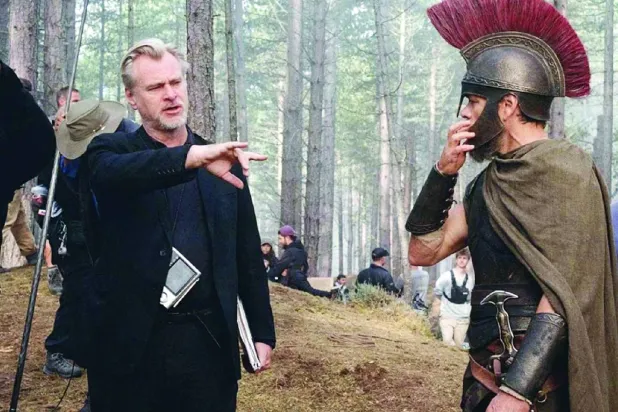
Nolan's films have earned billions of dollars, earning him the trust of Hollywood studios
Today, director Christopher Nolan returns to giant IMAX screens with a new film titled 'Odyssey,' his first since winning 7 Academy Awards 3 years ago for his previous film 'Oppenheimer.' Hollywood is not only releasing his new film, but some theaters are also screening 5 of his previous films, in an event aimed at boosting the popularity of this director on one hand, and recalling his most prominent works on the other.
The films being shown in parallel are: 'Insomnia' (2002), 'The Dark Knight' (2008), 'Inception' (2010), 'Interstellar' (2014), and 'Dunkirk' (2017).
Matt Damon and Zendaya in a scene from 'Odyssey' (Universal)
The legendary epic
'Odyssey' is the first film in Nolan's career that belongs to cinema dealing with ancient history wars. It is based on the epic 'The Odyssey' by the Greek poet Homer, consisting of 24 books (or chants), who is also the author of the other famous epic 'The Iliad,' along with other works that did not receive the same attention. The mystery surrounds not only the time and place of composition of these two epics but also the life of Homer himself.
Nolan's film does not delve into Homer's life, nor does it recount all the events of the epic 'The Odyssey'; instead, it merely presents Odysseus's (Matt Damon) journey returning from Troy 10 years after its fall, along with key characters such as his wife Penelope (Anne Hathaway), his son Telemachus (Tom Holland), his memoir publisher Antinous (Robert Pattinson), as well as other figures including Athena (Zendaya), Calypso (Charlize Theron), and Helen of Troy (Lupita Nyong'o).
The subject itself is vast, but its events, characters, and wars are even more expansive and intricate. Those who know Nolan understand that he does not deliver a film that is smaller or less ambitious than the material it is based on, which is reflected in the film's budget of $250 million, borne by Universal, along with an extensive promotional campaign that began months ago and is still ongoing.
From Nolan's film 'The Dark Knight' (Warner)
Technical details
Ambition and uniqueness are hallmarks of this director's career, encapsulating his passion for cinema since he picked up a Super 8 camera at the age of eight.
At the turn of the 21st century, Christopher Nolan was still an unknown name. He completed his short film 'Doodlebug' in 1997, then presented his first feature-length film 'Following' in 1998. Afterwards, he moved to the United States driven by his cinematic vision and ambition, as if a star guided him along the path he should take. There, in Hollywood, he made his notable film 'Memento' (2000), which marked a turning point in his career.
The film's success led to 'Insomnia' (2002), before Warner Bros. bet on him in 2005, tasking him with directing 'Batman Begins' with a large budget and extensive creative freedom. The result was one of the best films to explore the Batman character, alongside Tim Burton's 1989 version, and paved the way for a trilogy considered among the most prominent in superhero cinema. Since then, Nolan has continued to make films he believed in, becoming one of the world's leading film directors today.
His journey to Hollywood carried within it an ambition to make big cinema. He realized that British cinema did not allow productions of this scale, and he did not want to spend his time on limited-budget experiments. This passion also reflected in his constant attention to filming techniques, especially the camera systems he uses. He started filming his movies on 35mm film, then later moved to using IMAX cameras and 65mm Kodak film, starting with 'Dunkirk' (2017). In his new film, he uses an advanced camera that combines IMAX technology with 65mm film, with the capability for 70mm projection, a format famous for major historical and epic films during the 1960s and 1970s.
Intellectual and visual space
Beyond techniques, we find that the common features of his films match his visual achievements. He is a director who does not merely tell an exciting story in itself, but engages with its deep and meaningful content. He invites viewers of each of his films to think about what they see, not just follow it. This is a difficult challenge. Many have preceded him in this, but many have failed.
'Memento,' as the beginning, is more than just a story of a man searching for his wife's murderer. The protagonist suffers from memory loss, forcing him to devise alternative means to achieve his goal. In response, Nolan adopts a non-traditional narrative style: starting with the end then sequentially returning to the beginning.
'Insomnia' is a police film based on psychological drama, starring Al Pacino in one of his best performances of this century. The detective arrives in Alaska to investigate a murder, undergoing psychological crises and moral conflicts that shake his convictions.
In the 'Batman' trilogy ('Batman Begins' 2005, 'The Dark Knight' 2008, 'The Dark Knight Rises' 2012), Nolan does not merely present the character as a dark knight standing at the same distance from the law and his enemies, but redefines him within a realistic framework different from most previous Batman films and the majority of superhero cinema, in terms of character depth and realistic treatment. Yes, Nolan's Batman films remain exciting and heroic, but they are far from cartoonish or devoid of thought-provoking content as a condition for completing the visual pleasure.
Nolan is distinguished as a director who chooses his projects carefully, aiming to turn each film into a broad intellectual and visual space. The diversity of topics he addresses is as important as his style in handling them; he moves from the police film in 'Insomnia,' to suspense in 'Inception,' from science fiction in 'Interstellar,' to war film in 'Dunkirk,' then to biographical drama in 'Oppenheimer,' before arriving today at the world of historical epics with 'Odyssey.'
This new film is not without risk; its huge budget requires it to earn revenues many times its budget before entering the profit zone. But Nolan bets on a broad fan base that has followed him throughout his career, and also relies on attracting fans of historical epics, based on his unparalleled visual style. Additionally, his films have earned billions of dollars at the box office, which has earned him the trust of Hollywood studios, which no longer hesitate to finance his most ambitious and costly projects.
Original source: Asharq Al-Awsat






Comments (0)
Be the first to comment.