Figures Standing on the Line Between an Ancient Temple and a Metro Station
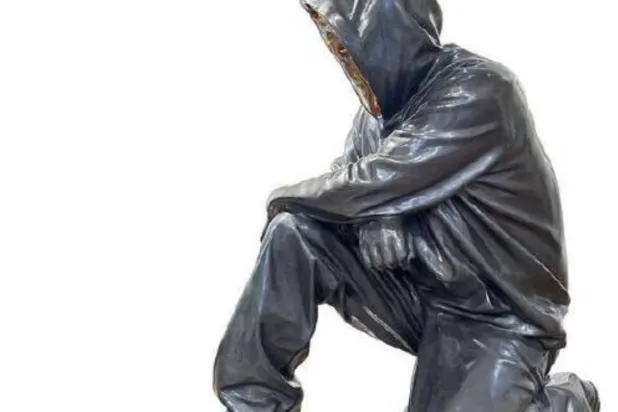
There are exhibitions that make you feel as if you are in front of a different kind of art. Rather, it's a youthful art. This is the case with Chinese sculptor Huang Yulong and his exhibition currently held in Paris. And I don't know where we got the idea that artistic innovation comes from London and New York. Even Paris and Tokyo are no longer in the competition. But China, that distant, closed country, has opened its gates and begun to conquer the world in various fields, at an amazing speed.
Huang Yulong is a contemporary Chinese sculptor born in 1983 in Anhui Province. He belongs to the post-80s generation, meaning the generation that grew up while the country was rapidly opening up to the world and to Western cultures. He studied sculpture at the Jingdezhen Institute, famous for ceramic art, and graduated in 2007. He then began to build his own style that made him one of the most distinctive contemporary Chinese sculptors.
Huang Yulong is interested in questions of identity, culture, youth, and the relationship between East and West (images from the artist's website).
His sculptures share a general similarity in form. They can be summarized as the figures of today's youth who go out for strolls, work, and attend parties wearing the hooded sports jacket with a cotton hood covering the head. It's the look that pleases teenagers but worries police officers. When a young person pulls down their cap over their head and puts their hands in their pockets, it becomes difficult for surveillance cameras to recognize them. Everyone looks alike without distinction, except for the color of the suit.
It can be said that Huang Yulong is the Chinese sculptor who transformed the 'hoodie,' that ordinary piece of youth clothing with drooping head coverings, into a philosophical symbol that encapsulates the struggle of identity in contemporary China. Perhaps this challenge brings to mind how denim jeans, in previous periods, became a symbol of American youth and modern ideas.
What immediately catches the eye in the works of the Chinese sculptor is that the faces of the figures wearing the jackets are often hidden or non-existent. The viewer does not see features but feels the character. For the artist, identity is not just a face but an attitude, presence, and a whole culture. Hence, the hoodie became his artistic signature, recognized in international exhibitions.
Many of his characters are without clear features (images from the artist's website).
Huang Yulong grew up during a time when rap music and hip-hop culture were beginning to infiltrate Chinese cities. He did not treat them as a passing Western fashion but as part of his personal formation. Therefore, we hear him say on more than one occasion that for him, hip-hop is not just music but a lifestyle that carries ideas of freedom, energy, rebellion, and self-expression. Thus, his works blend ancient Chinese spiritual symbols and modern urban culture.
It is no surprise that among his most famous works are Buddhist statues or meditative figures wearing modern street clothes. At first glance, it seems shocking: how can Buddha meet hip-hop? But this paradox is the essence of his artistic project. He attempts to say that contemporary man carries within himself both the past and the present, and that traditions do not disappear but reshape themselves in new forms.
For the artist, identity is not just a face but an attitude, presence, and a whole culture (images from the artist's website).
Technically, his work is not limited to bronze. He uses traditional Chinese ceramics, steel, crystal, and sometimes wood. Of course, these materials are not chosen randomly. Ceramics connect him to ancient Chinese heritage, while metals give his works a contemporary urban character.
There is another important point in his works: the absence of the face. Many of his characters are without clear features. Certainly, this absence is not a deficiency but intentional. The artist wants the viewer to see themselves within the artwork. When individual features disappear, the character becomes a symbol of an entire generation living between two cultures and two worlds.
Artistically, Huang Yulong can be placed within the contemporary Chinese art movement that emerged after the economic boom of that rising Asian tiger. However, he differs from other Chinese names that are more engaged with politics. He is more concerned with questions of identity, culture, youth, and the relationship between East and West. Also, his works are less politically noisy and more preoccupied with the social and psychological transformations experienced by his generation.
Today, he is a globally recognized artist. His works have been exhibited in China, Hong Kong, France, the United States, and other countries. Complex magazine selected him among contemporary Chinese artists to follow. The French got to know him through a solo exhibition held in Paris three years ago titled 'Bronze to Beats.'
At that time, critics saw his works as an accurate portrait of an entire Chinese generation—a generation raised on Eastern teachings but listened to American rap. They preserved ancient traditions while wearing the usual attire of youth in Stockholm or Cairo. Hence, his sculptures always seem to stand on the line between an ancient temple and a modern metro station.
Original source: Asharq Al-Awsat



Comments (0)
Be the first to comment.