How Open Spaces and Tourist Destinations Reshaped Wedding Fashion?
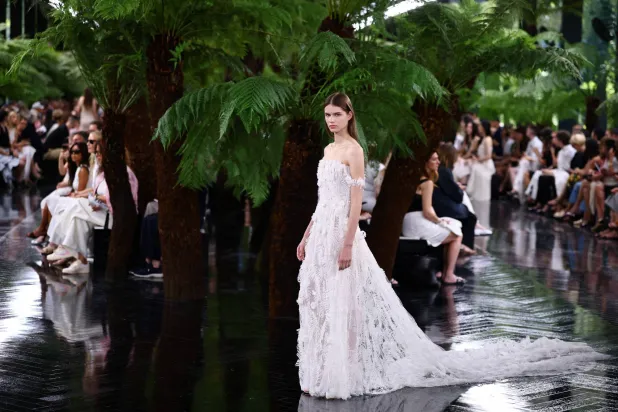
The change in wedding designs did not come solely from designers' decisions, but because weddings themselves changed, after moving outdoors.
Paris recently hosted Haute Couture Week. The event coincided with news of singer Taylor Swift's wedding in a ceremony from which no photo has leaked so far. Details of her dress remain shrouded in secrecy. All that has been revealed is that it was designed by Jonathan Anderson, creative director of Dior.
A few weeks earlier, singer Dua Lipa's wedding took place, where she revealed images of a dress specially designed for her by Matthieu Blazy, embodying all the craftsmanship and magic of Chanel. It was handmade at 31 Rue Cambon in Paris, with contributions from its specialized ateliers, such as Lesage, Lemarié, and Montex.
And so, between a dress we have not yet seen and a dress that set social media ablaze, we not only grasped the true meaning of the craftsmanship associated with Haute Couture season, producing pieces that embody their owner's story, but it also reminded us that dreams turn into reality there, and diverse tastes and cultures coexist. Taylor Swift is known for her classic fashion choices, so her wedding dress was expected to be a princess design, while designer Jonathan Anderson tends to be more experimental. This contrast between them increased curiosity and speculation about the dress, and reaffirmed that this high-end line unites tastes at one point: the appreciation of craftsmanship and the desire for uniqueness.
From the Runway to Execution
The wedding dress proposed by Rami Al Ali with a train extending several meters (AFP)
However, the story of Haute Couture with weddings and important occasions is not limited to celebrities alone, but extends to every woman looking for a dress that immortalizes the night of her life in memory and photo albums. With this woman, the real journey begins.
After the shows end, models leave the runways, and workers finish dismantling the huge sets, work begins on translating what was presented into reality.
After fashion shows, the real work begins for fashion houses and clients (Tamara Ralph)
Inside the tailoring salons of the major houses, private meetings begin with designers and heads of design departments, during which clients reserve the dresses they like. They add their personal touches, whether by choosing fabrics and colors or making slight modifications, such as lengthening or shortening sleeves, raising or opening the neckline, according to the needs of each one's environment. Then, initial measurements are taken, and the execution process begins, which may take weeks before the final design reaches its owner.
Immediately after this stage, skilled hands work on executing the pieces in a race against time, to be ready for the start of the wedding and social events season.
‘Elie Saab Bride’ a dress that sums up luxury (Elie Saab)
The Bride's Guests Have Their Share
It is a tradition in Haute Couture shows for each designer to conclude their show with a collection of evening dresses culminating in a princess wedding dress. This focus on evening dresses and the wedding dress indicates that attention is not solely on the bride. A Haute Couture client typically seeks not just one dress, but a complete wardrobe for all members of the bride's family.
From this perspective, it was not surprising that the Lebanese duo George Choueiry and Assaad Assad, founders of ‘Azzie & Assaad’, presented a collection of 16 designs all aimed at the bride's guests, and designer Stephane Rolland presented 33 pieces, most of which are in shades of white. Each piece can suit a bride, her bridesmaid, or her mother, all adaptable according to each one's desire. This is not only about color, but also about their fabrics, from crepe, georgette, and muslin to organza and satin, giving them a lightness where volumes seem to oscillate between strength and softness. The designer points out that embroidery with agate, crystal, mother-of-pearl, and porcelain was not just for decoration, but to imbue the piece with emotion, and in respect of the idea that high fashion was and still is based on major social occasions.
Designer Stephane Rolland's proposals address the bride and every guest who wants distinction (Stephane Rolland)
Since its inception, it has lived at the heart of these occasions, from opera galas, costume parties, and aristocratic seasons, to red carpet events, where stars began appearing in white dresses, even made of lace, evoking a bridal image without their looks seeming discordant or contradictory to conventions.
This is thanks to social, cultural, and even economic transformations that have been reflected in wedding dresses. A high percentage of brides nowadays do not want to spend large sums on a lavish, voluminous dress that they will only wear for one night and then store away. Instead, they prefer a design they can use for other occasions. Thus, snowy white has begun to recede in favor of other shades like golden beige, light pink, and even diamond gray, while structured designs have softened their stiffness and formality to become more flowing and comfortable. Over time, wedding dresses started to approach evening dresses, until the boundary between them became less clear, and evening dresses became a legitimate option for brides who do not wish to adhere to the traditional mold.
Designs for all seasons and places from Armani Privé and Dior
Destination Weddings
Neither has Haute Couture completely abandoned the traditional wedding dress, nor have women rejected it, but the concept of the occasion itself has changed with the changing venues of wedding celebrations. Weddings held in homes, palaces, hotel halls, and social clubs may allow wearing lavish dresses full of embroidery, wide skirts, and trains that extend for tens of meters. However, with an increasing number of couples aiming to make the night of their lives an integrated experience beyond the traditional celebration, dreamy destinations and stunning natural landscapes have become part of the experience, imposing on designs lighter materials, more flowing cuts, and more practical shoes, without sacrificing elegance and uniqueness.
From Elie Saab's proposals... evening dresses adaptable for all occasions (Elie Saab)
This shift began in the West in the late 1990s and early 2000s with the rise of what is known as the ‘destination wedding’, where guests travel to a city, island, or resort chosen by the couple specifically for the occasion. Then social media came to accelerate this shift at a tremendous pace, as the importance of the wedding was no longer limited to the event itself, but extended to the image it would leave behind, making the location as important as the dress.
The situation was no different in the Arab world. Although five-star hotels and grand halls have not lost their traditional status in hosting wedding parties, that has not prevented the emergence of new destinations, such as beaches in Dubai, coastal resorts in Oman, and El Gouna and the North Coast in Egypt. It was natural for the dress and accessories to become more harmonious with the place as much as with the occasion. Parisian designers have not forgotten that the Arab client has been a major supporter of Haute Couture since the 1970s, and thus they must take her into consideration, by getting closer to her needs, such as the French designer Alexis Mabille, who presented modest looks that require little modification to suit Arab women, whether brides or guests. He covered the models' hair and made the dress ready to adapt to the requirements of a different culture.
Original source: Asharq Al-Awsat


Comments (0)
Be the first to comment.