Hurvin Anderson Excavates Caribbean Memory with a Brush
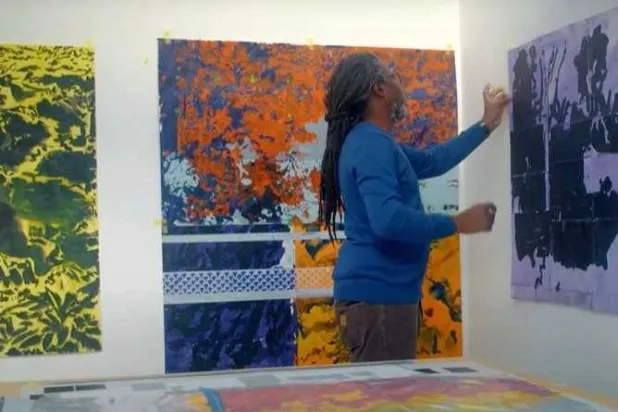
It is not an exciting idea for an artist to keep painting a barbershop as an aesthetic inspiration for fifteen years. Nor is it expected that the paintings from that period would be stunning and of high artistic value. But the experience of Hurvin Anderson, born in 1965 in Birmingham, England, to a family of Jamaican immigrants, dispels those doubts by shifting that place from its realistic location to create a world stripped of its practical purposes, serving as a stage reimagined to explore different painting styles. Through these, the artist moves between figuration and abstraction, strongly driven toward traditional subjects such as still life, landscapes, and portraits. Since 2006, Anderson has painted dozens of works depicting the barbershop; he even held an exhibition titled 'Salon Paintings,' using that ordinary scene as a means to excavate Caribbean memory in search of identity elements that could serve as a criterion for national belonging.
Anderson embarked on this series from an experience he had in childhood that accompanied him as an indicator of difference in identity and belonging. Because white barbers in Britain were reluctant to cut black hair, Caribbean immigrants in the 1950s and 1960s would cut each other's hair at home. That led him to view the temporary barbershop his father frequented as a space that brought him back to his true home, located far away. It would be a mistake to view the paintings from that foundational period in the artist's experience—who was nominated for the Turner Prize in 2017—as merely descriptive. The restless and unstable aesthetic reveals the artist's inclination to join that world as a customer, but as a customer whose presence there marks his difference. The barbershop returns him home, a home that may be imagined but could also be real there, in Jamaica.
A fictional world dwelling on two shores. The exhibition at Tate Britain features over 80 paintings by Hurvin Anderson, resembling a retrospective covering his entire career, from his student days to new works never shown before. In the exhibition, Anderson reveals his deep engagement with the British landscape painting tradition. However, that does not conflict with his evocation of images of his family, experiences from his youth, and places of personal and cultural significance, such as the barbershop. By revisiting certain elements and sometimes merging one location with another, Anderson addresses the unreliability of memory and the tension surrounding cultural heritage.
In one way or another, art critics attribute an abstract quality to Anderson's paintings. In several works, he painted the barbershop without customers, making it appear as if he had painted a still life. The mirrors evoke an imaginary world, a world rich in color. For the artist, that world creates a space linking belonging to diaspora. 'I was born here as if I was born there.' Between Britain and the Caribbean, there is a tense aesthetic distance that simultaneously tolerates incompatibility. That distance can be verified abstractly. Hurvin Anderson paints with the strength of his belonging to two places; each teaches him a different language. It might seem a ready-made judgment to say that the artist, whose works have been sold at auctions for millions of pounds for over a decade, distributes his attention through his themes between belonging and diaspora. That is a quick and premature judgment that does not capture the spirit of the artistic experience.
True, Anderson was born in Britain, and true, his painting style is connected to British painting traditions; in several works, he stands close to the experience of the late artist David Hockney, for example. But it is also true that his art raises tense existential questions that concern not only the identity of place but also the identity of people who think in one language and dream in another—an identity whose solid reality does not prevent the presence of mythical specters within it.
That ball is a moon fallen from the sky. 'His paintings usually focus on a particular mood, a specific time of day, a certain angle, or a specific house. But the thought of another place always remains present,' says critic Hais Mamoor. That means a symbolic character penetrates Anderson's paintings from within, as if a voice is heard in another language to expand the boundaries of visual experience. What you see directly is not the whole truth. There are submerged truths that can only be reached through contemplation filled with questions.
In his painting 'Ball Watch' from 1997, a group of boys stands on a grassy patch by a lake. The sky is hazy blue, and the water is vibrant turquoise. The green below them, as they turn their backs to the viewer, contrasts with the dark gravel behind them, isolating them in what resembles their own tropical island. That is a scene Anderson would return to in other paintings more than ten years later, in an attempt to transform a photograph he took in 1983 in the neglected Handsworth Park in Birmingham into an emotionally charged vision of his hometown and the Caribbean, his family's original homeland. In one of those paintings from 2010, the artist revisits the same scene, but this time Caribbean trees dominate the horizon, their usual brilliance muted by shades of gray. Here, the artist proposes a difficult but psychologically plausible equation: seeing one place while one's imagination goes elsewhere.
Anderson comments on that experience: 'Because of the ball's position in the middle of the picture, in the middle of the pond, it looked like the moon had fallen from the sky.' The artist does not stray far from the concept of the image as a mental game. What the direct eye does not see, memory stores to be reproduced at later times. Simply put, Hurvin Anderson moves lightly between the shores of the Atlantic and the Caribbean. That is what he excels at.
"); googletag.cmd.push(function() { onDvtagReady(function () { googletag.display('div-gpt-ad-3341368-4'); }); }); }
Original source: Asharq Al-Awsat



Comments (0)
Be the first to comment.