Jokha Mohammed Al-Harthi.. Harvesting Global Literary Awards
Perhaps many outside the Sultanate of Oman had not heard the name 'Jokha Al-Harthi' before 2019, but her name became synonymous with narrative creativity in the Gulf region, reflecting the cultural developments witnessed in the region. In fact, this young Omani woman became the focus of attention of Arab and foreign media and international publishing houses as soon as the announcement of her winning that year's International Booker Prize for her novel 'Sayyidat al-Qamar' (Ladies of the Moon) in collaboration with American academic Marilyn Booth, who translated the novel from Arabic into English under the title 'Celestial Bodies'. Especially that...
Jokha Mohammed Al-Harthi.. Harvesting Global Literary Awards
6 July 2026 - 00:17 | Last update 6 July 2026 - 00:17
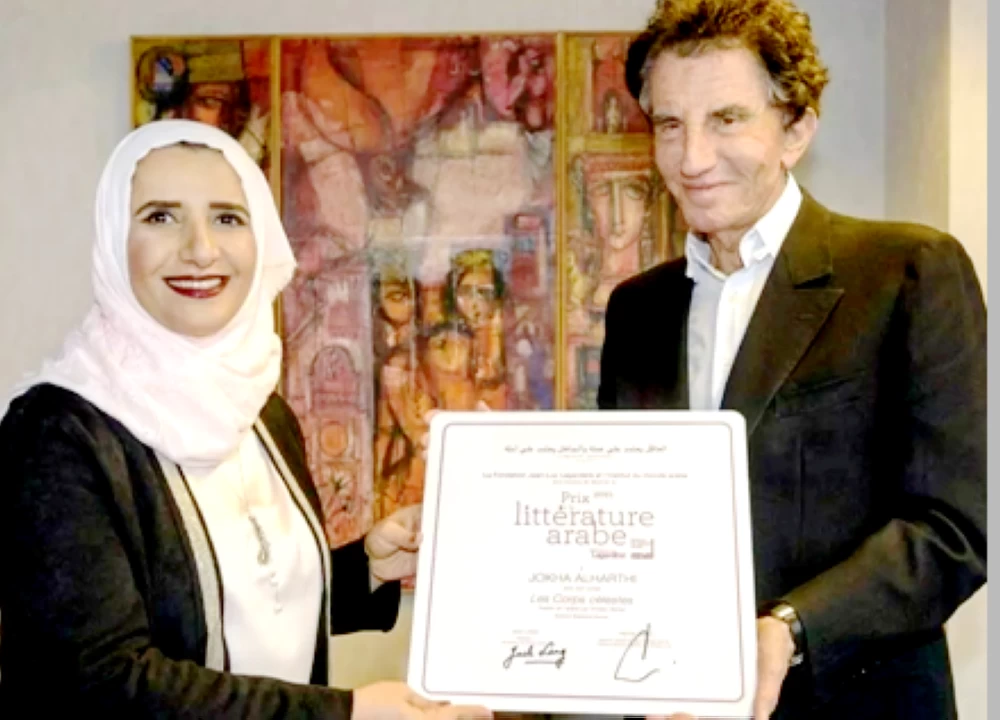
Al-Harthi receives the Arabic Literature Award from the President of the Arab World Institute in Paris.
Al-Harthi with American writer Marilyn Booth, who translated her award-winning novel.
Jokha with Omani journalist Sulaiman Al-Maamari, who interviewed her in 2021.
Jokha in a discussion session at the Beirut International Book Fair in May 2025.
Jokha signing one of her publications.
--:--
Follow Okaz channel on WhatsApp
By Dr. Abdullah Al-Madani abu_taymour@
Perhaps many outside the Sultanate of Oman had not heard the name 'Jokha Al-Harthi' before 2019, but her name became synonymous with narrative creativity in the Gulf region, reflecting the cultural developments witnessed in the region. In fact, this young Omani woman became the focus of attention of Arab and foreign media and international publishing houses as soon as the announcement of her winning that year's International Booker Prize for her novel 'Sayyidat al-Qamar' (Ladies of the Moon) in collaboration with American academic Marilyn Booth, who translated the novel from Arabic into English under the title 'Celestial Bodies'. Especially since Jokha managed to defeat big names included in the final shortlist, such as Polish writer Olga Tokarczuk, who won the Nobel Prize for Literature in 2019, and French writer Annie Ernaux, who won the Nobel Prize for Literature in 2022. In the grounds for awarding the prize to 'Sayyidat al-Qamar', the International Booker Prize jury said it is a novel that 'challenges stereotypes of the East'. This was also the consensus of those who wrote articles about her in European newspapers; all of them said, in effect, that their perception of the East was completely different and that the novel succeeded in changing their ideas about this stereotypical East.
The novel quickly became a bestseller in the United States, Australia, India, Canada, and Britain. In fact, foreign publishing houses competed to purchase translation rights, and it was republished in twenty-four languages, including: French, German, Italian, Spanish, Catalan, Russian, Chinese, Swedish, Turkish, Azerbaijani, Portuguese, Bulgarian, Hungarian, Serbian, Croatian, Greek, Korean, Indonesian, Japanese, Hindi, Sinhala, and Persian.
Jokha had expressed her happiness upon learning of her selection for the final shortlist, and told the media that the novel 'Sayyidat al-Qamar' provides a glimpse into the rich life of an Omani family, especially women, through the three sisters (Mya, Asma, and Khawla) who witnessed the period of change and transformation in Omani society since 1970. That period accompanied their growth, and they reaped its fruits manifested in opening up to the world after years of isolation and seclusion, and granting women their right to work, education, production, travel, and holding public and private positions.
Those who read the novel that won that prestigious international award, which made Jokha the first Arab figure to win it, found that some of its contents are merely a reflection of what the author herself experienced. She comes from an Omani family rich in history and traditions, and was born and raised in the era of civilizational transformations led by the late Sultan Qaboos bin Said, which transferred Oman and its people from one state to another. She is one of the Omani women who benefited from the fruits of reform and renaissance; without it, she would not have achieved what she did in terms of higher education, academic and research status, cultural prominence, and successive publications (Jokha has published, throughout her literary career, collections of short stories under the titles: 'Mawāqi' min Sīrat Lubnā idh ān ar-Raḥīl', 'Ṣabiyyun 'alā as-Saṭḥ', and 'Fī Madīḥ al-Ḥubb', then published four novels: 'Manāmāt', 'Sayyidat al-Qamar', 'Nāranjā', and 'Ḥarīr al-Ghazāla'. She also published a number of children's stories, including: 'Ushsh lil-ʿAṣāfīr', 'as-Saḥāba Tatamannā', 'Fūfū wal-Alwān', 'an-Naḥla aṣ-Ṣaghīra', 'Fūfū wal-Ḥayawānāt', 'Fūfū fī al-Mazraʿa', 'Fūfū fī Madīnat al-Malāhī'. In addition to the above, she published academic works bearing the following titles: 'Mulāḥaqat ash-Shumūs, Minhaj at-Ta'līf al-Adabī fī Kitāb Kharīdat al-Qaṣr lil-ʿImād al-Iṣfahānī', 'Jam' wa-Taḥqīq Dīwān Abī al-Ḥakam ash-Shaykh Aḥmad bin ʿAbdullāh al-Ḥārithī', 'al-Jasad fī Shi'r al-Ḥubb al-ʿUdhrī wat-Turāth al-ʿArabī' which Jokha published in English, then its Arabic version was published in 2023 under the title 'al-Jasad fī al-Ghazal al-ʿUdhrī' translated by Zuwaina Al Tuwaijri).
And because the Man Booker launched her name in the spaces of international fiction as a creative from a country whose citizens had never before won such an award, global interest was not limited to her award-winning novel, but extended to her previous works, including the novel 'Nāranjā' which American house 'Catapult' and British house 'Simon & Schuster' translated into English simultaneously in Britain and the United States, which consolidated the literary reputation of Jokha Al-Harthi, especially after major world newspapers such as 'The New York Times', 'The Guardian', and 'The New Yorker' published reports, articles, and praises about this novel, which was published in 2016. In fact, newspapers such as Scotland's 'Herald' and Ireland's 'Breaking News' recommended it to their readers, and magazines such as 'Book Riot' and 'Electric Literature' included it among books to read. As for 'Publisher's Weekly', it described the novel as a wonderful story about nostalgia, adding that it is 'a novel full of indelible images that symbolize aborted freedom, such as a broken kite and a bird torn to pieces'. The British Booksellers Association, which includes 92 independent bookstores, also selected 'Nāranjā' as the Book of the Month for June 2022.
Jokha acknowledged, in her interview with journalist Sulaiman Al-Maamari of the daily 'Oman' newspaper (26/1/2022), that winning the International Booker Prize and the global acclaim it received caused her confusion and put her under heavy pressure. She had to present her next work (the novel 'Ḥarīr al-Ghazāla') at a level no less than 'Sayyidat al-Qamar', and she said: 'I realized that if I succumbed to this pressure, I would not write anything and would fulfill the claim of those who say that prizes are like a death sentence for the writer, and I did not want that to happen to me.'
Jokha Mohammed Khalifa Al-Harthi was born in the village of Al-Qabil in the Wilayat of Al-Qabil in the North Sharqiyah Governorate, about 170 kilometers from Muscat, on July 16, 1978, i.e., 8 years after the political change and reform in her country by the late Sultan Qaboos bin Said. She grew up in an environment different from that of her family: the environment of Omani urbanization, whose most prominent feature was the opening of educational doors at various levels to both sexes of all ages. Because she was intelligent from childhood, her father, who was a governor of several cities, the last of which was the city of Samail, enrolled her in school at the age of five and took care of her academically and cognitively. Jokha recalls that period of her life and says: 'My father believed in the importance of education.' Therefore, she and all her siblings hold or are pursuing advanced degrees. As for her mother, she used to memorize ancient Omani poetry and recite it to her, which made her acquainted with literature and poetry from a young age.
Original source: Okaz

Comments (0)
Be the first to comment.