"Street of Art"... Egypt's bet on elevating public taste
Summary: The Street of Art initiative was launched in Egypt, bringing arts to streets and public spaces to achieve cultural justice. How can these initiatives affect people? And what is the way to make them more effective?
In a step aimed at launching various arts from closed halls to public spaces and reaching audiences in the streets, downtown Cairo is witnessing a new experiment where different artistic performances are presented, a step that many specialists see as positive and effective in creating a relationship and communication between the arts and people by going out to them in open gatherings.
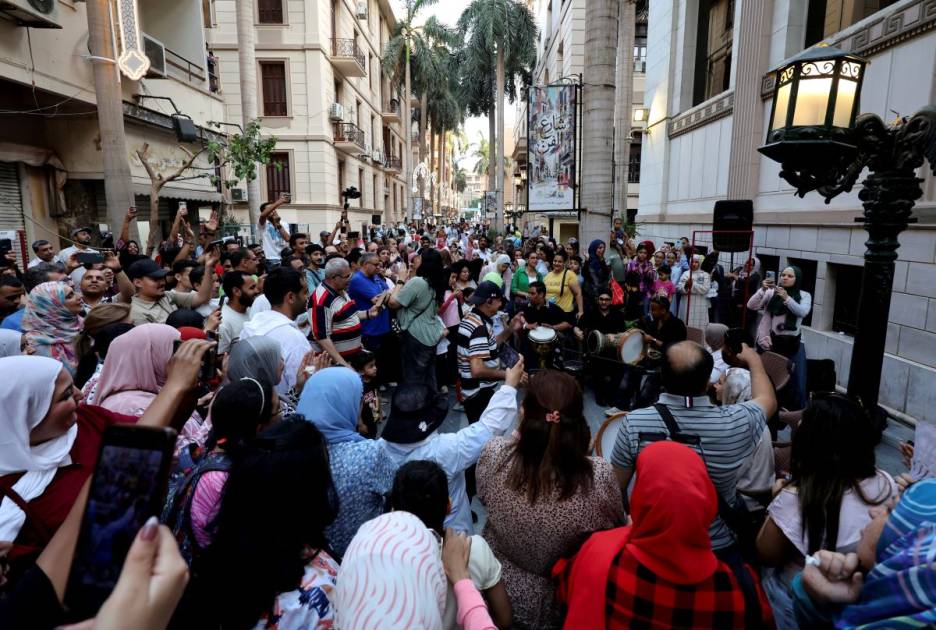
Last May, Egyptian Prime Minister Mostafa Madbouly inaugurated the 'Street of Art' initiative in downtown Cairo, turning it into an open space offering diverse cultural and artistic events every Thursday, Friday, and Saturday of each week, available to all people without any restrictions and completely free of charge, requiring no expenses.
This initiative comes under the supervision of the Academy of Arts, which coordinates with all institutions and bodies wishing to participate, in addition to presenting performances in cooperation with its various institutes, such as world ballet masterpieces featuring scenes from Russian, Italian, and Spanish ballet, and creations of students from specialized institutes such as solo instrumental and individual and group singing segments, as well as distinguished opera singing performances for classical music lovers. Part of the performances focuses on reviving Egyptian identity through shows of various folk arts such as Saidi stick dancing, tanoura, and samsemiah, in addition to puppet and circus shows.
The initiative includes participation from multiple entities, including the Syndicate of Plastic Artists and private and civil artistic institutions and entities interested in the arts, in addition to allowing participation by any independent artist, whether presenting his own show such as singing, playing instruments, or various visual arts, or wishing to hold a workshop for the public in the street for children or adults.
In a press statement accompanying the launch of the initiative, the head of the Academy of Arts at the Ministry of Culture, Nabila Hassan, affirmed that the Street of Art initiative aims to revive artistic life in Egyptian streets and create a direct space for communication between the artist and the public. She indicated that the initiative comes within the framework of the Academy's approach to transfer arts from closed halls to public spaces, and to make cultural and artistic activities available to all segments of the public through a diverse program combining heritage and contemporary arts, allowing citizens to interact with all types of creativity.
Street of Art events are held in several governorates in cooperation with the General Authority for Culture Palaces (Reuters)
After several weeks and with the public turnout in Cairo, the initiative was expanded and the Street of Art was held in several governorates in cooperation with the General Authority for Culture Palaces. Five governorates—Alexandria, Ismailia, Kafr El Sheikh, Beni Suef, and Aswan—witnessed events of the Street of Art initiative through artistic and cultural programs tailored to the specificity of each governorate.
For example, the events on Nabi Daniel Street in the heart of Alexandria saw a large turnout from the city's residents and visitors, and wide participation from Alexandrian artists in all fields. The same approach was followed in the other governorates with the participation of their local artists.
The Street of Art initiative is not the first of its kind regarding bringing arts to people in streets and gathering centers recently in Egypt. It was preceded some time ago by another initiative to present various artistic performances in Cairo metro stations, which received great interaction and achieved notable success.
Do street performances change public taste?
In the long term, and with the continuation of such initiatives, they are supposed to have a return and impact on the masses. For this reason, many artists and intellectuals encouraged them. So how can these initiatives affect people, and what is the way to make them more effective?
According to Professor at the Faculty of Fine Arts - Alexandria University and member of the Supreme Council of Culture, artist Saeed Badr, 'These initiatives are of great importance. An ordinary street person while passing through the area can stop to watch the shows and events, in addition to people who will hear about this event and go to watch it, especially since it is completely free and requires no expenses. This has a great impact. Art nourishes the soul, whether visual or auditory, and improves mental and sensory perception that all types of arts develop. These events reshape people's reception of arts and their awareness of their importance, starting from interest in having high-level artworks in streets and squares such as statues and murals that elevate public taste and make art part of people's culture, passing through such initiatives that seek to reach an audience that may not have arts in their interests.'
Badr suggests that 'these initiatives will later push people, after enjoying these arts, to go to a music concert, theater, or visit an art exhibition, which represents the best impact they can have. These events have a significant impact, especially given the current lack of interest in arts in schools, whether music, drawing, etc. Thus, children grow up thinking these things are secondary and unimportant, with priority given to other academic subjects. Unfortunately, this results in the loss of many talents because there was no opportunity to discover them in the first place, in addition to the absence of artistic sense and ability to appreciate different arts among many people.'
Presenting shows that intersect with the audience's identity and popular culture achieves double success (Reuters)
He points out that 'initiatives like the Street of Art make all kinds of art reach people in the street. They do not need to go to a theater, exhibition, or any place; people see them by chance in the streets, and they become part of their daily lives. Establishing the Street of Art in different governorates is very important because cultural events are always concentrated in Cairo and major governorates, while many areas are already deprived of any cultural activity, and this undoubtedly has a negative impact on people.'
Also, Edmond Boutros, head of the 'Art Egypt' foundation, which organizes and coordinates the 'Street of Art' initiative, says, 'Visitors to art halls, no matter how many they are, are ultimately limited and interested in such types of arts. But the audience of an event like the Street of Art is in the thousands daily. It is a great opportunity for every artist to reach this number of audiences. We presented the show in an attractive way for the public and ensured the presence of all artistic schools to suit all tastes and to expose the non-specialist public to diverse schools. The plastic arts exhibitions saw great turnout and notably attracted street passersby, and this is a great success.'
Read more
Cairo Metro... A daily journey to the rhythm of art and heritage
The Clown... Acrobat of laughter and horror
Monasticism... A spiritual journey from isolation to unity
Original source: Independent Arabia



Comments (0)
Be the first to comment.