Advisor to the Assistant Minister of Health: Eastern Province and Jazan Lead in Hereditary Blood Diseases
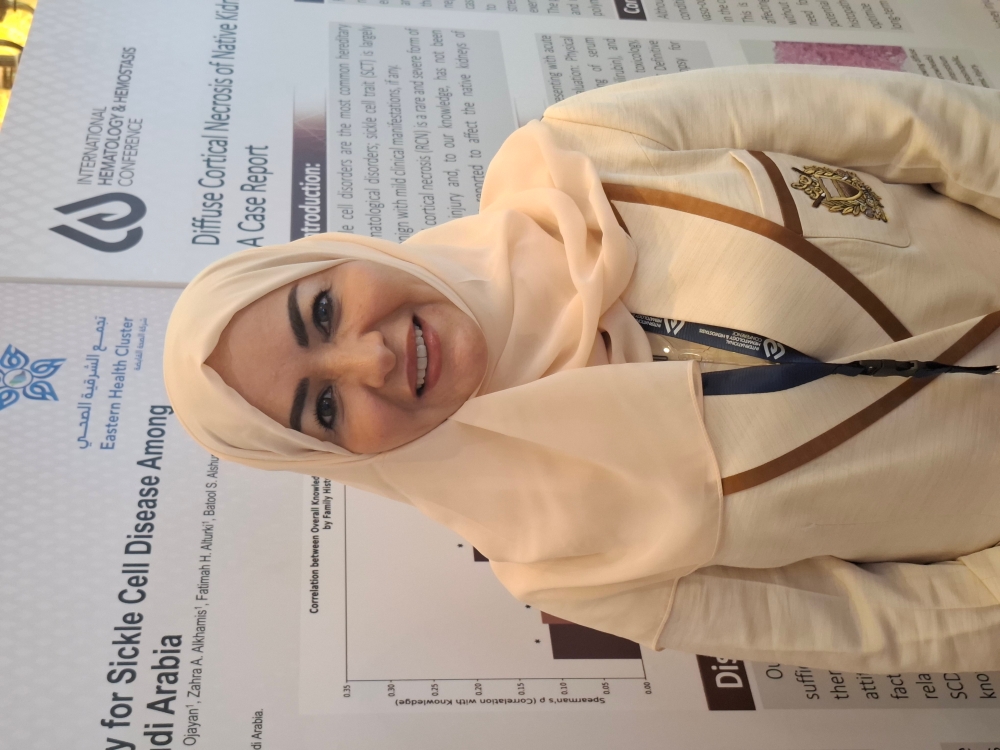
The General Supervisor of Blood Disease Services at the Ministry of Health and Advisor to the Assistant Minister of Health for Health Services, Prof. Dr. Hatun Muhammad Izzat, revealed the Kingdom's readiness to launch the third phase of the National Registry for Hereditary Blood Diseases, integrating artificial intelligence technologies to enhance the quality of health data, improve diagnostic accuracy, and support health service planning.
Dr. Hatun Izzat
In her interview with Al-Yaum, she affirmed that the national registry has, for the first time, drawn an accurate map of the spread of hereditary blood diseases in the Kingdom, revealing that the regions of Jazan and the Eastern Province have the highest infection rates, while the data showed notable rates in Makkah, Jeddah, and Al-Qunfudhah, in addition to changes in geographic distribution due to patient migration to major cities.
Related News
First, what are the most prominent hereditary blood diseases spreading in the Kingdom? Hereditary blood diseases are among the most significant health challenges, with sickle cell disease at the forefront, along with thalassemia and hemophilia. Sickle cell disease results from a genetic defect that alters the shape of red blood cells, leading to their breakdown and blockage of blood vessels, causing complications such as acute pain episodes, chest problems, and strokes.
What are the most notable developments in early detection? One of the most important achievements is the inclusion of sickle cell disease screening in the newborn screening program since March 2023, where about one million newborns have been screened. The results showed the importance of early detection in identifying cases and providing timely therapeutic intervention, which in itself reflects the utmost importance of early detection in containing the disease and providing proactive care for the child.
What about the National Registry for Hereditary Blood Diseases? The national registry was launched in 2019 and today includes tens of thousands of patients. It is considered one of the largest specialized national registries globally, providing an accurate database that helps in planning health services, measuring treatment needs, and supporting decision-makers.
We are currently working on launching the third phase, which will witness broader integration of artificial intelligence technologies, enhancing data quality, increasing analysis efficiency, and contributing to health decision support and strategic planning, in addition to improving diagnostic accuracy and faster monitoring of health indicators.
Has the registry helped you understand the geographic distribution of patients within the Kingdom? Absolutely, the national registry has provided for the first time an accurate picture and a clear map of the disease spread in terms of patient numbers and geographic distribution. The data revealed that Jazan and the Eastern Province are among the most affected regions by hereditary blood diseases, followed by Al-Ahsa Governorate and Makkah Region. Among the most notable outputs of the registry is also the detection of significant rates in areas that were not previously observed or apparent with the same accuracy, such as Makkah, Jeddah, and Al-Qunfudhah. Additionally, we have observed changes in geographic distribution due to patient migration to major cities like Riyadh for work or study.
Has this been reflected in the development of services? Certainly, this data helps direct preventive and therapeutic services to the most needy areas, and supports more efficient distribution of health resources, which directly reflects on the quality of care provided to patients.
The year 2024 witnessed an important development in treatment. What was achieved? Treatment options previously focused on reducing and controlling complications using drugs such as Hydroxyurea, but 2024 saw a significant medical development with our approval of 'gene editing technology,' an advanced technique that allows treating the patient's cells and returning them after genetic modification.
And I am pleased to inform you through Al-Yaum that the Kingdom has achieved a global milestone by performing the first cases of gene editing for thalassemia and sickle cell disease patients. The results over the past period have been very promising, opening broad horizons toward more effective and definitive treatments in the future.
You recently launched an initiative called 'Mahaja.' What are its details and how does it serve patients? The 'Mahaja' initiative was launched in 2024 as an integrated health alliance bringing together various sectors with the Ministry of Health to unify efforts and enhance the quality of life for patients with hereditary blood diseases. The initiative is based on two tracks: (technical connection, which links patients to the national registry, and the comprehensive program, which implements a 90-day program covering nutritional, preventive (including vaccinations), physical, and psychological aspects).
Moreover, 'Mahaja' has strengthened the Kingdom's international presence by signing memoranda of understanding with prominent global organizations, most notably the World Federation of Hemophilia and the Thalassaemia International Federation, to exchange expertise and enhance international coordination.
You mentioned that Jazan region has become a 'national model to be emulated.' How was that achieved? Indeed, the Jazan region experience is an inspiring success story. After the registry data helped identify the region as the most affected, we presented the 'Mahaja' initiative there, and we witnessed immediate and direct interaction from His Highness the Emir of the region, who promptly issued a decision to form a specialized committee for hereditary blood diseases to accelerate institutional work. This effort was recently crowned by laying the foundation stone for the first specialized center of its kind for hereditary blood diseases in the Kingdom.
What about the premarital screening program? Has it achieved its goals in reducing these diseases? The premarital screening program was launched in 2004 and has played a pivotal role in reducing the spread of hereditary diseases. More than 6 million prospective spouses have been screened in the Kingdom. The program has undergone significant developments, including: (improving the quality of medical consultations, training health personnel to provide professional awareness, and clearly classifying results into 'compatible' and 'incompatible' based on genetic risks).
We are currently working on an advanced step consisting of linking 'premarital screening' with 'newborn screening' to study cases that continue with marriage and childbearing despite medical warnings, which will help us improve future awareness tools.
What is your message to patients and their families? My direct message to them is: the barrier of shame and social stigma must be broken. I urge them to engage with specialized health associations and register in national initiatives. The development of health services cannot happen without the participation of patients themselves; therefore, the Ministry of Health is currently moving toward working integratively with non-profit organizations to reach patients directly.
The Kingdom has achieved advanced accomplishments, including developing one of the largest national registries globally, implementing early screening programs, and introducing gene editing as a treatment option, all according to an approach focused on 'sustainability' to ensure the continuity of services.
Finally, I say to every patient: 'We adopt a participatory approach that places the patient at the heart of the health system. We are here to listen, and through collaboration with patients, we will be able to develop services and improve quality of life.'
Original source: Al-Yaum




Comments (0)
Be the first to comment.