Dining out in the Arab world... sometimes a recipe for disaster
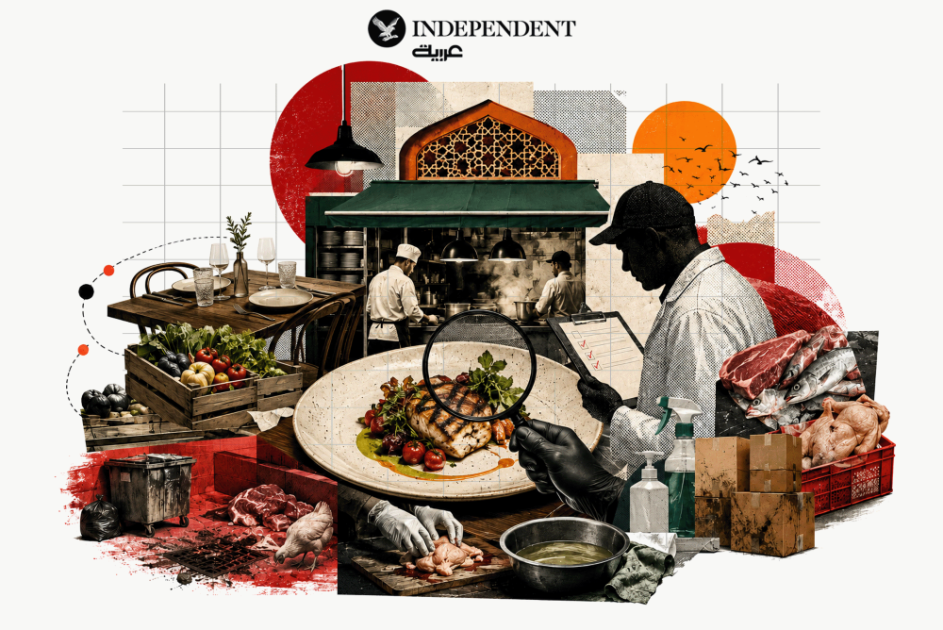
Food safety in the Arab world faces serious challenges, ranging from corruption and regulatory overlap to the proliferation of unregulated street food vendors, leaving consumers at risk of severe health consequences.
When a restaurant meal ends in a night or two of intensive care, when paper egg cartons are passed off as "hawawshi," when the meat of dogs, cats, or donkeys finds its way into delicious grilled kofta, or when a customer consumes moldy, bacteria-ridden vegetables digested with a cup of juice laced with titanium, one must realize food safety is in peril. When a restaurant owner balances their electricity bill against a customer's health and chooses the former, leaving the customer to end up in the emergency room, the toxicology department, or their final resting place, it means eating out may require life insurance or far better oversight of kitchens, staff, and ingredients.
Independent Arabia's tours of restaurants in Arab cities and villages have revealed striking similarities. Shawarma is no longer just those mouth-watering slices of meat or poultry with wonderful garlic sauce; it has become a potentially explosive roll, where every diner relies on luck. Laws are abundant, texts are rich, and legislative visions are sharp, yet corruption stands in their way. Bribery can soften hearts, minds, and violation books, while circumventing regulations remains dominant. Survival—for the individual, the restaurant, and the business—has become the sector's guiding principle.
Even in countries that have made significant progress in regulating restaurants and ensuring food safety, small and micro-enterprises—such as meals prepared in home kitchens or food sold by those seeking an escape from unemployment via carts that disappear during surprise inspections—bring food safety back to square one.
Amidst these risks and gambles, food safety in most Arab countries remains caught between a massive number of inspection agencies, oversight bodies, and ministries, to the point where the plight of a food poisoning victim is often lost in overlapping jurisdictions, denied responsibility, or dismissed under the perpetual excuse of the "need to make a living."
Egypt... The secret is in the seasoning
Food safety—or rather, its failure—is a system caught between two extremes in Egypt: first, an increase in public awareness alongside government efforts to monitor and hold accountable "as much as possible"; and second, a combination of economic hardships that drive some to consume food of unknown origin or participate in its sale. This is coupled with a complete disconnect between the pervasive religiosity of society and the pragmatic, strictly commercial view of food quality held by many restaurant owners and suppliers. This is compounded by the lingering negative effects of an era where regulatory responsibilities were scattered across the ministries of health, supply, agriculture, industry, and religious authorities.
Karim, his wife, and their three children suffered food poisoning a few weeks ago. The previous day, they had breakfast at a famous ful and falafel restaurant in Heliopolis, had shawarma sandwiches for lunch from a branch of a well-known chain in Mohandessin, ate rice pudding and ice cream from a nearby shop, and stopped for tea, coffee, and cappuccino from a roadside mobile cart.
Karim's feverish desire to trace the source of the poisoning was thwarted by the multitude of food sources, making it nearly impossible to identify which meal or drink was the culprit. His efforts were further aborted by the difficulty of finding a responsible authority to report the incident to.
Between the Central Administration for Food Inspection at the Ministry of Health, the Consumer Protection Agency, the Ministry of Supply and Internal Trade, the police department, and the National Food Safety Authority, he found himself lost and unable to navigate the bureaucracy while he and his family were trying to recover.
Others were luckier, though closer to death due to severe poisoning that forced their relatives to rush them to the hospital, which required police intervention and eventually led to the restaurant in question. About two weeks ago, a mother and her children suffered severe poisoning, leading to the arrest of the owner of a famous restaurant in East Cairo.
The norm for dealing with food safety failures—where people suffer from gastroenteritis, poisoning, or even death—is to apply the laws of "fraud and deception," which include penalties ranging from closures and sealing with wax to fines or imprisonment for at least a year.
The phenomenon of food and beverage carts on streets and in neighborhoods in Egypt has expanded alongside traditional restaurants (Reuters).
Law professor at the University of the Capital (formerly Helwan), Farag Al-Khalfawi, explained in a paper titled "Commercial Fraud: Between Legislation and Dead Consciences" how "commercial fraud is a phenomenon with economic and social dimensions spawned by the development of commercial and consumer life. Just as development has positive effects, it also has negative ones, most notably commercial fraud, which has become a widespread global phenomenon."
He notes that the Egyptian legislator recognized the dangers of deception and fraud since the early 1940s, issuing Law No. 48 of 1941 to suppress such practices. The law covers all goods, including food for humans and animals, drugs, medicinal plants, and agricultural and industrial products. Legislators have continued to update and add provisions to keep pace with societal changes and evolving methods of fraud.
Laws are numerous, and penalties are graded based on the severity of the damage—from simple fraud to providing harmful food that contains toxic substances or microbes, to cases resulting in permanent disability or death. Penalties include fines, closures, and prison terms ranging from one year to life imprisonment in cases of death.
Supplementary penalties include confiscating and destroying tainted food, sealing the restaurant or café, revoking its license, and publishing the court rulings in two widely circulated newspapers at the defendant's expense.
There remains a margin for unintentional liability, which is also punishable under Egyptian law even if the restaurant did not intend to commit fraud; this covers negligence, failure to implement necessary safety procedures, or poor supervision of storage and staff hygiene.
In Egypt, with the expansion of street food carts—most of which are not subject to standard monitoring—the minority calling for government oversight finds itself in a fierce social and psychological clash with the majority, who believe that imposing regulations on these micro-enterprises is an act of hostility toward the poor or an exaggeration of the law, and should be at the bottom of the priority list because these owners are "vulnerable."
Original source: Independent Arabia




Comments (0)
Be the first to comment.