Drinking Water Returns to its Networks in Syria's Hasaka Province
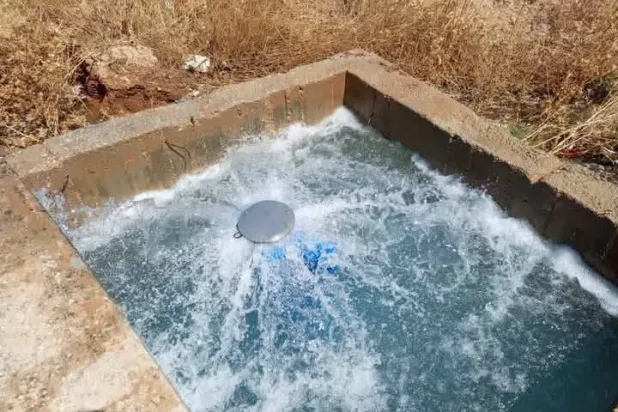
Obtaining drinking water from unreliable sources, away from monitoring, led to a dangerous increase in the spread of diseases and epidemics, especially with changes in hygiene habits and behaviors.
Water from the Alouk station has returned to its networks in Hasaka province, and residents are eagerly awaiting its safe arrival at their homes, after more than seven years of suffering from thirst. Local media sources said that water reached the town of Tel Tamer and the outskirts of Hasaka city on Saturday, after the completion of maintenance and rehabilitation work, paving the way for full operation and the resumption of regular drinking water supply to the entire area.
Teams from the water establishment began monitoring the water arrival and network pressure, while conducting technical tests to ensure the safety of transmission lines and their freedom from faults or leaks, in preparation for full operation and regular supply to benefiting neighborhoods and towns, according to the Kurdish Hawar News Agency.
The Syrian Ministry of Energy had announced last Thursday the start of the experimental pumping phase, after completing 90% of the maintenance work that took nine months, in collaboration between the General Establishment for Drinking Water and Sanitation and the International Committee of the Red Cross, with rehabilitation work to be completed in cooperation between the establishment's staff and UNICEF to reach the station's full capacity.
The ministry stated in a post on its official accounts that the experimental pumping is a prelude to fully restoring the station to service, which will help ensure the regular supply of safe and clean drinking water to citizens after the station had been out of service for years.
Alouk Station (Ministry of Energy)
It is noted that the Ministry of Energy received the Alouk water station last April, as part of a plan to restart it. The station is the main source of drinking water for more than one million people in Hasaka city, Tel Tamer, and the Al-Hol area. The experimental pumping phase is expected to continue in the coming days, with full operation to begin after completing technical tests and ensuring the stability of the pumping system.
The Alouk water station is located in the eastern countryside of Ras al-Ain city, near the border with Turkey, which witnessed the 'Peace Spring' operation and the takeover by the Turkish-backed Syrian National Army in 2019. Military operations, power outages, and encroachments on water lines led to the station's prolonged shutdown, amid mutual accusations between conflict parties over responsibility for the acute drinking water crisis in Hasaka.
It is noted that the Syrian Foreign Ministry under the previous regime sent several official letters to the United Nations and the Security Council, accusing Turkish forces of 'committing inhumane practices' and deliberately cutting off water for more than one million people in Hasaka to achieve political and military gains. In turn, Turkey denied the accusations, blaming the Autonomous Administration and the Syrian Democratic Forces (SDF), claiming that the water station's failure was due to the cutting of electricity supply from the Tishreen Dam and the Derbasiyah station, which were located in SDF-controlled areas.
The Alouk station contains about 34 artesian wells and a main collection station, pumping water for a distance of approximately 67 kilometers to the Al-Hamah reservoirs west of Hasaka city, and from there to the city's neighborhoods, Tel Tamer, and other areas.
From the maintenance work on the Alouk station water line (Station page - Facebook)
The deprivation of drinking water for the people of Hasaka caused a humanitarian crisis that threatened public health. Besides the burdensome financial costs of obtaining water from tankers, especially in summer seasons and high temperatures, obtaining drinking water from unreliable sources, away from monitoring, led to a dangerous increase in the spread of diseases and epidemics, especially with changes in hygiene habits due to water deprivation.
The Health Directorate in Hasaka city has recorded, from February until mid-July this year, 181 cases of diarrhea among children and 169 among adults, while the number of acute diarrhea cases reached about 9,000 among children and 7,000 among adults.
The people of Hasaka are awaiting the experimental water pumping to begin a new phase that closes the chapter of their long suffering from thirst, and the return of drinking water to their homes safely, hoping that the authorities in the area can secure the necessary electricity supply to operate the station, protect the water pumping lines, and prevent encroachments on them.
The Ministry of Energy had pledged to activate the water police to confront encroachments on the water line extending between Alouk and the Al-Hamah reservoirs, and to address faults before reaching full operation.
Original source: Asharq Al-Awsat

Comments (0)
Be the first to comment.