Health Holding Company Concludes Second Phase of Transfer of Ministry of Health Staff to 7 Health Clusters

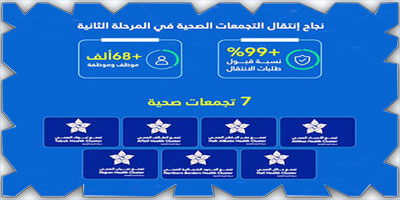
Health Holding Company announced the conclusion of the second phase of procedures for transferring Ministry of Health staff to seven health clusters, with the acceptance rate of transfer offers exceeding 99% among those who expressed interest, as part of procedures covering more than 68,000 male and female employees from health and administrative cadres.
This follows the success achieved in the first phase of transferring Ministry of Health staff to health clusters, which included more than 62,000 male and female employees, with an acceptance rate exceeding 99%; thus the number covered by transfer procedures in both phases exceeds 130,000 male and female employees in 10 health clusters.
The second phase included the clusters of Al-Ahsa, Taif, Najran, Hail, Tabuk, Northern Borders, and Hafar Al-Batin, while the first phase included the clusters of Eastern Province, Al-Qassim, and Riyadh Health Second.
Transfer procedures were implemented in accordance with approved regulatory frameworks and based on Cabinet Resolution No. (616), preserving staff rights, enhancing their job stability, and ensuring continued receipt of their benefits. This also included completing contracting procedures via the "Qiwa" platform and ensuring the continuity of operational work and services provided to beneficiaries.
The transfer phase was preceded by comprehensive orientation and communication programs, including workshops and interactive meetings, both in-person and remotely, with male and female employees to answer their inquiries, clarify procedures, rights, and benefits, and discuss their role in the next phase and the development of work environments.
The transfer of health and administrative cadres to health clusters embodies a pivotal step in the health transformation pathway, by empowering national competencies, raising operational efficiency, and enhancing integration of care levels, supporting the improvement of beneficiary experience and facilitating access to health services according to the Saudi healthcare model.
This reflects the progress achieved by health transformation in community health indicators and quality of life, foremost among them the rise in average life expectancy in the Kingdom to 79.7 years, supporting the goals of Saudi Vision 2030.
It is noteworthy that health clusters represent a main pillar in the healthcare provision system in the Kingdom, as they provide comprehensive and integrated health services to the population in various regions, by applying the Saudi healthcare model that places the human at the center of its concern, focuses on prevention before treatment, facilitates access to care, and improves service quality.
Original source: Al-Riyadh

Comments (0)
Be the first to comment.