Is tracking your food purchases beneficial to your health?
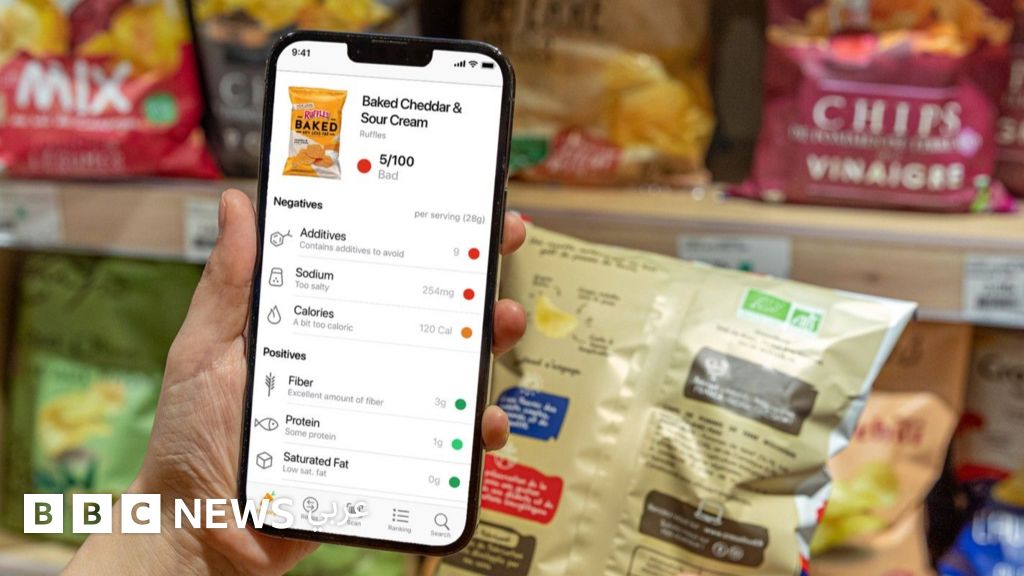
Food tracking apps are popular, but are they a good way to make us follow a healthy diet?
Is tracking your food purchases beneficial to your health?
Image caption, Natalie uses the Yuka app
Article Information
Author, John Laurence, Role, Technology Correspondent - Paris
Published 4 hours ago
Reading time: 6 minutes
Natalie was standing in the sweet biscuit aisle at the local 'Hyper U' supermarket west of Paris, holding a box of biscuits in one hand and her smartphone in the other, using an app to evaluate the nutritional value of products. Suddenly, a red result appeared on the phone screen.
Then she said, showing me the screen: 'Look at this!' The app had rated the product 0 out of 100, and the result appeared in red.
She added: 'This is one of Malo's favorite biscuits,' referring to her 12-year-old son, 'but it's not only full of sugar and saturated fat, it also contains four additives, including one that is a health hazard.'
Then Natalie tapped on the name of the additive in question: E450, and read: 'A mineral that, when consumed in excessive amounts, may lead to problems in the bone marrow and kidneys.'
She said: 'Frankly, the mere fact that they put such things in foods aimed at children makes me furious!'
We then scanned the barcode of an alternative Italian product, whose packaging suggested that the biscuits were handmade by rural women wearing black scarves.
But its rating wasn't much better.
Natalie said: 'Malo hates shopping with me now. You spend so much time scanning products, and in the end he can't get what he wants.'
Skip most read and continue reading
"How Israel recruited former Iranian President Ahmadinejad?" - New York Times
Activation of air defenses in Tehran and explosions in the north and west of the country, and Trump says 'Iran will be defeated soon'
Messi leads Argentina to World Cup final and a showdown with Spain in an 'unprecedented' final
Why do mosquitoes bite some people more than others?
Skip podcast and continue reading
Worth attention
In-depth explanation of the most important events and topics, to help you understand the key changes around you and their impact on your life
Episodes
Podcast end
After the app issued the red alert, it suggested a healthier alternative, an organic product containing whole wheat, fruit, and fiber.
She concluded: 'In the end, you end up buying a lot of organic products, and that makes shopping more expensive.'
Natalie is one of a growing number of people using the Yuka app, developed in France, with the aim of shopping more healthily, not only for food products but also for cosmetics and personal care products.
Once the app is downloaded, users can scan the barcode of any product from among approximately six million products listed in Yuka's database, to which around 1,200 new products are added daily. The app displays an instant rating: green for good products, red for bad, and yellow for those that could be better. It also allows users to view detailed information if they wish, spanning several pages.
Yuka was launched in 2015 and is now used by around 85 million people in 12 countries, including several European countries, as well as the United States, Canada, and Australia.
The United Kingdom ranks third in terms of users, with about five million, followed by France in second with about six million, while the United States leads by a wide margin with around 28 million users.
The app also has the support of several prominent figures in the United States, including US Health and Human Services Secretary Robert F. Kennedy Jr., who described it as his favorite app.
Image caption, Yuka's system includes a traffic light system in addition to extra nutritional information
Yuka was founded in France, where its headquarters remain, but three years ago co-founder and CEO Julie Chapon moved to the United States after the app achieved great success in the American market.
She says the app is more successful in the United States because the need is greater. She added, diplomatically: 'I am happy to be in a country that still has a lot of progress to make.'
In France, Yuka is part of a broader phenomenon related to tracking nutritional information.
In 2012, French programmer Stéphane Gigandet launched a free and open-source database of food products called Open Food Facts, relying on user contributions, during the Food Revolution Day event organized by British chef Jamie Oliver.
The project is managed by a community-led non-profit organization, not a private company, and today provides information on more than four million food products worldwide.
Just two months after Yuka's launch, the French government began implementing the Nutri-Score system for placing nutritional labels on products.
The system's creator, nutrition science researcher Serge Hercberg from the Sorbonne University in Paris, says: 'I was inspired especially by the UK's traffic light system, which uses green, orange, and red to evaluate sugar, fat, salt, and calories... but I wanted a simpler system. Nutri-Score gives an overall rating, so you can tell if a product is healthy or unhealthy just by looking at it.'
The Nutri-Score system was introduced after heated discussions with the food industry, and it is an optional label placed on the front of pre-packaged food packages.
Major food companies, such as Danone and Nestlé, have widely adopted this system, while some brands, especially those that would receive low ratings, have preferred not to use it.
Hercberg says: 'Apps like Yuka and Open Food Facts fill this gap.'
He adds that these apps go beyond what Nutri-Score offers, providing, for example, information on additives (chemicals used to preserve or color food, known by codes starting with the letter E), and their presence is a strong indicator that the food is ultra-processed.
Image caption, The French government's nutritional labeling system is Nutri-Score
What's wrong with Yuka? Christian Reynolds, lecturer in food policy at City, University of London, says technology is part of a solution set, but research shows its effectiveness is limited.
He adds: 'I supported a UK government review on how people interact with labels and information, and the conclusion was that few people have the time, ability, or desire to engage with shopping and food choices beyond routine habits.'
Hercberg also sees limitations in food tracking systems, saying: 'Unfortunately, these systems primarily reach the most privileged segments of society, which are not the most vulnerable to health problems related to their eating habits.'
He considers that the Nutri-Score nutritional labeling system he created, along with apps like Yuka and Open Food Facts, are mutually supportive tools.
Original source: BBC Arabic





Comments (0)
Be the first to comment.