New Technology for Wound Treatment Using Cooling and Light
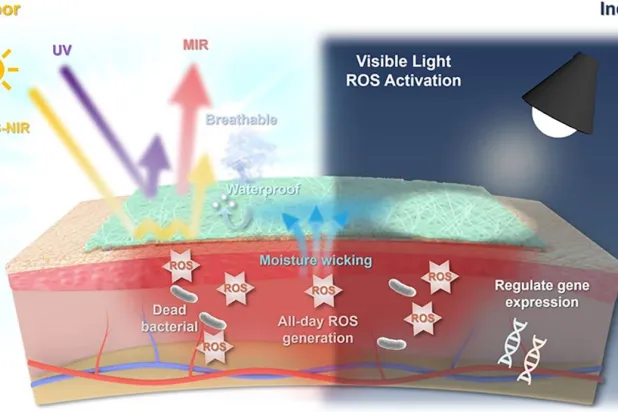
Researchers from The Hong Kong Polytechnic University, in collaboration with researchers from universities in Hong Kong and China, have developed a smart bandage that mimics the properties of natural skin, combining wound cooling and antibacterial activity using light.
The researchers explained that the innovative bandage could help accelerate the healing of infected wounds and reduce inflammation. The findings were published on Friday in the journal 'Nano-Micro Letters'. Traditional bandages still suffer from a number of limitations; gauze may stick to the wound and cause pain when changing, while some modern bandages do not provide effective protection for infected wounds. Hence, the researchers sought to develop a bandage that not only protects the wound but also contributes to its treatment.
The team created what they called 'cooled artificial skin', a smart bandage that mimics natural skin in its structure and function. It consists of two thin layers of nanofibers, reinforced with advanced materials that respond to visible light, giving it the ability to cool the wound site and eliminate bacteria at the same time. The researchers used a special technique to bond the nanofibers together, giving the bandage strength and flexibility close to the properties of human skin, making it more comfortable to use and more adaptable to body movement.
The outer layer, which repels water, reflects part of the sunlight and eliminates excess heat, while the inner layer absorbs moisture and contains iron-modified nanoparticles with antibacterial properties. When the bandage is exposed to light, these particles are activated and produce reactive oxygen species capable of killing bacteria, while the bandage's structure helps dissipate heat and release it outward, contributing to cooling the wound site.
Tests showed that the bandage allows air and water vapor to pass through while providing a high level of protection against fine particles. In a simulation of sunlight, the bandage reduced its surface temperature by about 4 degrees Celsius compared to traditional bandages, while laboratory experiments recorded an average decrease of 1.7 degrees Celsius in wound temperature. In terms of infection control, the bandage succeeded in eliminating 97.1% of Staphylococcus aureus bacteria when exposed to white light, one of the most common bacteria causing wound infections, and achieved efficacy similar to antibiotics without harming healthy cells.
Experiments also showed that wounds treated with this bandage closed almost completely within 11 days, with a healing rate more than double that achieved in untreated wounds or those treated with traditional bandages. Genetic analyses revealed that the bandage's effect is not limited to protecting the wound or eliminating bacteria, but extends to stimulating the natural mechanisms responsible for tissue repair; it enhanced the activity of genes associated with the formation of new blood vessels, activation of cell movement, and production of natural antimicrobial compounds, while simultaneously reducing the activity of genes associated with inflammation, providing a more favorable environment for wound healing.
Original source: Asharq Al-Awsat





Comments (0)
Be the first to comment.