Paralysis of 70% of Gaza's Ambulances: 27 Dilapidated Vehicles Face a Wave of Injuries
أعلنت وزارة الصحة في غزة عن شلل تام لنحو 70 بالمئة من أسطول الإسعاف وبقاء 27 مركبة متهالكة فقط، وسط استمرار الحظر الإسرائيلي على إدخال قطع الغيار والإطارات، مما يهدد حياة آلاف المرضى والجرحى.
Summary: 70% of Gaza's ambulance service is paralyzed, cutting off lifelines. Only 27 dilapidated vehicles struggle to rescue thousands amid a blockade that prevents the entry of tires and oils under the pretext of 'dual use'.
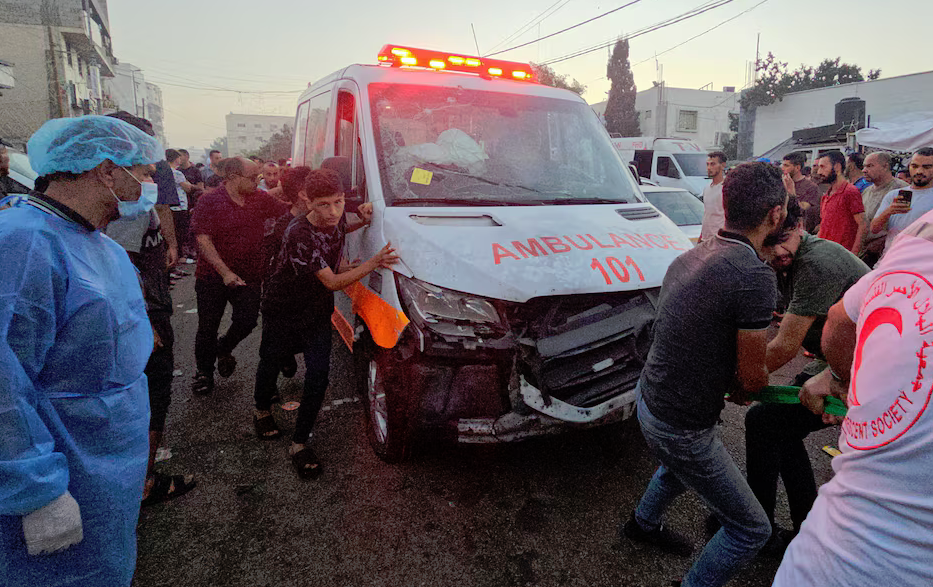
In the devastated streets of Gaza, the sirens of ambulances have disappeared. The white vehicles with red stripes that once raced against time to rescue those injured in Israeli airstrikes have become either charred wreckage lying by the roadside or dilapidated vehicles moving slowly on worn-out tires that are about to burst. The Gaza Ministry of Health announced the breakdown of the ambulance and medical transport system following the permanent loss of 70% of its vehicles. It stated that this paralysis is due to direct targeting, accumulation of technical faults, and the continued ban on importing essential spare parts, putting the lives of thousands of patients and wounded in immediate danger.
An ambulance is not just a means of transport; it is a lifeline and the exclusive carrier of blood, medicines, and medical staff between hospitals (Reuters).
No resources to move ambulances
In the Gaza arena, an ambulance is not just a means of transport; it is the lifeline and exclusive carrier of blood, medicines, and medical staff between hospitals, meaning its halt immediately paralyzes the health system.
Ministry of Health spokesman Ramez al-Wahidi said, 'The absence of ambulances from Gaza's streets means leaving the wounded to face their fate without any hope of receiving urgent medical help, especially with the continuous military shelling, airstrikes, and artillery fire around the clock, causing dozens of victims and injured every day in various alleys and camps of the Strip.' He added, 'Bleeding that can be stopped within minutes in operating rooms becomes a main cause of death on street pavements, because victims are left for hours without medical evacuation, making the emergency fleet the only tool that literally separates life from death.'
Gaza is surrounded by closed crossings that control everything entering the Strip.
Al-Wahidi explained that the Israeli authorities' strict ban on the entry of tires, batteries, essential spare parts, and engine oils is not just a logistical obstacle but a direct decision to halt the medical emergency system.
Rijai al-Hassi, a maintenance employee and field follow-up officer in the ambulance service, experiences the crisis firsthand, saying, 'Today we are completely unable to provide the simplest operational requirements to revive the remaining vehicles. We suffer from a lack of spare parts for cars and a lack of oils. We have reached a stage where we lack the most basic essentials to move a car from its place.' He added, 'We are forced to operate ambulances with worn-out tires and engines threatened with combustion and sudden stoppage in the middle of destroyed roads. The continuation of this acute deprivation heralds a humanitarian catastrophe that deprives thousands of wounded, patients, and staff from safe access to hospitals.'
Disabled ambulances
The war has caused horrific destruction to the ambulance fleet, which was already scarce before the war and does not meet international standards for serving Gaza's population. According to Ministry of Health data, it had only 82 ambulance vehicles before the war to serve the entire Strip. Of this very limited number, the military operations between 'Hamas' and Israel in Gaza destroyed about 39 ambulances, all turned into scrap metal out of service. Among the remaining ambulances, 17 cars need complex and comprehensive maintenance that is no longer available in Gaza.
The rescue and emergency crisis is not limited to vehicles for transporting the wounded. 100 service vehicles belonging to the Ministry of Health have completely gone out of service, including 30 vehicles that were completely destroyed with no ability to restore them. These were designated for transporting medical staff, vital gases, emergency blood units, and medicine shipments.
In short, there are currently about 27 ambulances in Gaza that are fit for movement, and they are responsible for securing the movement of at least 5,000 wounded who fall weekly. The field also requires running 140 truck trips dedicated to transporting medical supplies.
Complicating matters in Gaza is the halt of backup networks for transporting the wounded. The Palestinian Red Crescent Society, the largest civilian partner in medical evacuation operations, is experiencing a parallel crisis of depletion and destruction of its vehicles.
At the same time, civil defense teams, primarily responsible for extracting survivors from under the rubble, announce near-total paralysis of their rescue and ambulance vehicles.
Cause of the crisis
The ambulance system faces a severe blockade, like the residents of Gaza. Every supply line entering the Strip is subject to strict scrutiny, preventing the flow of essential materials needed to sustain patient transport. Israel bans the entry of simple spare parts such as tires, batteries, and engine oils, placing them at the top of the list of prohibited items. This ban has led to the depletion of spare parts inventory in the Ministry of Health's central workshops. The remaining vehicles that survived the bombing are now moving with completely worn-out tires and weak batteries that threaten to suddenly stop the vehicle during emergency transport of the wounded.
Director of Administrative Affairs at the Ministry of Health Mahmoud Hammad said, 'The deepest crisis is the shortage of engine oils. The remaining vehicles need at least 250 liters of oil monthly to complete essential periodic maintenance and protect engines from total damage.' Hammad explained that 'the continued ban on importing vehicle maintenance supplies represents a practical and direct decision to halt the entire ambulance and emergency system, multiplying the risks to the lives of patients and wounded who lose their chance to reach hospitals.' He added, 'Medical maintenance and operation teams are forced to run cars with burnt and worn-out oils that have exceeded their lifespan by thousands of kilometers, exposing the engines of the remaining fleet to the risk of internal corrosion and sudden combustion in the middle of destroyed roads.'
Psychological battle
In a corner of the central control room of the ambulance service, Muhammad Abu Samak, head of the planning department of the ambulance and emergency unit, sits with his hand on the radio signal device, waging a silent arithmetic battle over the price of distance and the cost of mechanical survival of the remaining fleet.
He says, 'It is no longer the severity of bleeding or shrapnel from bombing that determines the destination of the incoming vehicle. The worn-out tires whose treads are completely gone, and the rare liter of oil in the engine, have the authority to steer the rescue.' Abu Samak recalls a call that came simultaneously with two airstrikes—his fingers froze over the control panel: the distance to the first neighborhood consumes a full liter of irreplaceable fuel, not to mention its pothole-filled roads that could destroy the only available vehicle's tires.
Abu Samak breathes slowly and recalls the details of that day: 'In the normal ambulance world, we rescue the most critically injured person. But in Gaza, we are forced to leave families crying for help under the rubble, simply because the mechanical calculations tell us that moving the vehicle that long distance means burning its engine.' He adds, 'This situation is a suffocating psychological crisis experienced by medical teams when they are forced to leave the wounded on street pavements to face their fate with primitive tools, only because the rescue fleet has been paralyzed by the absence of a spare tire or a liter of engine oil.'
Read more
A drug crisis threatens thousands of patients in the West Bank
Original source: Independent Arabia



Comments (0)
Be the first to comment.