Tragedy of Infant Issam: Disease Besieges His Brain, Israel Besieges His Treatment
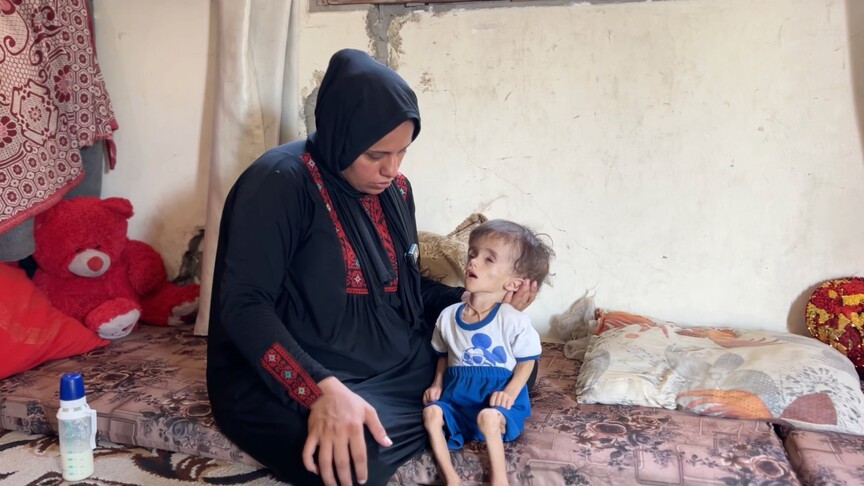
Gaza / Ramzi Mahmoud / Anadolu
Maysaa Radi, mother of infant Issam, told Anadolu:
- My child no longer moves, not even his eyes, and makes no sound or cries like other children his age.
- Due to lying down all the time, sores have appeared on various parts of his body, and he can no longer bear more pain.
- Doctors confirmed that the lack of medical equipment in Gaza could endanger my son's life if any complications occur during or after the operation.
- My child urgently needs to travel to undergo the operation in better medical conditions, but we are still waiting without any horizon.
- We are between two fires; delaying the operation means continued deterioration of his condition, while performing it under current conditions could endanger his life.
- Every passing day I think I might lose my son, and I have nothing but prayer and waiting for a chance for treatment.
The infant Issam Fadi al-Nabih, 16 months old, lies on a small bed with his frail body, unable to move his limbs or even his eyes, while his parents silently watch his breath, fearing a new episode of deterioration in his health.
Since his birth, Issam has not known a normal child's life, as he fights a daily battle for survival due to his condition of hydrocephalus, caused by the accumulation of fluid inside the brain.
His condition required an early surgery to implant a shunt to drain excess fluid into the abdominal cavity before he was one month old.
But what was supposed to be the start of a treatment journey turned into continuous suffering, amid the collapse of the health system in the Gaza Strip due to the Israeli genocide war and siege, and the severe shortage of medicines and medical supplies.
The suffering of the child and his family is compounded by the impossibility of traveling for treatment outside the Strip, due to the slow procedures for evacuating patients and injured through the Rafah border crossing with Egypt.
UN data indicates that more than 18,000 patients in Gaza urgently need medical evacuation to receive treatments not available inside the Strip, while travel operations remain limited and do not match the scale of needs.
The health sector in Gaza faces an unprecedented crisis, as the destruction of health facilities and shortage of fuel, medicines, and medical consumables have reduced hospitals' ability to perform surgeries and provide specialized care.
A body exhausted by surgeries
The child's mother, Maysaa Radi (30 years old), says Issam was born healthy, but after a few days doctors discovered he had hydrocephalus.
She told Anadolu: 'When he was only 20 days old, he underwent surgery to implant a shunt to drain excess fluid from the brain, extending from his head to the abdominal cavity.'
She continues that Issam later underwent several surgeries, which 'exhausted his small body and made him unable to resist what he is going through.'
She points out that the deterioration of health services and lack of medical capabilities in Gaza have greatly worsened his condition, so he is unable to move or interact with his surroundings.
She says: 'My child no longer moves, not even his eyes, and makes no sound or cries like other children his age.'
Malnutrition and sores
Issam's suffering is not limited to the neurological disease; he has also developed severe malnutrition after losing the ability to breastfeed or eat normally.
His mother explains that she has to feed him formula milk using a small syringe, in an attempt to keep him alive, while his weight currently does not exceed 5 kg, which is far below the normal weight for a child his age.
She adds: 'Due to lying down all the time, sores have appeared on various parts of his body, and he can no longer bear more pain.'
As she speaks, she gently runs her hand over her child's head, where the marks of the surgeries he underwent during his short months of life are visible.
Urgent operation and missing capabilities
According to his mother, doctors told the family that Issam urgently needs an operation to drain the accumulated fluid in his brain, but performing it inside the Strip involves great risks due to the lack of basic medical supplies and capabilities.
She says: 'Doctors confirmed that the lack of medical equipment could endanger my son's life if any complications occur during or after the operation.'
She adds that about a year ago, the family obtained a medical referral to travel outside the Gaza Strip, but the slow evacuation of patients and restrictions on travel through the Rafah crossing prevented his departure.
She continues: 'My child urgently needs to travel to undergo the operation in better medical conditions, but we are still waiting without any horizon.'
Between two painful options
Maysaa describes what the family is living as a daily wait between two harsh possibilities, saying: 'We are between two fires; delaying the operation means continued deterioration of his condition, while performing it under current conditions could endanger his life.'
She continues, looking at her child with sorrow: 'Every passing day I think I might lose my son, and I have nothing but prayer and waiting for a chance for treatment.'
She appeals to the relevant authorities and international institutions to urgently intervene to facilitate Issam's evacuation from the Gaza Strip so that he can receive the treatment he needs.
She concludes her appeal with a phrase that sums up long months of waiting and fear: 'I will lose my child Issam if he is not urgently rescued.'
The Rafah crossing was partially reopened on February 2, 2026, as part of the first phase of the US-sponsored ceasefire agreement, after a closure of about 20 months since the Israeli army took control of the Palestinian side in May 2024.
But Israel reclosed the crossing again at the end of last February, against the backdrop of the outbreak of war with Iran, before resuming limited operations during the past March and April.
Since May 21, 2026, the crossing has been operating very limitedly for pedestrian crossing only, with dozens of patients, wounded, and humanitarian cases leaving intermittently, amid strict Israeli oversight and restrictions, while thousands of cases inside the Gaza Strip still await permission to travel for treatment.
Original source: Anadolu Agency


Comments (0)
Be the first to comment.