What is the mosquito-borne disease Sri Lanka is using drones to combat?
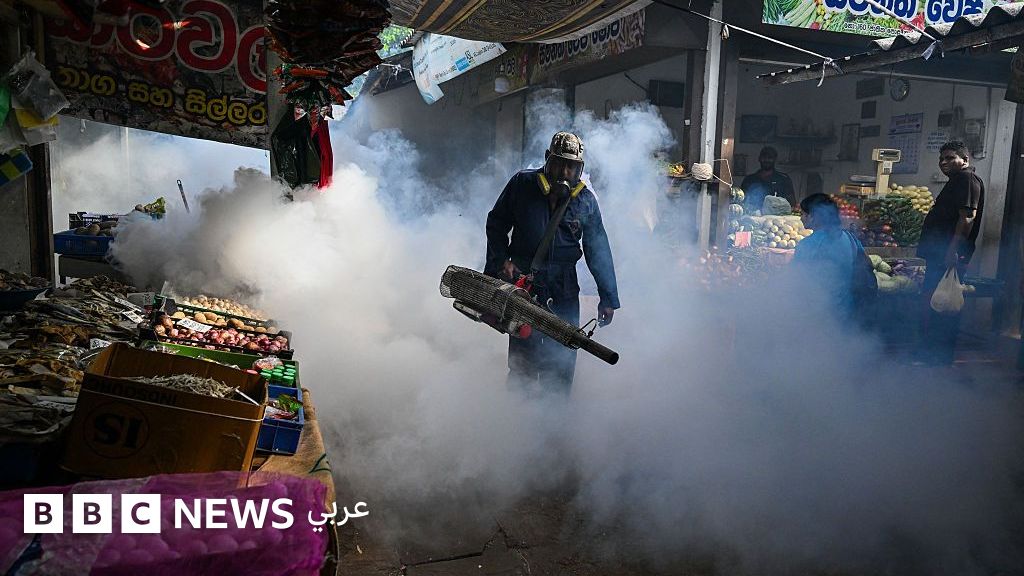
Sri Lanka is facing its worst dengue outbreak in years and is using drones to monitor mosquito breeding grounds.
What is the mosquito-borne disease Sri Lanka is using drones to combat?
Image caption, Sri Lanka has intensified a military-backed campaign to curb the spread of mosquito-borne dengue fever
Article Information
Author, Kelly Ng and Author, Sampath DeshapriyaRole, BBC Sinhala
Published 7 minutes ago
Reading time: 4 minutes
For the first time in years, Sri Lanka has resorted to military drones to track stagnant water pools on rooftops as part of efforts to combat the worst wave of dengue fever the country has witnessed in nearly a decade.
Dengue is a viral disease transmitted by Aedes mosquitoes, which is prevalent in tropical climates.
The death toll from the virus has reached 56 people, while infections have exceeded 77,000 cases in Sri Lanka since the beginning of this year, with more than a quarter of them recorded in July alone.
Dengue is transmitted to humans via mosquitoes and is common in tropical climates.
With global temperatures rising, the range of disease-carrying mosquitoes has expanded to include Europe and the Mediterranean basin. World Health Organization statistics indicate a jump in reported infections from 500,000 in 2000 to 14.4 million in 2024.
Why are animal viruses infecting humans more frequently?
Video caption, Watch: The Sri Lankan Air Force uses drones to monitor mosquito breeding sites as part of efforts to combat the dengue outbreak.
What is dengue fever and what are its symptoms?
Dengue fever is a viral infection caused by the dengue virus, transmitted to humans through the bites of infected Aedes mosquitoes.
These mosquitoes breed in stagnant water, such as water collected in buckets, vases, and flower pot saucers. Their activity peaks during daylight hours, usually biting just after sunrise and right before sunset.
Many people infected with dengue do not show symptoms. For those who do develop symptoms, the most common include high fever, headache, muscle and joint pain, nausea, and a rash. These symptoms usually disappear within a week or two.
However, in severe cases, dengue fever can lead to internal bleeding or even death.
Skip most read and continue reading
Why do I constantly wake up at 3:00 AM?
What is the story of the Egyptian child "Makary Younan" who was excluded because of his religion?
Araghchi warns against the consequences of confiscating state assets, describing it as a "dangerous precedent," and Washington continues its strikes on Iran
How did camels fail to adapt to rising temperatures in Africa?
People who are infected for a second time are more likely to develop severe dengue fever.
Pollution: What do we know about chemicals that remain in the environment "forever," and how dangerous are they?
There are four strains of the dengue virus, and recovering from infection with one strain only provides protection against that specific strain, according to Kapila Kanangara, director of the Dengue Control Unit in Sri Lanka.
He says: "This immunity does not extend to other strains of the virus. This means that a person who has been infected with one strain may contract dengue again if bitten by a mosquito carrying a different strain."
He added in an interview with BBC Sinhala Service: "This could lead to a more severe infection."
Given the lack of a universal vaccine against dengue, treatment often focuses on relieving pain using medications such as paracetamol. Patients who develop severe symptoms typically require close monitoring in the hospital, as complications can be fatal.
What is the situation in Sri Lanka?
Skip podcast and continue reading
Worth paying attention to
An in-depth explanation of the most prominent events and topics, to help you understand the most important developments around you and their impact on your life
Episodes
Podcast end
Health authorities in Sri Lanka attribute the sharp rise in dengue infections to a cyclone that swept across the island last December, leaving behind debris that turned into new mosquito breeding grounds.
The government tasked the military with using drones to scan the roofs of houses, schools, and construction sites, and deployed police officers to conduct indoor home inspections.
So far this month, about 11,000 mosquito breeding sites have been eliminated, and fines have been imposed on more than 4,000 buildings for containing such sites.
Although infections have been recorded across the country, they are mostly concentrated in urban areas, such as the capital, Colombo.
Hospitals have added more beds and extended working hours to cope with the outbreak, while Kapila Kanangara of the National Dengue Control Unit told Reuters that public health workers "have reached their limit."
He said: "Patient numbers are high, and the severity of cases is also high," noting that about 75% of cases are linked to the most virulent strain of the dengue virus.
Limited capacity has prompted doctors to recommend that patients with mild symptoms rest and recover at home.
Authorities are also considering using a dengue vaccine, but health experts say developing an effective vaccine can be difficult due to the existence of four different strains of the virus.
Image caption, Public health workers have reached their limits due to the dengue outbreak.
This is not the first time Sri Lanka has witnessed a dengue epidemic.
In 2017, the disease claimed the lives of 450 people amid heavy monsoon rains that exacerbated the spread of the infection.
Why are dengue cases increasing around the world?
Dengue is prevalent mainly in tropical and subtropical regions, where high temperatures and high humidity help Aedes mosquitoes breed and spread.
Outbreaks are concentrated in South and Southeast Asia, Latin America, and the Caribbean.
However, rising global temperatures have helped these disease-carrying mosquitoes spread to new regions, such as Europe and the Mediterranean.
Longer and wetter rainy seasons also give mosquitoes more time to breed in tropical areas.
According to the World Health Organization, the incidence of dengue has increased 30-fold over the past 50 years, and the organization classifies the disease as one of the top ten global health threats.
About half of the world's population is currently at risk of contracting it.
Image caption, Dengue has claimed the lives of 56 people and infected more than 77,000 others in Sri Lanka since the beginning of the year
Removing stagnant water, such as emptying flower pot saucers, turning over unused buckets, and loosening compacted soil, can help break the transmission cycle of dengue fever.
Some governments also use Wolbachia bacteria, a natural bacterium found in about half of insect species, to reduce the spread of mosquito-borne diseases like dengue.
These bacteria do not kill mosquitoes, but they make it harder for them to transmit the virus.
Discover more
Skip short videos and continue
Short videos
End of short videos
How to protect yourself from dengue fever?
Dengue fever terrifies Egyptians after news of its spread in Upper Egypt
Original source: BBC Arabic



Comments (0)
Be the first to comment.