'Ash al-Warwar'... A poor Damascus neighborhood faces the legacy of the Assad regime
Summary: A resident who preferred not to be identified said, "The raids came on Thursday evening on specific streets, but all entrances to the neighborhood were closed, while vehicles were prevented from entering for hours, and then the situation returned to normal after the mission was carried out."
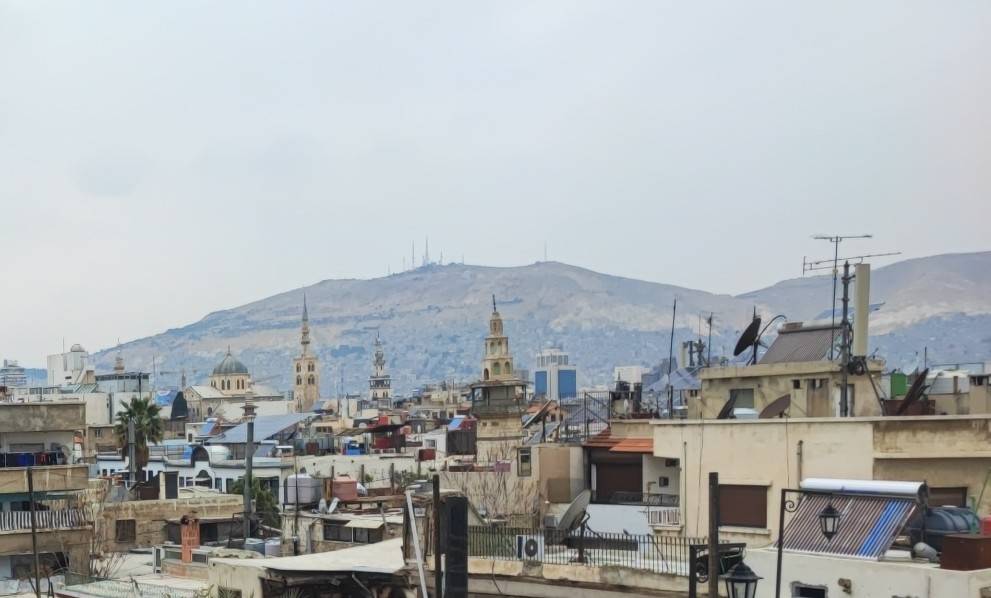
Residents of 'Ash al-Warwar', the popular neighborhood on the slopes of Mount Qasioun in Damascus, spent a night fraught with anxiety and apprehension after it dominated the security scene for 24 hours following a precise intelligence operation that led to the arrest of a sabotage network in several different locations across the capital.
The security operation revealed those involved in the explosion in the Victoria area, near the Four Seasons Hotel, the residence of French President Emmanuel Macron during his official visit to Syria for two consecutive days on July 6 and 7 of this month, and it garnered wide attention as it was a state visit by the first European leader to a country recovering after the fall of the Assad regime.
Raid and Fear
Cautious calm finally prevailed in the streets of Ash al-Warwar, a neighborhood densely packed with various ethnic and religious components of society, with a majority from the Muslim Alawite sect, and it also harbors figures loyal to the former regime and its supporters, making the neighborhood, which has expanded chaotically over decades, hot enough.
Incoming information indicated that the raids the neighborhood witnessed coincided with raids on other neighborhoods, sparking concern about the background of the targeted individuals and their political and religious affiliations, while the places of detention and identities of the cell or detained individuals remained unknown after their arrest, amid demands from civil organizations for the need to disclose detention locations, clarify the reasons for the arrests, announce the fate of detainees, and ensure they receive the necessary legal procedures.
Meanwhile, the Syrian Observatory expressed concern about the possibility of arbitrary arrests taking place in the absence of disclosure of the names of detainees or the nature of their files, and the Observatory stated in a statement on this issue that 'there are fears that some arrests may be arbitrary or based on general suspicions or sectarian backgrounds, in the absence of announcing the names of detainees or the evidence attributed to them.'
A resident who preferred not to be identified said, "The raids came on Thursday evening on specific streets, but all entrances to the neighborhood were closed, while vehicles were prevented from entering for hours, and then the situation returned to normal after the mission was carried out."
There are fears that some arrests may be arbitrary (Independent Arabia)
It is believed that the chaos and rush of residents, especially from Alawite families, came as a precautionary measure to guard against any security developments that might put them at the center of events, while the Ministry of Interior stated in a statement that a complex security operation succeeded in bringing down all members of the cell that carried out the bombing in front of the French president's residence, and raided various locations in areas such as al-Qutayfah, Qudssya suburb, and Ash al-Warwar, arresting about 30 people, some of whom belonged to remnants of the regime, and some information pointed to the involvement of the extremist organization 'ISIS' in the sabotage operation.
Sigh of Relief
With the cell uncovered in record time, a sense of relief prevailed on the Syrian street, which seemed in a state of surprise and questioning about the capabilities of the security system, and granted the intelligence and security services a quick success card despite the details of the sabotage operation not yet being revealed, and Syrians await the outcome of investigations.
The commander of Internal Security in Rural Damascus, Ahmed al-Dalati, said that preliminary investigations with the cell involved in the recent Damascus bombings point to the 'ISIS' organization, adding, 'Security forces were able to reach one of the members of the executing cell, and through monitoring we reached the rest of the cell members, and the operation was simultaneous in several areas of Damascus and its countryside, and all members of the cell involved in the bombing were arrested.'
With this, 'Ash al-Warwar' returns, whose concrete blocks multiplied decades ago in a suspicious manner, not for reasons related to technical and engineering matters and the fact that it is an informal settlement, but because of its role under the rule of the Assad family, as told by civil activist Amer al-Shouni, a resident of Damascus.
Al-Shouni believes the neighborhood is in a critical condition, and it must be acknowledged that it is on a 'volcano's mouth' as he describes it, as it houses many figures who lived and still live in the neighborhood, including officers and fighters in the former regular army since Hafez al-Assad came to power.
Read more
After the Damascus bombings: 4 questions about the emergence of the new 'ISIS' in 2026
Macron's visit to Damascus holds the breath of 'French fighters'
9 killed in explosion inside a cafe near the Justice Palace in Damascus
He added, 'This raises the state of tension from time to time, but it also draws attention to the fact that the neighborhood is poor in services and informal, and contains civilian families of women and children who must not be terrorized and should be reassured if accountability of regime remnants is pursued, and care must be taken not to drag the street into accountability outside the framework of the judicial institution.'
A member of the Internal Security spoke about the extreme care to protect the area from anything that could lead to a state of chaos and instability by intensifying state security agencies and increasing the number of patrols and checkpoints to protect residents, while a number of neighborhood residents considered security protection to be a safety valve and an impenetrable barrier against voices calling for attacking the neighborhood to take revenge on remnants, causing a state of resentment and apprehension among Alawite families.
Justice and Revenge
Meanwhile, in mid-June of last month, dozens of protesters entered neighborhoods in the capital Damascus with an Alawite majority, including Ash al-Warwar and another neighborhood called Mazzeh 86, demanding retribution and the application of justice. Security forces responded by closing the entrances to the neighborhood to prevent the protesters from reaching it, as they raised slogans calling for justice, some of which were not free of sectarianism.
Consequently, dignitaries and notables of Ash al-Warwar issued a statement condemning all crimes committed against the Syrian people, and affirming their support for legitimate demands to uphold justice, give redress to the oppressed, and resort to the law and state authority. The statement said, 'The criminal, whatever his status, religious, sectarian, or denominational affiliation, has no cover or protection.'
At the same time, Human Rights Watch, in light of the attacks in mid-June on Ash al-Warwar, called on Syrian authorities to protect people accused of being linked to the deposed regime, to prevent targeting them outside the law, or turning demands for justice into collective punishment. The organization's first advisor for the Middle East and North Africa, Heba Zaydan, said in a statement, 'Syrians have the right to demand justice, but this should not turn into a pretext for targeting people because of their religion or backgrounds.'
A belt to protect the regime
The origin of Ash al-Warwar, north of Damascus, dates back to the period of Hafez al-Assad's rise to power (he ruled Syria from 1970 to 2000 until his death). It is located near the Barzeh area, and under security and military cover, construction spread on the mountain slopes without clear building permits, and families, the majority of whom are from the Muslim Alawite sect, settled there.
Original source: Independent Arabia




Comments (0)
Be the first to comment.