Beast and Prey in a Carved Relief from Qasr al-Hayr al-Gharbi
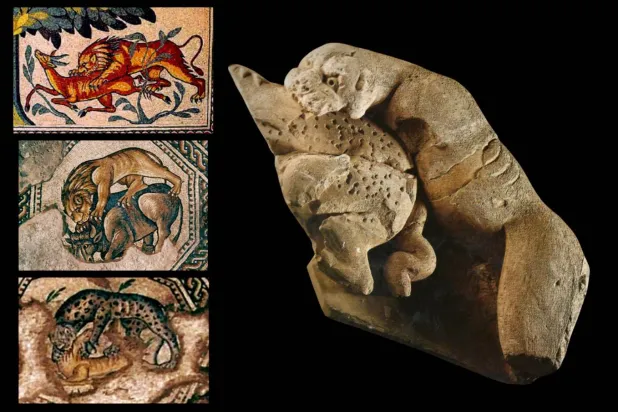
The Syrian desert contains two archaeological sites known as 'Qasr al-Hayr', dating back to royal buildings from the Umayyad period, specifically the reign of Caliph Hisham ibn Abd al-Malik.
The Syrian desert contains two archaeological sites known as 'Qasr al-Hayr', dating back to royal buildings from the Umayyad period, specifically the reign of Caliph Hisham ibn Abd al-Malik. The first, known as Qasr al-Hayr al-Sharqi (Eastern Qasr al-Hayr), is located northeast of Palmyra and is distinguished by its massive architectural foundations. The second, known as Qasr al-Hayr al-Gharbi (Western Qasr al-Hayr), is located southwest of Palmyra and is distinguished by the richness of its decorative ornaments, the most famous of which is its external façade that was moved to Damascus and installed at the entrance of the National Museum in the mid-1950s. This façade is covered with a harmonious set of decorations executed in carved stucco technique, combining abstract geometric shapes and stylized pictorial elements, including an unusual image of a predatory animal pouncing on and killing its prey.
This image occupies one of the corners of the upper section of the Umayyad palace façade, which became the entrance façade of the Damascus International Museum. It sits above a protruding sculpture, much of which has been lost, originally depicting a reclining man with a woman seated behind him, according to a composition known as the 'funeral banquet'. This composition was widespread in Palmyra and other parts of the Middle East, as evidenced by the many sculptural examples that have survived. In contrast, the image of the beast pouncing on its prey appears unique in the field of carved stucco decoration, with no parallel found in the varied heritage of Umayyad palace reliefs. This piece has survived incompletely: the upper half of the prey's body and the lower part of the beast's hind leg are missing. What remains is a medium-sized block, 55 cm long and 85 cm wide.
The wild animal occupies the upper part of this carved block, and it is certainly a felid, from the genus Panthera (big cats), but determining its exact identity is not easy. At first glance, this predatory beast resembles a lion, but the absence of any trace of a mane, which distinguishes lions, suggests it is a lioness, a leopard, or a cheetah. These different felids are among the animals that lived in the Arabian Peninsula and the Levant, and have been known to Arabs by these names since ancient times. The animal's body is sculpted with delicacy, as evidenced by the joints of the back, belly, and hind leg. The facial features are clear and prominent, primarily represented by two round eyes, each with a ring-shaped pupil surrounding a sunken hole. The nose is wide and prominent, with two parallel cavities at its top representing the nostrils. The left ear occupies the tip of the head, shaped like a small oval crescent. The jaw is open, with lively movement, revealing the tips of its fangs embedded in the back of its prey.
Only the lower half of the prey remains: a smooth back topped by three triangles, most likely representing the beast's claws; a full belly with a spiral tail emerging from behind; and a curved leg buckling under the weight of the deadly beast. This leg appears small compared to the body mass, and its small size suggests it belongs to a bull, not a gazelle or an antelope. In summary, this carved relief likely depicts a cheetah pouncing on a bull, a composition that entered Islamic art and is well attested in the world of glassware, ceramics, and metalwork, but its presence in stucco carving remains rare, and the piece from Qasr al-Hayr al-Gharbi is considered the most prominent example in this field. Researchers believe that this composition symbolizes royal authority represented by the caliphate, and the placement of this piece at the top of the palace façade suggests it is linked to this symbolism.
This piece emerged from darkness into light during the excavation works that uncovered the site in the 1930s. In that same period, a parallel excavation campaign uncovered another Umayyad palace at the village of Khirbat al-Mafjar near Jericho, revealing a mosaic depicting a fruitful tree with two gazelles grazing around its trunk on one side, and a lion pouncing on a third gazelle on the other side. This mosaic survived intact, preserving all its components, showing the predatory lion in a lateral position, pouncing with its front legs onto the back of its prey, its open jaw's fangs embedded in the middle of the prey's back. This mosaic appeared unique in the Umayyad field for decades, until another mosaic floor emerged bearing a similar composition in two different images.
This floor was discovered by chance in the year 2000 through some illegal excavations at the site of al-Qastal, about 10 kilometers south of Amman in Jordan. Subsequent survey work showed that it belonged to a palace built during the reign of Caliph Yazid ibn Abd al-Malik and completed during the reign of al-Walid ibn Yazid. This palace lost most of its ornamentation, but the mosaic floors decorating its northern and southern chambers remained relatively well-preserved, and these floors exemplify the high level achieved by this technique in the Umayyad period. These panels consist of a central medallion surrounded by borders adorned with braided chains. The center of each frame is formed by two intersecting braided chains, creating a twisted octagonal knot containing a pictorial panel in its middle. In the northern chamber, a panel is decorated in its center with an image of a lion pouncing on a bull, its claws and fangs embedded in the neck of its prey. In the southern chamber, a panel is decorated with an image of a spotted leopard pouncing on a gazelle in a similar posture.
These two images actually adopt a classical model that was widespread in the Roman period, with many examples, such as a mosaic panel from the so-called Great Palace of Constantinople (now Istanbul) and a panel from the collections of the Hadrumetum Museum in Tunisia. Here and there, pictorial elements change, features and colors vary, but the unifying classical composition appears the same: a wild animal pouncing on and killing its prey.
Original source: aawsat.com


Comments (0)
Be the first to comment.