Hisham's Palace Mosaic in the Palestinian Badia
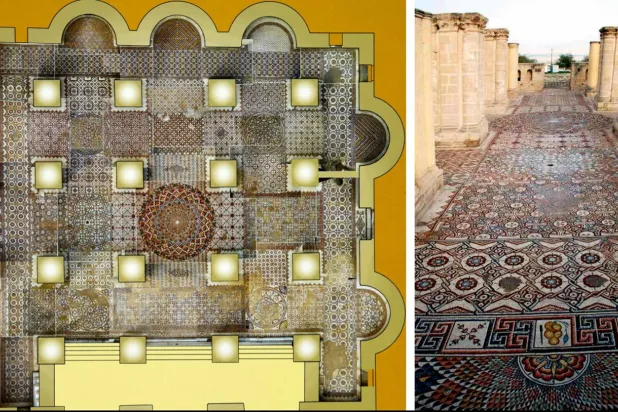
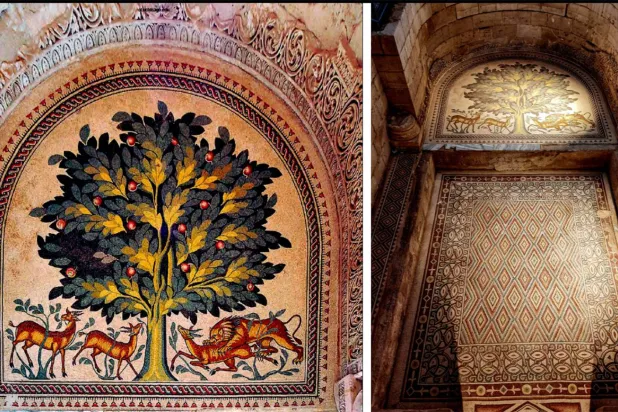
The Palestinian badia houses several Umayyad monuments, the most important of which is a structure dating back to the era of Caliph Hisham ibn Abd al-Malik, uncovered by a British expedition at a ruin known as 'Khirbat al-Mafjar'.
In the 1960s and 1970s, Paris was not just a European city; it was the crucible in which the ambitions of Latin American writers melted, giving birth from the womb of their exile to a literary 'boom' that reshaped the global novelistic map. Giants such as Gabriel García Márquez, Mario Vargas Llosa, Julio Cortázar, and Carlos Fuentes formed a vibrant literary community, turning the streets of the 'City of Light' into arenas for experimentation and intellectual rebellion, making Paris the cradle that nurtured the Latin American literary boom.
Márquez: Among the towering figures who dwelt on the banks of the Seine, each distinguished from the others: Mario Vargas Llosa (Peru) – in the embrace of Paris, within the walls of the Agence France-Presse, his talent blossomed to yield 'The City of Dogs'; the novel that resounded far and wide and announced the birth of a writer who would change the face of modern fiction. And Gabriel García Márquez (Colombia), who endured hardship and poverty in Paris in his early days, but from the womb of this poverty he drew the threads of his immortal epic 'One Hundred Years of Solitude', turning his Parisian isolation into an unforgettable magical universe. And Julio Cortázar (Argentina), who made Paris his permanent home since the 1950s, and in its maze-like alleys and streets, he wove his masterpiece 'Hopscotch' (Rayuela), which made the city a true protagonist in a context of the fantastic and the absurd. And Carlos Fuentes (Mexico), who was the living bridge connecting the continent's writers to one another, and the link that strengthened their presence on the global literary scene.
Asturias: Cultural icons: The residence of these giants was not random; it revolved around spaces that became cultural icons: the Latin Quarter – the beating heart that pumped life into their creativity, where ideas converged over the tables of ancient cafes. And Shakespeare and Company bookstore – the sanctuary that harbored the souls of expatriates, and to this day remains a beacon gathering creators from every deep chasm. And Hotel Louisiana – the silent witness to their humble beginnings, where the hotel was a 'waiting station' before they soared into global fame and spread their renown far and wide.
Paris was the necessary 'distance' that granted them a harsh objectivity to see their homelands clearly; from thousands of kilometers away, they discovered the essence of their Latin identity. This literary convergence was not mere coincidence but was supported by institutions that published their work (such as Gallimard), opening the doors of global recognition to them. Amidst this giving, their journey was not devoid of human drama; their relationships transformed from brotherly friendships to iconic conflicts, like the famous brawl between Vargas Llosa and Márquez in 1976, turning these events into part of the legend surrounding the Latin American literary 'boom'.
In his astonishing book titled 'Homelights: A Century of Latin American Writers in Paris', author Jason Weiss, in a style combining intellectual rigor and rhetorical depth, embodies a profound philosophical paradox: the equation of creativity in exile and alienation. The homeland they left, whether forced or voluntary, never left them; instead, it became an inner 'light' illuminating the darkness of exile, granting their texts an incomparable brilliance. We can contemplate this relationship from several literary and spiritual angles: Exile as a mirror of the self: When the creator distances himself from the geography of his homeland, he discovers that the homeland is not just topography but a language, memories, and a psychological rhythm. Paris here was not merely a European city; it was the 'mirror' in which the homeland reflected more clearly. In exile, nostalgia intensifies, and the faded images of the motherland transform into vivid scenes in their novels.
Next comes the cross-fertilization of civilizations (acculturation): Paris, as a 'global laboratory' of ideas, gave these writers modernist tools and advanced narrative techniques, but they did not dissolve into it. Their success lay in 'literary hybridization'; they melded Parisian absurdity, philosophy, and history with Latin American 'magical realism' and myths, producing a fully global literature imbued with an ancient local spirit. Thus, Paris became a compass of success, documenting a 'station of consciousness'; once a Latin American writer is read in Paris or translated through its prestigious publishing houses, he gains international recognition that returns him to his homeland as a literary hero, granting him the legitimacy to enter the global scene. In this context, if we delve into the experience of writers like Mario Vargas Llosa, Gabriel García Márquez, or Julio Cortázar, we discover that they carried the 'lights of their homelands' to illuminate the skies of Paris, and they clung to their native language. Other writers 'breathed' the city (like Cortázar and Vargas Llosa); these remained faithful to their mother tongue (Spanish), but Paris functioned in their texts as a 'surrealist catalyst'. Vargas Llosa's induction into the French Academy – though he writes in Spanish – is a French acknowledgment that 'Latin American literature' has become an integral part of global cultural evolution. Yet there are those who turned to writing in the language of the other: those who took 'Molière's language' as a bridge to express their migrant selves, sparking debates on the 'immigrant intellectual' and 'language as an alternative homeland'. These writers, who chose French, did not merely 'translate' themselves but became 'creators' who drew from the spirit of the French language a new structure for their ideas, enriching the global literary scene. Examples include Eduardo Manet, who experienced forced exile and his novel 'The Outsiders', and Hector Bianciotti, from the banks of Argentina to the dome of the Academy; Bianciotti is an exceptional case: he not only wrote in French but climbed the ladder of French cultural recognition to earn a seat at the 'French Academy'. And Raúl Damonte Botana, known by the pseudonym Copi, who is considered an embodiment of surrealist rebellion.
There is a decisive moment in the life of a creator when he finds himself standing on the threshold of a city not his own, subsisting on memories of a distant land, writing in a language that may not be his mother tongue, or writing about a homeland he sees more clearly the greater the distance. This is what the experience of Latin American writers in Paris expresses, intersecting with the story of those creators who chose 'French' as the homeland for their pens, together forming a unique portrait of 'the human in exile'.
On the other side, we find that constellation who chose French as their language of creation, such as Kundera, Makine, and Ionesco. If Latin American writers turned to Paris to preserve the 'memory of the homeland', these creators turned to the 'French language' to find a 'homeland for the soul'. Choosing a language is not merely a tool for writing; it is a philosophical decision to deconstruct identity and rebuild it. When one writes in a language other than his mother tongue, he does not just write; he sheds the excesses of the familiar and reaches the core of the idea without the constraints of heritage and upbringing hindering the movement of his imagination.
Original source: Asharq Al-Awsat





Comments (0)
Be the first to comment.