Environmental Emergency Ship Captain to 'Al-Youm': We Can Contain Spills Exceeding 70,000 Barrels.. Quick Decision Protects Marine Environment
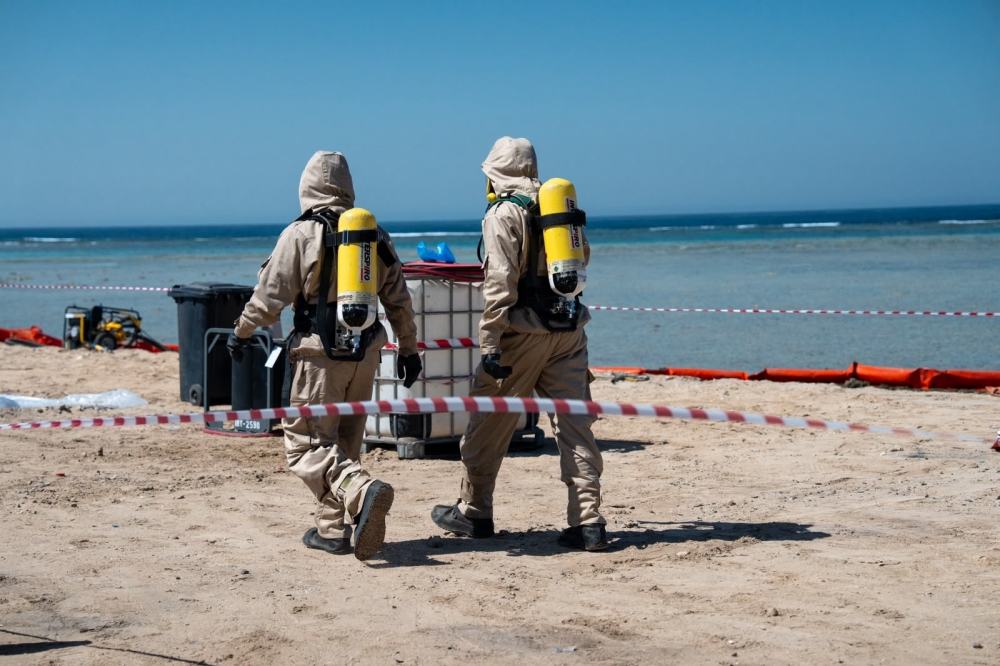
Environmental emergency ship captain Badr Ali Bukhari affirmed that the command of the oil spill response vessel begins from the first moment of receiving the incident report, not upon arrival at the spill site.
He pointed out that the success of control operations depends on the speed of decision-making, accurate reading of marine conditions, and continuous coordination with the operations room and participating entities.
Oil Spill Response Vessel
Bukhari explained to 'Al-Youm' that the captain leads one of the most important stages of response to marine environmental incidents, relying on his field experience and knowledge of the sea's nature, the ship's capabilities, wind directions, wave movement and sea currents, to ensure reaching the appropriate location at the optimal time.
Related News
He noted that the periodic 'Response' exercises simulate complex and highly sensitive scenarios, with the participation of 42 government and private entities, in implementation of the requirements of the National Plan for Combating Oil Spills and Other Harmful Substances, thereby enhancing the readiness of competent authorities to deal with various marine environmental emergencies.
He added that the ship's movement towards the incident site occurs after the spill is detected via satellite, while maintaining continuous communication with the operations room and field teams, to ensure the implementation of the response plan according to the highest standards of efficiency and speed. He explained that among the captain's most important responsibilities is precisely selecting the ship's positioning, enabling response teams to deploy oil booms, operate oil recovery equipment, and carry out control and treatment operations, while taking into account maritime navigation traffic, safety requirements, and changing weather conditions.
Changing Marine Environment
Bukhari stressed that response operations require a great ability to make decisions in a changing marine environment, as wind speed, wave height, or changing sea currents may require adjusting the ship's course or repositioning it more than once during the mission, making the captain's experience in reading the sea and dealing with its variables a key factor in the success of containment and pollution control operations. He pointed out that the captain's role is not limited to commanding the ship, but includes crew management and coordination with various participating entities, within an integrated system that begins with monitoring and analyzing the incident, utilizing modeling and simulation programs to predict the movement of pollutant patches on the sea surface, up to implementing control procedures and protecting the marine environment.
He explained that the 'Response' exercises test the readiness of all elements of the emergency system, foremost the ship's captain, who leads the containment and control operations of the polluted patch, even in the worst hypothetical scenarios where spill quantities exceed 70,000 barrels, reflecting the level of national readiness to protect the marine environment and reduce pollution impacts.
Original source: Al-Yaum



Comments (0)
Be the first to comment.