Sighting of Smallest Owl Species Highlights Biodiversity in Northern Border Wilderness
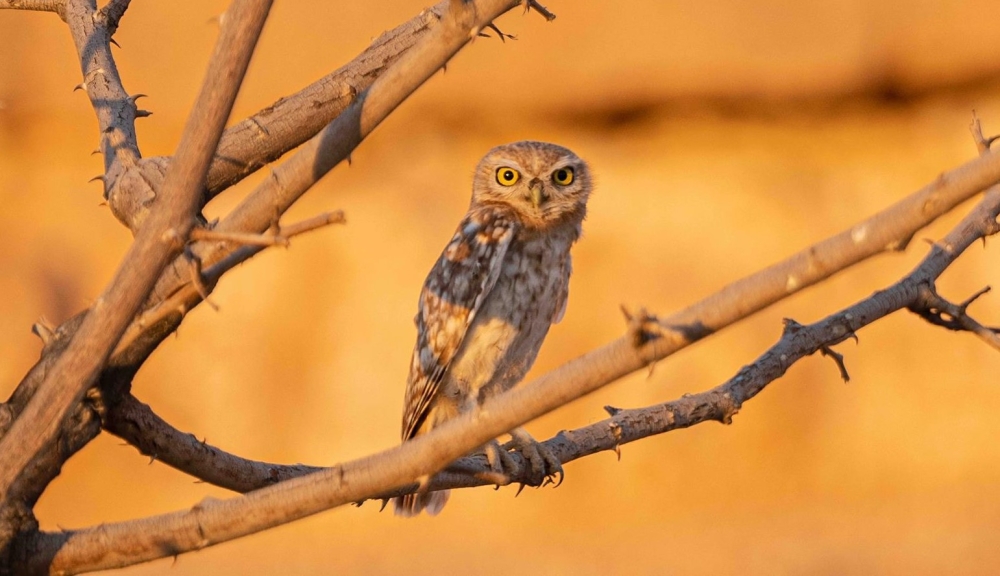
The little owl, known locally as 'Umm Qweiq' or 'Umm Al-Sahar', plays a crucial ecological role in maintaining natural balance and reflects the rich biodiversity of the Northern Border region.
Despite its small size and quiet presence among the desert landscapes, the 'little owl', locally known as 'Umm Qweiq' or 'Umm Al-Sahar', plays a critically important ecological role, embodying the ability of wild creatures to maintain natural balance, and reflecting the richness of biodiversity in the Northern Border region.
The little owl, with the scientific name Athene noctua, belongs to the true owl family, and is characterized by its round head, flat crown, and long legs, while its feathers are predominantly greyish-brown with white spots covering the upper parts of the body, and its bright yellow eyes and pale yellow beak stand out, while feathers cover most of its pale yellowish-white legs.
Related news
Clear physical differences
The little owl measures between 21 and 23 centimeters in length, with no clear physical differences between males and females, and is active during dusk and night hours, relying on its acute hearing and eyesight to hunt prey. The little owl feeds on rodents, small birds, and reptiles, as well as a number of insects such as beetles and locusts, making it one of the birds that play an important role in reducing pest populations and maintaining ecological balance.
Open environments
The little owl inhabits open and semi-desert environments, and takes refuge in natural cavities in rocks and trees, sometimes also using abandoned buildings and old burrows for nesting, reflecting its ability to adapt to different environments. Specialists in wildlife emphasize that the presence of the little owl in the Northern Border wilderness reflects the health of natural habitats and the availability of wildlife resources, pointing to the importance of conserving this species by protecting its natural environments and reducing practices that may affect the sustainability of biodiversity, in line with the Kingdom's goals for environmental protection and wildlife conservation.
Original source: Al-Yaum





Comments (0)
Be the first to comment.