Digital Transformation and Modern Consumption Redraw the Map of Traditional Professions
The disappearance of some professions from the Saudi street was not only due to declining demand, but was a natural reflection of rapid transformations the society has witnessed in recent decades, starting with the digital revolution and accelerating with the spread of smartphones, e-commerce, and digital government services that made it easier for citizens and residents to benefit from services wherever they are and anywhere in the world.
The presence of 'watch repairers' in neighborhoods and main locations has shrunk to narrow limits (AFP)
With these data and changing consumption patterns, some shops that were indispensable daily stops have become a thing of the past and part of the cities' memory, after technology removed their reasons for existence; passing by 'watch repairers, key cutters, photography studios, video rental stores, and what are known as calligraphers' was part of daily life details, but today many storefronts have disappeared and others have closed, after the smartphone, digital platforms, and modern devices replaced services that at the time were independent professions.
Although some traditional professions have not completely disappeared, their presence has shrunk to narrow limits, such as 'watch repairers'; their presence in neighborhoods and main locations was a form of life, as it saved time and provided services at lower cost than watch outlets.
But the scene changed with the spread of low-cost electronic watches, then smart watches that rely on updates and software more than mechanical parts, and many global brands now provide authorized service centers, reducing the need for small workshops.
Technology imposed other characteristics on workers in the field of 'key cutting' (Photo: Ghazi Mahdi)
Key cutters
In the same context, the key cutting shop was one of the most present shops in neighborhoods and markets; residents constantly needed additional copies of keys for their homes, cars, or offices, but the spread of electronic locks, entry systems via cards, fingerprints, or smart applications changed the demand map, and modern cars now rely on encrypted electronic keys, which some shops can provide if they have specialized equipment and electronic programming, but most shops continued in their traditional way.
Here, Mohamed Adel, a worker at a 'key cutting' shop, believes that the market has declined significantly from previous years, and this is due to several factors, foremost among them technology, which imposed other characteristics on workers in this field, including dealing with smart key printing machines, which are usually only found in dedicated locations belonging to large companies, in addition to some workers moving from this profession to other jobs due to declining demand.
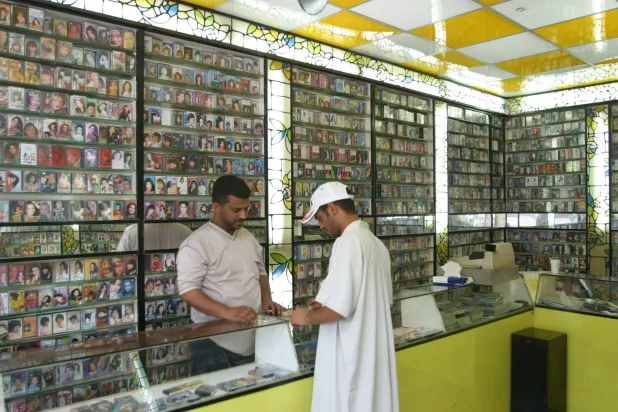
Digital platforms and online streaming services have completely put these outlets out of service (Archive - Asharq Al-Awsat)
Cassettes and tapes
In past years, cassette and video tape stores were a weekly destination for families and individuals, whether to buy music albums or rent movies and series, but this reality gradually changed with the advent of CDs, then digital platforms and online streaming services, until these outlets went completely out of service; users can now access thousands of artworks with a click of a button without leaving home.
Years ago, video tape stores were a weekly destination for families and individuals (Archive - AP)
Smartphones, music platforms, and on-demand viewing services contributed to ending a business model that lasted for decades, causing most of those stores to close or turn to other commercial activities.
Parallel to this exit are film developing shops 'photography studios' that were present before the spread of digital cameras; taking pictures was associated with waiting for the film to finish, then handing it over to developing and printing shops, but this state of anticipation ended with the advent of digital cameras and smartphones, in addition to what government sectors provide, which now rely on digital photos taken via smartphone, provided they meet the required conditions, or by providing photography service directly within the competent authority.
Along with the disappearance of cassette recorder repair workshops, the profession of calligrapher has declined, which was widespread until the beginning of the new millennium, but it declined with the existence of alternatives that the calligrapher provided, such as drawing identification boards for school students or writing tips or rules on boards that adorned the walls of schools and many government and private sectors.
Photography studios and film developing were present before the spread of digital cameras and smartphones (Photo: Ghazi Mahdi)
Memory of cities
Although these professions have disappeared from the daily scene, they still live in the memory of generations who lived their details, when repairing a watch required a visit to that shop in your neighborhood street, renting a movie required part of the weekend program, and taking an appropriate formal personal photo preceded every government transaction.
A number of workers whom 'Asharq Al-Awsat' met in some of these shops agreed that the disappearance of several traditional professions in Saudi Arabia reflects an accelerating economic and social transformation driven by technology and quality of life. Digital transformation, the spread of smart applications, automation, and electronic services have changed consumer behavior and demand patterns, and quality of life projects have contributed to developing work, shopping, and service environments, raising efficiency and speed standards, making way for new jobs and professions more connected to the digital economy and innovation.
Original source: Asharq Al-Awsat





Comments (0)
Be the first to comment.