Our Summer, Our Way: A Window to Contemplate Al-Baha
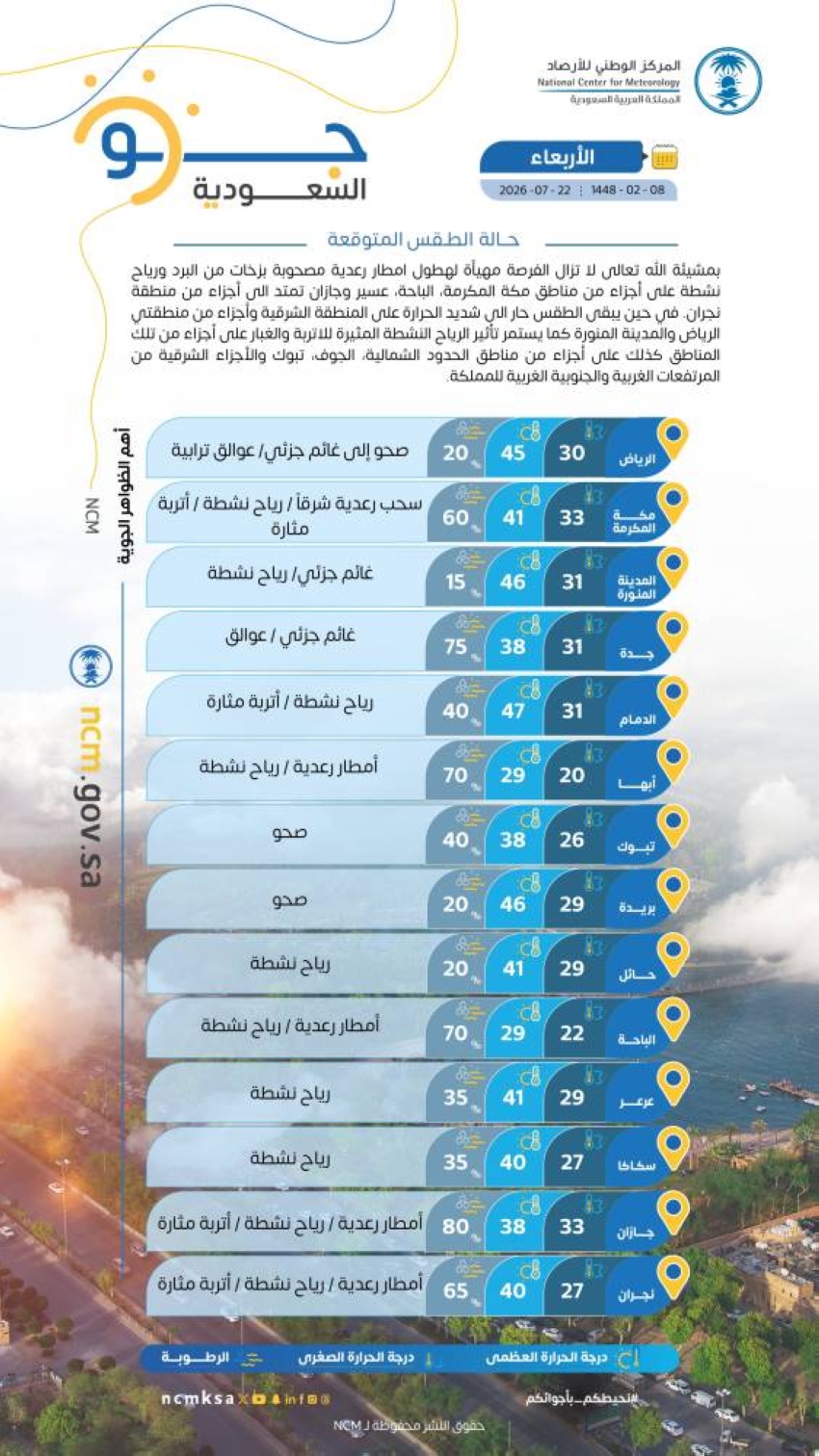
“Our Summer, Our Way” is the slogan for Saudi Summer 2026, opening a window for contemplation that inspires every traveler and resident not to have their summer be a copy of a monotonous past summer. The summer resorts in our country enjoy splendor, abound in natural beauty, and receive care and attention. Among those resorts, there is a cloud waiting for you in the heights of the Sarawat Mountains, and forests that have prepared a seat for you in their shade. A region named “Al-Baha,” captivating with its beauty, to dazzle you as you approach it as if you are rising to a dream that delights your soul. Its road gently ascends as if its land lifts you in its palms, heat recedes, fog draws near embracing your soul, and its mountains adorn themselves by wearing their cloak…
The world has never witnessed in its history such wealth as it does today, nor has the global economy reached its current size. Yet poverty has not disappeared, nor has the gap between rich and poor narrowed as much as many economists expected. Rather, the great paradox is that the world is becoming richer while the feeling of inequality increases.
Reports from the World Bank and the United Nations indicate that hundreds of millions of people still live in poverty despite tremendous scientific and technical progress. Moreover, a large proportion of global wealth is concentrated in the hands of a limited number of individuals and companies, while millions of people face difficulty in obtaining quality education, healthcare, housing, and decent job opportunities.
Globalization has contributed to raising living standards in many countries and lifted hundreds of millions out of poverty, especially in Asia. But at the same time, in some economies, it led to a widening gap in incomes and wealth, as the most educated groups and those best able to invest in technology benefited at a faster rate than others.
Then the digital revolution came to add a new dimension to this gap. The modern economy rewards knowledge and innovation more than ever, and giant technology companies have achieved market values exceeding the economies of entire countries. Conversely, traditional jobs face increasing pressure due to automation and artificial intelligence, posing challenges for less skilled labor.
The effects of the widening wealth gap are not limited to the social aspect, but extend to the economy itself. When wealth is excessively concentrated, consumption by low-income groups weakens, opportunities for social mobility decline, which is reflected in growth and stability rates, and increases pressure on public policies.
The Organisation for Economic Co-operation and Development (OECD) indicates that investment in education, training, health, women's empowerment, and support for small and medium enterprises are among the most effective policies in reducing inequality and achieving more inclusive economic growth.
In the Kingdom of Saudi Arabia, the Vision represents a model of development that not only focuses on increasing GDP but also seeks to expand economic opportunities, increase homeownership rates, empower youth and women, develop the non-profit sector, improve quality of life, enable them through education, work, and healthcare, and give them a fair chance to participate in shaping the future.
The question remains: Can poverty be eradicated in the world? Perhaps complete eradication of poverty is an extremely difficult goal, but reducing it and mitigating its effects is an achievable goal if the right policies, investment in people, governance, and fairness in access to opportunities are available.
Original source: Okaz

Comments (0)
Be the first to comment.