Prince Mohammed bin Salman International Center for Arabic Calligraphy Reviews Its Development Stages
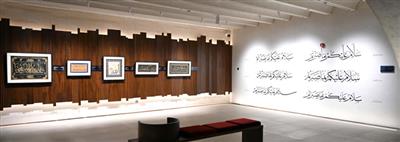
Al-Jazeera - SPA:
The Prince Mohammed bin Salman International Center for Arabic Calligraphy (Dar Al-Qalam) is a specialized cultural landmark aiming to highlight the status of Arabic calligraphy as one of the most important components of Islamic civilizational identity, and to enhance its presence through education, research, museum exhibitions, and cultural programs.
The center combines cultural, educational, and administrative functions within a modern environment designed according to the best architectural and sustainability standards, merging heritage preservation, education, research, museum display, and artistic innovation. It offers a rich cultural and educational experience that highlights the evolution of Arabic calligraphy through the ages and affirms its continuity as one of the most prominent elements of Islamic civilizational identity.
The center is located on a plot of more than (5,000) square meters, while the total built-up area exceeds (9,000) square meters distributed over several floors. The building's design incorporated environmental sustainability standards, resulting in connecting the center to solar energy systems, natural lighting solutions, and the use of local sustainable building materials such as basalt volcanic stones. It culminated with the center obtaining the Gold category for sustainability certification from the U.S. Green Building Council, in support of the 'Saudi Green' initiative and the Kingdom's Vision 2030.
The building is distributed over three floors, each with a specialized function. The ground floor serves as the main facade of the center, including a visitor reception wing, main lobby, store, café, permanent museum, temporary exhibition, library, first aid room, and VIP hall, ensuring an integrated cultural experience for the visitor.
The first floor of the center is dedicated to educational and training programs. It contains three training halls, three Arabic calligraphy studios, and multipurpose spaces that can be used for training, meetings, or office workspaces, along with a theater dedicated to events and activities. Its rehabilitation preserved the historical character and some original parts that were renovated in a way that maintains their identity and character. The second floor houses administrative facilities, meeting and conference rooms, in addition to an outdoor area designated for seating and relaxation.
The museum constitutes one of the most prominent cultural elements of the center, housing more than (56) museum pieces representing various stages in the history of Arabic calligraphy and documenting Medina's connection to the inception and evolution of this art through the ages.
The museum journey begins with a display of the Mushafi script (Madani or Makki), which represents the earliest beginnings of Arabic calligraphy development in Medina and Mecca. Then the visitor moves to a display of the first purely Islamic dinar, which Caliph Abd al-Malik ibn Marwan ordered to be minted in (81 AH / 700 CE), as a testament to the connection of Arabic calligraphy with Islamic civilization and its economic systems.
The museum highlights stone inscriptions that document the evolution of Arabic writing, along with a collection of original calligraphers' tools and gilded manuscripts reflecting the skill of calligraphers, the art of gilding, and the precision in executing Qur'ans and manuscripts.
The museum dedicated a space to highlight the historical role of the Prophet's Mosque in the flourishing of Arabic calligraphy arts, by displaying samples of the mosque's murals calligraphed by Abdullah Zahdi, and the locks of the Rawdah (the Noble Garden) engraved with Quranic verses on pure silver, reflecting the artistic and religious status of Arabic calligraphy.
The museum showcases the spread of Arabic calligraphy beyond the Arabian Peninsula through diverse examples of Qur'ans and manuscripts from China, Africa, and other regions of the Islamic world, embodying local cultural influences on letterforms, decorations, and Qur'an bindings.
Urgent Electronic News
It also addresses the transition of Arabic calligraphy from writing Qur'ans to documenting Arabic literature, through displaying a copy containing the poem 'Al-Burda' by Ka'b ibn Zuhayr, which he recited before the Messenger of God – peace be upon him – in Medina, indicating the use of Arabic calligraphy in preserving literary heritage alongside religious texts.
The exhibits conclude by highlighting Arabic calligraphy as a contemporary visual art, displaying modern artworks, most notably works by Saudi artist Lulwah Al-Homoud, who reimagined Arabic letters within innovative geometric and mathematical compositions, inspired by the Most Beautiful Names of God.
The museum offers the visitor a sequential historical journey starting from the emergence of Arabic calligraphy in Medina, then reviews its development during the Islamic caliphate era and the role of the Prophet's Mosque in the flourishing of its arts, before moving on to its spread across various Islamic civilizations in Africa, Morocco, India, and beyond. It contains prominent historical evidence, including a stone indicating the location of the house of Abu Ayyub al-Ansari, alongside contemporary artworks that embody the continued evolution of Arabic calligraphy as a living art that combines authenticity and creativity.
Original source: Al-Jazirah

Comments (0)
Be the first to comment.