Qatar condemns Houthi accusation of Saudi Arabia besieging Yemenis
It affirmed its support for Riyadh in all measures it takes to preserve its sovereignty and security, according to a Qatari Foreign Ministry statement.
Istanbul / Anadolu
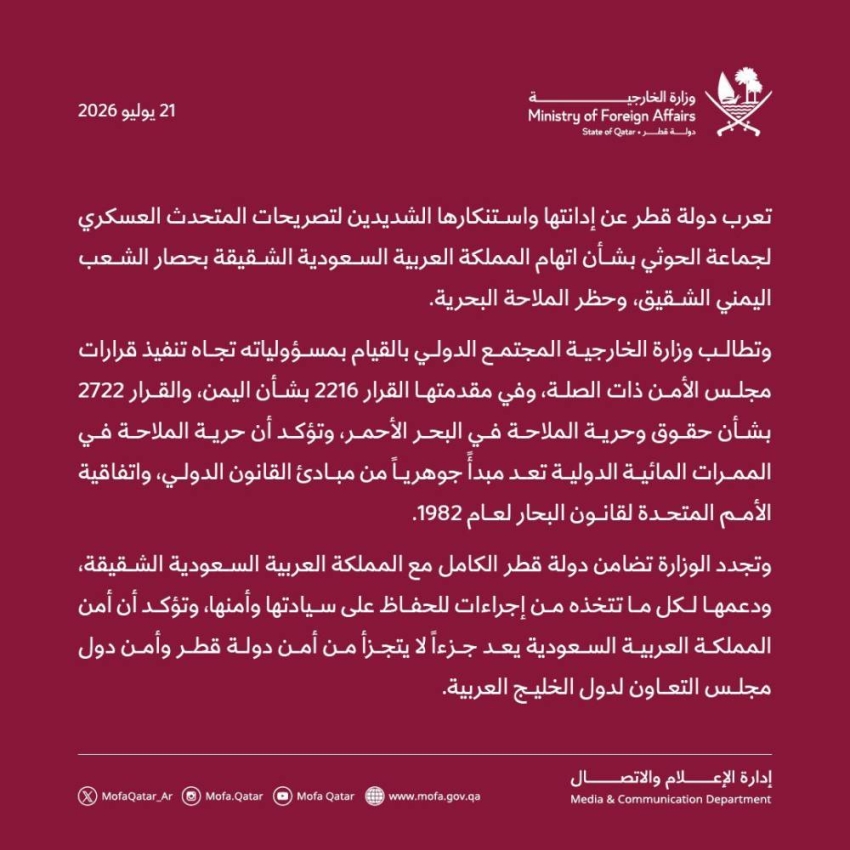
Qatar condemned on Tuesday the Houthi group's accusation of Saudi Arabia of besieging the Yemeni people and its announcement of a maritime navigation ban on the kingdom, stressing that freedom of navigation is a 'fundamental principle' in international law and the Law of the Sea Convention.
The Qatari Foreign Ministry expressed in a statement its 'strong condemnation and denunciation of the statements of the military spokesman for the Houthi group regarding the accusation of Saudi Arabia of besieging the Yemeni people and imposing a maritime navigation ban.'
It called on the international community to fulfill its responsibilities regarding the implementation of relevant Security Council resolutions, foremost among them Resolution 2216 on Yemen and Resolution 2722 on rights and freedom of navigation in the Red Sea.
On April 14, 2015, the UN Security Council adopted Resolution 2216, imposing a targeted arms embargo on individuals and entities on the sanctions list, including Houthi leaders.
The Qatari Foreign Ministry affirmed that freedom of navigation in international waterways is a 'fundamental principle' of international law and the 1982 United Nations Convention on the Law of the Sea.
The Ministry stressed the complete solidarity of the State of Qatar with Saudi Arabia and its support for all measures it takes to preserve its sovereignty and security.
It emphasized that the security of the Kingdom of Saudi Arabia is an 'integral part' of the security of the State of Qatar and the security of the Gulf Cooperation Council states.
On Monday, the Yemeni Houthi group announced a 'maritime navigation ban' on Saudi Arabia, in response to what it said was a blockade imposed by Riyadh.
The group's military spokesman, Yahya Saree, said in a video statement: 'The Yemeni Armed Forces' — referring to the group's forces — 'announce a maritime navigation ban on Saudi Arabia according to the equation of blockade for blockade.'
He added that the ban 'will take effect from the moment this statement is announced,' according to the group's Al-Masirah TV channel.
In response, Saudi Arabia condemned in the strongest terms what was said by 'the military spokesman of the terrorist Houthi militia' regarding 'the accusation of the kingdom of besieging the Yemeni people and announcing a maritime navigation ban on it.'
The Saudi Foreign Ministry said in a statement that the kingdom will take all necessary measures to protect its ships in accordance with international law and the 1982 United Nations Convention on the Law of the Sea.
It added that the kingdom has worked over the past years with the Yemeni government to alleviate the suffering of the people through implementing development projects, supporting the budget, and providing oil derivatives to operate power plants.
Despite intermittent confrontations, Yemen has witnessed since April 2022 a lull in a war that began more than 11 years ago between government forces backed by a coalition led by neighboring Saudi Arabia and the Iran-backed Houthi group, which has controlled provinces and cities including Sanaa since September 21, 2014.
On July 13, the Yemeni Ministry of Defense announced that its forces targeted the runway of Sanaa International Airport to prevent an Iranian plane from landing, while the Houthi group accused Saudi Arabia of launching the attack and considered it to mean the end of de-escalation.
In recent days, clashes have renewed between government forces and the Houthis in several provinces, including Al-Jawf, Al-Dhale, and Taiz, amid mutual threats between the two sides, in a country facing one of the worst humanitarian and economic crises in the world.
Original source: Anadolu Agency


Comments (0)
Be the first to comment.